THE ASIAN INDEPENDENT UK

Dr RAMJILAL, Social Scientist,
Former Principal, Dyal Singh College,
Karnal (Haryana, India)
Email: [email protected]
Brief:
Bhagat Singh holds a significant position in the narrative of India’s freedom struggle. While he is often remembered as a young revolutionary who made the ultimate sacrifice at the tender age of 23, his contributions extend far beyond this singular event. He was a profound thinker, journalist, political organiser, rationalist, and socialist ideologue who critically examined elements such as communalism, caste oppression, and economic exploitation. His legacy is enriched by a body of work that includes writings, a prison notebook, political engagements, courtroom declarations, and correspondence, which collectively illustrate his intellectual evolution from a romantic view of revolutionary nationalism to a more sophisticated understanding of socialist revolution and socio-economic transformation.
Key words: Jallianwala Bagh massacre of 1919,Romantic Nationalism, Russian Revolution, Marxism, socialism, Marx, Engels, and Lenin, Ganesh Shankar Vidyarthi, journalist, Bharat Naujawan Sabha, Hindustan Socialist Republican Association (HSRA), imperialism, communalism, untouchability, youth, workers, peasants, social justice, political strategy, freedom struggle,Lala Lajpat Rai, Saunders, Sukhdev, Rajguru, B.K. Dutt, Legislative Assembly Bombing case (April 8, 1929), Inquilab Zindaba, Lahore Conspiracy case (1929-1930), “Why I Am an Atheist?”, Prison as a University, Mahatma Gandhi, Udham Singh, and Martyrdom.
Expansion:
Early Life and Influences:
Born on September 28, 1907, in Banga, Lyallpur district, in undivided Punjab, Bhagat Singh was raised in a politically active family. The socio-political environment of Punjab at the time greatly influenced his formative years. A pivotal moment in his life was the Jallianwala Bagh massacre of 1919, which instilled in him the belief that India’s liberation required more than a mere change of rulers; it necessitated a comprehensive transformation of the social and economic fabric of the nation.
Political Development: From Romantic Nationalism to Revolutionary Politics:
Bhagat Singh’s early political maturation was shaped by the revolutionary ethos prevalent in Punjab, drawing inspiration from figures such as Kartar Singh Sarabha and Lala Lajpat Rai, as well as the broader anti-colonial movements. His education at National College, Lahore, was critical, exposing him to a stimulating environment where historical and political discussions flourished, allowing students to critically engage with colonial rule.
A voracious reader, Bhagat Singh delved into an array of topics beyond nationalist literature. His studies encompassed European revolutionary movements, the Russian Revolution, Marxism, socialism, anarchism, Irish nationalism, and Indian history. His prison notebook serves as a testament to the breadth of his intellectual pursuits, containing references to influential thinkers like Marx, Engels, and Lenin. This intellectual evolution is essential for understanding the transition from the youthful revolutionary of the early 1920s to the mature socialist revolutionary by the late 1920s.
Bhagat Singh—A remarkable journalist:
His journalistic career began in the early 1920s and was associated with publications including Pratap, Kirti, Maharathi, Vir Arjun, Matwala, Prabha, Akali, Chand, and Bande Mataram. He wrote under pseudonyms, including Balwant Singh and Vidrohi, partly because colonial surveillance made open political writing dangerous.
His journalism covered revolutionaries, communalism, youth, workers, peasants, untouchability, imperialism, youth engagement, politics, social justice, political strategy, and the freedom struggle. His work with Pratap (Kanpur) under Ganesh Shankar Vidyarthi was particularly significant. He also translated revolutionary literature, thereby helping bring international revolutionary experiences to Indian readers.
For Bhagat Singh, journalism was not simply reporting. The printed word was an instrument for political education. He wanted readers to understand why people rebelled, what social conditions produced oppression, and what kind of society the revolutionaries wished to create.
Notably, his 1928 article on communal riots, published in Kirti, highlights his perspective that mere appeals to religious leaders could not resolve deep-seated communal conflicts. He asserted that political and economic conditions, along with colonial policies and societal prejudices, must be confronted to achieve lasting solutions. His Writings emphasised that the interests of workers and ordinary people transcend religious divides.
Furthermore, his commentary on Untouchability underlines his belief that political freedom alone was not sufficient; it was imperative to challenge social oppression alongside imperialism. This dimension of his thought has gained renewed attention in modern scholarship, including articles by Dr. Ramjilal featured in publications such as Samaj Weekly UK./ The Asian Independent UK/Partibim Media ,Chd.
Political Organisation: Bharat Naujawan Sabha:
Bhagat Singh recognised the necessity of organised public participation in revolutionary politics. In 1926, he, along with his comrades, established the Naujawan Bharat Sabha in Lahore, aiming to mobilise youth around key issues such as imperialism, communalism, social inequality, and political freedom. The Sabha’s political program is significant, as it illustrates Bhagat Singh’s evolving conception of revolution, which extended beyond mere individual acts of violence. The primary goal was to educate the youth, enhance political consciousness, and foster a movement capable of challenging systemic exploitation.
This organisational strategy eventually transitioned into the Hindustan Socialist Republican Association (HSRA). In 1928, the term “Socialist” was intentionally included in the organisation’s name, reflecting an important ideological shift that linked political independence with social and economic transformation.
Lala Lajpat Rai, Saunders, and the Revolutionary Crisis:
The death of Lala Lajpat Rai, following a violent Lathi charge during an anti-Simon Commission demonstration in Lahore in October 1928, marked a critical turning point. Revolutionaries believed that the British authorities who were responsible for this assault should be held politically accountable. On December 17, 1928, Bhagat Singh and Rajguru assassinated Assistant Superintendent of Police J. P. Saunders, mistakenly identifying him as James Scott, the officer involved in the lathi charge. This incident became central to the Lahore Conspiracy Case and should be contextualised historically, as an act of revolutionary violence shaped by the repressive colonial environment, which ultimately led to the arrests of Bhagat Singh, Sukhdev, and Rajguru.
The Assembly Bombing: Political Communication:
On April 8, 1929, Bhagat Singh and B.K. Dutt threw smoke bombs in the Central Legislative Assembly in Delhi, intentionally designed to avoid mass casualties. After carrying out the act, the revolutionaries did not flee; instead, they shouted revolutionary slogans and distributed leaflets, welcoming their arrest.
This event was pivotal in Bhagat Singh’s political evolution. They effectively used the courtroom and prison as platforms to communicate revolutionary ideals. The slogan “Inquilab Zindabad” (Long Live Revolution), initially coined by famous Urdu poet and freedom fighter Maulana Hasrat Mohani in 1921, gained prominence through Bhagat Singh and his comrade B.K. Dutt during the Assembly incident. Bhagat Singh further popularised it through his speeches and writings, ultimately making it emblematic of the Hindustan Socialist Republican Army. Although often closely identified with him, the slogan symbolises broader political awakening and resonates powerfully in various movements throughout the pre- and post-independence era.
Bhagat Singh’s actions reflect his commitment to engaging with the masses. Thus, the Assembly incident transcends being merely an act of bombing; rather, it served as a well-crafted political intervention aimed at drawing public attention to imperialist repression and revolutionary thought.
Sukhdev and Rajguru: The Collective Nature of Revolution:
It is essential to acknowledge that Bhagat Singh’s popularity does not overshadow the critical contributions of Sukhdev Thapar and Shivram Hari Rajguru. Together, they were executed on March 23, 1931, with their political lives intricately linked.
Sukhdev was a key organiser and intellectual within the revolutionary movement, making significant contributions to both the Naujawan Bharat Sabha and the HSRA. While historical accounts frequently centre on Bhagat Singh, Sukhdev’s organisational role has often received less recognition. Meanwhile, Rajguru, hailing from Maharashtra, was a vital associate of Bhagat Singh, who played an essential role in the Saunders assassination.
The history of the revolutionary movement should be framed as a collective narrative rather than the biography of a single individual. The trio—Bhagat Singh, Sukhdev, and Rajguru—epitomised the inter-regional character of revolutionary nationalism, connecting diverse linguistic and social backgrounds from Punjab and Maharashtra.
The Lahore Conspiracy Case (1929-1930): An Overview:
The Lahore Conspiracy Case (1929-1930) played a crucial role in revealing the interconnected lives and shared ideologies of revolutionaries in colonial India, emphasising their collective contributions to the freedom struggle. It became one of the most significant political trials of the era, wherein the British government employed extraordinary legal tactics against the accused. A special tribunal was established to oversee the case, indicating the gravity with which the colonial authorities approached the matter.
The prosecution utilised testimonies from former associates who turned government witnesses, highlighting the problematic nature of the judicial process. Key witnesses, such as Hans Raj Vohra and Jai Gopal have become important subjects for historical analysis regarding the trial. The reliance on approvers, police evidence, and extraordinary judicial practices showcased the colonial state’s commitment to dismantling revolutionary organisations.
This trial also offered Bhagat Singh and his comrades a platform to challenge the legitimacy of colonial governance, transforming the courtroom into a venue for political discourse.
Prison as a University of Political Thought:
Bhagat Singh’s time in prison became a pivotal period for his intellectual development. Instead of stifling his creativity, imprisonment fostered significant reading, writing, and political reflection. His hunger strike against the discriminatory treatment of Indian political prisoners garnered national attention and highlighted the demand for prisoner rights, including improved food, clothing, reading materials, and basic amenities.
This protest emphasised that Bhagat Singh’s revolutionary approach extended beyond covert conspiracies; it became increasingly focused on public mobilisation and political discourse. His prison writings, including letters and notebooks, reveal a thinker deeply engaged with history, philosophy, economics, and revolutionary ideology. The Jail Diary is especially notable, as it offers insights into the intellectual landscape that influenced Bhagat Singh’s thoughts.
“Why I Am an Atheist?”: A Rationalist Perspective:
Bhagat Singh’s essay, “Why I Am an Atheist?”, is one of his most acclaimed works. It should not simply be viewed as a critique of religion but rather as a call for reason, critical inquiry, and intellectual autonomy. Bhagat Singh rejected the notion that revolutionary commitment necessitated blind faith, advocating instead for a rational examination of beliefs, rather than accepting them uncritically based on tradition.
This rationalist viewpoint was inherently linked to his political philosophy. He argued that superstition, communal bias, and political oppression were interrelated barriers to human freedom.
Secularism and Communalism:
Bhagat Singh’s secular beliefs were particularly relevant amid the communal tensions of the 1920s. He recognised the potential for manipulation of religious identities for political gain and understood that communal divides hindered unified struggle. In his article “Communal Riots and Their Cure,” he expressed concern over the escalating Hindu-Muslim conflicts, positing that political organisation grounded in class interests, rational thought, and shared social goals could bridge communal divisions.
Rather than advocating mere religious tolerance, Bhagat Singh sought to forge a political identity that enabled the collaboration of workers, peasants, and youth across religious boundaries. This aspect of his thought continues to resonate in contemporary discussions about secularism and societal cohesion, as explored in recent publications by Dr. Ramjilal in Samaj Weekly uk ,the Asian Independent uk, and Pratibim Media, chd.
Caste and the Question of the Oppressed:
Bhagat Singh also addressed the issue of untouchability and social oppression in his writing on the “Untouchable Question”. He recognised that social inequities posed significant obstacles to national liberation, making it vital that revolutionary nationalism aligned with the pursuit of social equality. He argued that political independence without the dismantling of social humiliation would exclude a substantial segment of India’s population from the broader definition of freedom.
It is important to study Bhagat Singh’s writings contextualised within his time, as he was still developing his ideas. His significance lies not only in his conclusions but also in the questions he raised and the trajectory of his political thought.
Efforts of Mahatma Gandhi to Save Bhagat Singh, Rajguru, and Sukhdev;
The relationship between Mahatma Gandhi and Bhagat Singh offers a complex view of the Indian freedom struggle, marked by distinct ideological differences. Gandhi championed non-violent civil disobedience, while Bhagat Singh and the Hindustan Socialist Republican Association (HSRA) pursued a revolutionary approach. Despite their differing philosophies, they should not be seen purely as antagonistic figures.
After Bhagat Singh, Sukhdev, and Rajguru were sentenced to death, a significant wave of public outcry emerged, demanding the commutation of their sentences. During the negotiations of the Gandhi-Irwin Pact, Gandhi met with Viceroy Lord Irwin and raised the issue of their impending executions. Historical accounts vary regarding the effectiveness of Gandhi’s interventions, but documentary evidence confirms that he consistently appealed for clemency. Ultimately, however, the death sentences were not commuted. The key question for historians is not whether the executions were halted—since they were not—but rather how Gandhi’s efforts can be understood within the broader political context of early 1931. Gandhi made earnest attempts to save the lives of these revolutionaries, as indicated by historical documentation. In recent writings, published in Samaj Weekly UK, The Asian Independent UK, Partibim Media, Chandigarh, and Dainik Tribune, Chandigarh, and other newspapers, Dr Ramjilal, after examining various documents, has categorically stated that Mahatma Gandhi made the best efforts to save the lives of the three martyrs.
The Final Hours and Martyrdom of Bhagat Singh, Sukhdev, and Rajguru:
On March 23, 1931, Bhagat Singh, Sukhdev, and Rajguru were executed in Lahore Central Jail, ahead of the scheduled time, amidst heightened public tension. Following their execution, the bodies were secretly transported towards the Sutlej River near Hussaini Wala and cremated hastily. Local residents later discovered their remains and conducted the final rites.
The news of their executions provoked widespread outrage, prompting protests and demonstrations across India. The three young revolutionaries became enduring symbols of sacrifice, particularly resonating with the youth. Their martyrdom notably transformed Bhagat Singh into a prominent national political figure.
Comparison Between Bhagat Singh and Udham Singh:
Bhagat Singh and Udham Singh are frequently discussed in tandem, both serving as symbols of Punjabi resistance against British colonial rule. They shared several similarities: both were deeply influenced by colonial violence, rejected passive acceptance of imperialism, adopted revolutionary methods, and ultimately sacrificed their lives. They were also linked to socialist or radical political movements. An article by Dr. RAMJILAL highlights Udham Singh’s ties to revolutionary and socialist organisations and his admiration for Bhagat Singh.
However, their life paths differed significantly. Bhagat Singh was executed at the young age of 23, leaving behind a rich legacy of political writings and a focus on socialism, atheism, rationalism, and mass political mobilisation. In contrast, Udham Singh lived until 1940, with his most notable act being the assassination of Michael O’Dwyer in London in 1940, which he viewed as retribution for the atrocities committed in Punjab and during the Jallianwala Bagh massacre. Udham Singh’s political journey unfolded through years spent abroad and engagement with international revolutionary networks.
Thus, Bhagat Singh is predominantly remembered for his contributions to political theory and socialist thought, while Udham Singh’s legacy is tied to his personal commitment to avenging colonial violence. Together, they illustrate the diverse and complex nature of Punjab’s revolutionary tradition.
The Construction of the Bhagat Singh Image:
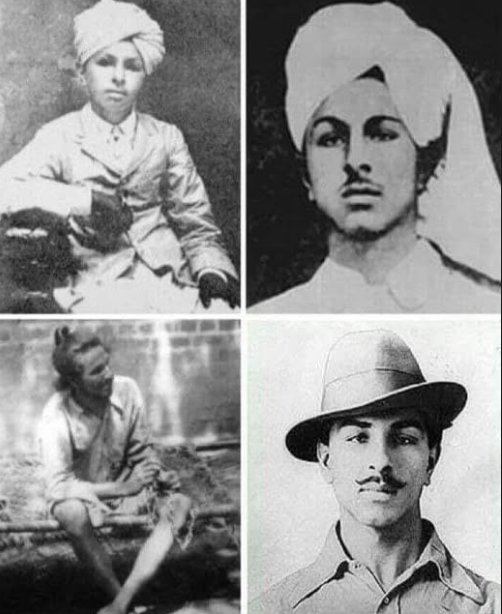
The historical figure of Bhagat Singh and his popular images are interconnected but not identical. His recognisable Likeness—characterised by a hat, moustache, and youthful demeanour—has become one of modern India’s most iconic political symbols.
The role of the media was crucial in shaping this image. Historian Kama Maclean notes that revolutionary politics engaged with violence, image, voice, and text. Bhagat Singh’s prominence can be attributed to his impactful courtroom statements, literary contributions, compelling photographs, and martyrdom, which collectively amplified his influence.
Acknowledging this constructed image does not undermine his historical accomplishments; rather, it emphasises that political memory is shaped by a combination of newspapers, literature, photographs, cinema, political movements, and public commemorations.
The Lasting Impact of Bhagat Singh on Youth: Prince of Youth:
Bhagat Singh’s legacy is particularly significant in its influence on young people. He championed the idea of intellectual engagement rather than ignorance or blind sacrifice. Singh’s own life exemplified this through extensive reading, active debates on political ideologies, a deep study of history, and thoughtful writing that shaped his political views.
His message to the youth emphasises the importance of intellectual independence, courage, active participation in public life, and a stance against injustice. Modern youth can explore Bhagat Singh’s contributions in a way that transcends the political landscape of the 1920s. His relevance today is found in his principles of questioning authority, resisting injustice, fostering a scientific outlook, and linking individual freedom with social responsibility.
From Revolutionary Nationalism to Social Revolution:
A pivotal shift in Bhagat Singh’s ideology was the transition from revolutionary nationalism to social revolution. Initially, his primary focus was on achieving freedom from British colonial rule. However, as his political thought evolved, he began to consider the type of society that would emerge post-independence.
This distinction is essential: if political power merely shifts from one group to another, while issues like poverty, caste discrimination, communalism, economic exploitation, and social inequality persist, then the true essence of revolution remains unfulfilled. His iconic slogan, “Inquilab Zindabad—Long Live Revolution”, symbolised not just the desire to overthrow British authority, but also the need for ongoing social and political transformation.
Conclusion: Bhagat Singh Beyond Martyrdom:
The historical significance of Bhagat Singh extends beyond the circumstances of his death; it lies in the intellectual trajectory of his life. He transformed from a revolutionary into a thinker, evolving from a nationalist to a socialist and from an activist to a dedicated scholar of history and political philosophy. Even while imprisoned, he continued his self-education and engaged with societal issues.
His writings on atheism, communalism, caste, youth, imperialism, and socialism reflect a profound refusal to accept inherited beliefs without scrutiny. Collaborating with peers such as Sukhdev and Rajguru highlighted that his revolutionary politics were a collective effort.
It is important to remember Bhagat Singh not merely as an armed revolutionary or a romantic martyr, but as a political intellectual whose ideas were developing at the time of his execution. His unfinished intellectual endeavours pose enduring questions that remain relevant today in the current neo-imperialist era.: What is the value of political freedom without social equality? Can democracy exist in a context of communal division? Is economic development meaningful without justice for workers and farmers? How are individual freedom and collective emancipation related? What role can youth play in public life without being manipulated politically?
These enquiries affirm Bhagat Singh’s relevance beyond mere commemorative occasions. His true legacy is not a fixed historical narrative but an ongoing encouragement to read deeply, question critically, reason thoughtfully, organise effectively, and strive towards a society founded on principles of freedom, equality, secularism, and social justice.
References for Further Reading:
1.Singh, Bhagat .(1930.) “Why I Am an Atheist?”, 1930.
2.Singh, Bhagat. (June 1928).”Communal Riots and Their Solution”, Kirti, June 1928.
3.Singh, Bhagat. (1928)”The Untouchable Question”, Kirti, 1928, published under the pseudonym “Vidrohi”.
4.Singh, Bhagat., Jail Notebook / Prison Notes, various editions, including A Martyr’s Notebook, edited by Bhupendra Hooja.
5.Singh, Kultar., ed. (2011). Shaheed- e Azam Bhagat Singh ki Jail Diary. Unistar Books, Chandīgarh.
6.Singh, Bhagat. Selected Writings, various compilations.
7.Chandra, Bipan., India’s Struggle for Independence, Penguin.
8.Panikkar, K N. Panikkar works on nationalism, colonialism and revolutionary politics in India.
9.Maclean, Kama. (2015).A Revolutionary History of Interwar India: Violence, Image, Voice and Text, Hurst, 2015.
10.Noorani, G, A. (1996)., The Trial of Bhagat Singh: Politics of Justice, Oxford University Press, 1996.
11. Verma, Shiv .,writings and memoirs concerning the HSRA and Bhagat Singh.
12.Yashpal, Sinhavalokan, for an important revolutionary-era memoir.
13. Kumari, Mamta. (May 2024)., Relevance of Bhagat Singh’s Thoughts, PhD Thesis, BMU, Asthal Bohar, Rohtak.
14.Lal, Ramji , Dr. (30 September 2025). “Bhagat Singh: A Great Inspiration for Students and Youth: A Scientific Perspective,” Samaj Weekly UK, 30 September 2025. The article examines Bhagat Singh as a reader, rationalist and organiser and discusses the Naujawan Bharat Sabha, the 1928 manifesto and scientific temper.
15.Lal, Ramji , Dr. “Shaheed-e-Azam Bhagat Singh: The Importance of Secularism – A New Look,” Samaj Weekly UK, 26 September 2025. The article examines his secularism, rationalism, communalism and intellectual development.
16.Lal, Ramji , Dr. “Amar Shaheed Sukhdev: A Glorious Golden Page of the Socialist Revolutionary Movement – An Analysis,” Samaj Weekly UK, 14 April 2025. This provides detailed material on Sukhdev, his relationship with Bhagat Singh, the HSRA, the Lahore Conspiracy Case and the revolutionary movement.
17.Ambedkar, B, R., Dr. (24 March 2025). , “Ambedkar on Bhagat Singh,” Samaj Weekly, 24 March 2025. This provides an additional perspective for studying Bhagat Singh alongside Dr. B. R. Ambedkar.
18.Puniyani, Ram.( 11/07/2025).’Secularism and Socialism in Constitution’s Preamble: Eyesore to Hindu Nationalists’, this places Bhagat Singh within the wider tradition of socialist and secular thought in the Indian freedom movement.
19.Lal, Ramji , Dr .(5 October 2025). , “Bhagat Singh: A Great Inspiration for Students and Youth: A Scientific Perspective,” Asian Independent UK, reproduced in the Samaj Weekly UK edition of 5 October 2025. The article particularly discusses Bhagat Singh’s intellectual life, Jail Diary, Naujawan Bharat Sabha, socialist ideas and cientific temper.
20.Lal, Ramji , Dr.( 2025),”Shaheed-e-Azam Bhagat Singh: The Importance of secularism – A New Look,” Samaj Weekly UK / Asian Independent UK related publication material, 2025.
21.Lal,Ramji,Dr. (2025).https://theasianindependent.co.uk/i-pay-tribute-to-the-great-martyr-and-revolutionary-shaheed-e-azam-udham-singh/
22.Lal, Ramji,Dr. (25 December 2025Pratibimb Media)’.Shaheed-e-azam-udham-singh-a-realistic’/https://pratibimbmedia.com/shaheed-e-azam-udham-singh-a-realistic-socialist-revolutionary/
23.Lal, Ramji,Dr (25 December 2025Pratibimb Media). Shaheed-e-Azam Udham Singh: A Socialist Revolutionary https://theasianindependent.co.uk/shaheed-e-azam-udham-singh-a-socialist-revolutionary/#google_vignette
24. Lal, Ramji,Dr. (30 जनवरी 2025).’भगत सिंह की फांसी के विरुद्ध थे गांधी’,दैनिक ट्रिब्यून, चंडीगढ़,30 जनवरी 2025, पृ .4 —(Lal, Ramji,Dr. ‘Gandhi was against the hanging of Bhagat Singh’, Dainik Tribune, Chandigarh, January 30, 2025, p. 4)
25. Lal, Ramji,Dr. and Kumari , Mamta.( 26/09/2025) .https://samajweekly.com/shaheed-e-azam-bhagat-singh-the-importance-of-secularism-a-new-look/
26.Lal, Ramji,Dr.( 29/01/2025).,https://samajweekly.com/mahatma-gandhi-the-best-effort-to-save-bhagat-singh-rajguru-and-sukhdev-a-review/Bottom of Form
27. Lal, Ramji,Dr. (14/05/2025).,Amar Shaheed Sukhdev: Catalyst of Socialist Revolutionary Movement – An Analysis/https://samajweekly.com/amar-shaheed-sukhdev-catalyst-of-socialist-revolutionary-movement-an-analys
28.Lal, Ramji,Dr. (May 14, 2025) https://theasianindependent.co.uk/amar-shaheed-sukhdev-catalyst-of-socialist-revolutionary-movement-
29 Lal, Ramji,Dr. (July 18, 2026). https://theasianindependent.co.uk/i-pay-tribute-to-the-great-martyr-and-revolutionary-shaheed-e-azam-udham-singh/
30. Lal, Ramji,Dr (.27 September 2026, Pratibimb Media). https://pratibimbmedia.com/bhagat-singh-life-and-ideology-dhruv-tara-revolutionary-socialist-and-prince-of-youth/