THE ASIAN INDEPENDENT UK
– Clancy Williams
Friends, elders, young people, honoured guests: thank you for inviting me to stand with you tonight.
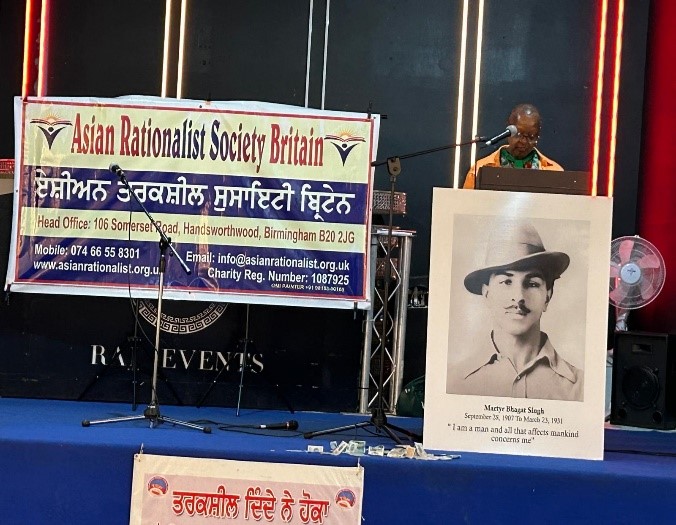
As you will know this Sunday, the 28th of September, marks the birth of Shaheed Bhagat Singh. He was born in 1907 in the Punjab. He was executed by the British colonial government in Lahore in 1931, alongside his comrades. He was 23 years old.
Let that settle for a moment. Twenty-three. Younger than many of the students sitting in our universities today. Younger than many of the young people in this room. Yet his name has outlived the empire that hanged him.
You call him Shaheed, a martyr. But I don’t want to remember him only for how he died. We want to remember him for how he thought, and for what he chose to care about.
“I am a man…
I have come know that Bhagat Singh was a reader. Even in his prison cell he filled notebooks with the words of thinkers from across the world. Among them was a line he took to heart, one he wrote out as his own conviction:
“I am a man, and all that affects mankind concerns me.”
 That line is centuries older than Bhagat Singh. It reached back to ancient writers, and it was carried forward by a young Sikh revolutionary in a colonial jail. That journey is the lesson. Good ideas do not belong to one people. They travel. They are handed on.
So what was he telling us? That his concern did not stop at the edge of his own village, his own faith, or his own community. Injustice anywhere was his business. The suffering of the labourer, the less than, the colonised, the forgotten: all of it concerned him.
In the tradition I work within, African-centred psychology, we have a word for this: Ubuntu. I am because we are. My wellbeing is bound up with yours. My freedom is incomplete while yours is denied.
Bhagat Singh and Ubuntu are saying the same thing in different languages. You cannot be fully human while looking away from another’s pain.
So tonight, as a Black woman standing in a celebration of a Sikh freedom fighter, I don’t see myself as a visitor to this story. His concern for mankind includes me. And my concern includes you. That is what solidarity means.
Speaking up has a cost
But Bhagat Singh knew that speaking truth to power comes at a cost. He paid the highest one.
Here in Britain, in our own time, many of us have been thinking about Professor Jason Arday.
Jason was the son of Ghanaian parents, raised in South London. In 2023 he became the youngest Black professor in the history of the University of Cambridge. He dedicated his work to race, inequality and education: why some children are lifted up by our schools and universities, and why others are quietly let down.
 He once said that if we want education to be more inclusive, the best tools we have are solidarity, understanding and love.
Solidarity. Understanding. Love. Hold on to those three words. We’ll come back to them.
This summer, after a long and very public period of scrutiny and accusation, Jason stepped down from his post. Days later, we learned that he had died. He was 41. His family spoke of years of sustained abuse and of how much it had worn him down.
People will hold different views about the questions that surrounded him, and tonight is not the place to settle them. But we do not need to settle every question to recognise a simple truth. When a person becomes the “first” or the “only” in a space, they often carry a weight that others never see. When that weight is joined by relentless public attack, it can become more than any one human being should have to bear alone.
We honour Jason tonight not by making him a symbol, but by remembering that he was a person: a father, a partner, a son, a brother. And by asking ourselves an honest question: who is carrying that weight right now, and does anyone know?
Our children in the room
That question brings me to the heart of what I want to say tonight. It brings me to our children.
Every September, across this country, we send our children and young people through new doors. Into schools. Into sixth forms and universities. Into apprenticeships and workplaces. We are proud of them, as we should be. We have sacrificed for these opportunities.
But I want to ask us, gently: when we send them through those doors, do we think about what is waiting on the other side?
Many of our young people walk into rooms where they are the only one. With a turban in the class. The only Black girl on the course. The only afro worn out. The only one whose name the teacher cannot, or will not, pronounce. The only one whose food, whose faith, whose hair, whose accent is treated as strange, or as a joke, or as a problem.
Being in the minority is not, in itself, a harm. Many of us have done it and grown strong. But being in the minority without support is a weight. It shows up as the child who stops putting their hand up. The teenager who laughs along with the “banter” because it feels safer than objecting. The student who is exhausted by the end of each day and cannot explain why. The young person who begins, slowly, to believe the story that they don’t belong.
As a therapist, I sit with the adults those children grow into. And I can tell you that so much of what people carry for decades begins with these quiet moments of feeling alone and unseen in a room where no one looked like them, and no one noticed.
Too often we say, “Just work hard, keep your head down, work twice as hard to prove who you are, you’ll be fine.” We say it with love. We say it because it is what we were told. But hard work alone is not protection. Our children need more than instructions. They need armour, and they need allies.
What better care looks like
So what can we do? Let me offer a few simple commitments, rooted in Shaheed and Jason’s words.
First, solidarity. Don’t send them alone. Before a young person starts somewhere new, ask: who else is there? Is there a society, a network, a mentor, an older student from our community? Connect them before they arrive. Bhagat Singh had his comrades. No one should walk into a hostile room without knowing that someone has their back.
Second, understanding. Ask better questions, and really listen. Not just “How was school?” but “Did anything happen today that didn’t feel right?” “Who do you sit with at lunch?” “Is there anyone there who gets you?” And when they tell you something hard, resist the urge to minimise it or fix it straight away. Listen first. The child who feels heard at home will keep talking. The child who is dismissed will go quiet, and silence is where harm grows.
Third, love, and I mean love that is grounded in who they are. Teach them their history. Teach them about Bhagat Singh. Teach them about the Black and brown scholars, artists and freedom fighters who came before them, on whose shoulders we all stand on and those who are present. A young person who knows where they come from stands differently in a room. Culture is not decoration. It is protection. It says: you did not come from nothing, and you are not alone.
And fourth, hold the institutions to account. It is not only our children’s job to adapt. Schools, universities and employers have a duty of care. Ask them what they are doing about racism and bullying. Ask who their pastoral staff are. Ask what happens when a complaint is made. Parents, grandparents, community leaders: you have a voice. Use it, and use it together.
A revolution of care
Bhagat Singh made a phrase famous: Inquilab Zindabad, “Long live the revolution.”
When he spoke of revolution, he was clear that he did not mean mindless violence. He meant a change in the order of things: a society where no one is exploited, where every person is free.
So tonight I want to invite us into a revolution of our own. A revolution of care.
A revolution where no young person enters a room without someone checking on them afterwards. Where our elders, parents, teachers and community groups become a web that holds our children. Where we look after those who speak up, so that speaking up does not have to mean standing alone. Where the Sikh community, the Black community, the South Asian community and every community that has known what it means to be in the minority stand side by side, because what affects one of us concerns all of us.
To the young people here tonight: you are not a problem to be managed. You are a gift. Bhagat Singh was your age when he changed history. But he listend…as you must listen.
Your voice matters. Your wellbeing matters. And if you are ever carrying something heavy, please, tell someone. Asking for help is not weakness. It is courage.
“If anything tonight has stirred up something difficult, please speak to someone you trust.
Closing
Bhagat Singh reminded us that everything that affects humanity is our concern. They also reminded us that the tools for change are solidarity, understanding and love. And our children remind us every single day why the work matters.
I want to leave you with the words of another voice for freedom, Bob Marley. In his song “War”, he took the words of Emperor Haile Selassie’s 1963 address to the United Nations, the same United Nations that are meeting this very week, and gave them a rhythm the whole world could carry. They remind us that the work is not finished, and that it is ours to continue:
Until the philosophy which hold one race
Superior and another inferior
is finally and permanently discredited and abandoned
Everywhere is war, me say war.
and until there are no longer first class
and second class citizens of any nation
and Until the color of a man’s skin
is of no more significance than the color of his eyes…is war….
So, Until then, we keep caring, we keep speaking, and we keep one another close.
Inquilab Zindabad. Thank you.
 For speaking engagements, workshops and consultancy