

THE ASIAN INDEPENDENT UK
Civil-society groups accuse the RSS of promoting majoritarian politics of hate, while the organisation and its supporters say the visit carries a message of unity and social harmony.
By Sat Pal Muman
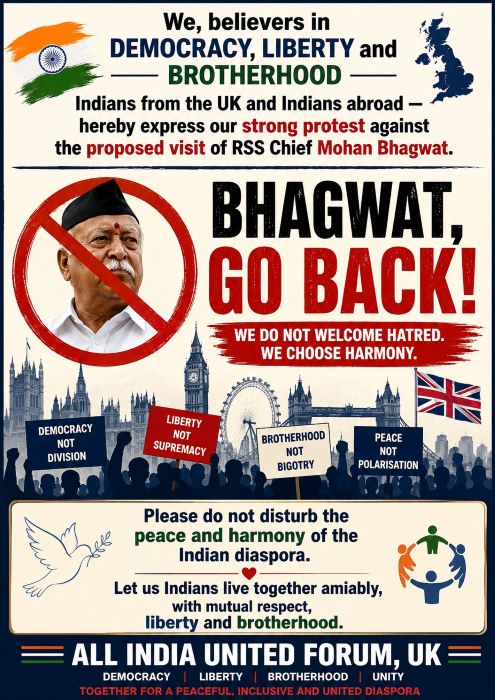
LONDON — The visit of Mohan Bhagwat, head of India’s Rashtriya Swayamsevak Sangh (RSS), to London sparked protests and renewed debate over Hindu nationalism, minority rights, and the RSS’s overseas influence. On Sunday, September 6, 2026, a large crowd gathered in Parliament Square to demonstrate against his arrival. The All India United Forum UK, a coalition of over 20 organisations, organised the protest.
 While the RSS and its supporters maintain that the visit carries a message of social harmony and unity, civil-society groups accused the organisation of advancing majoritarian politics.
Demonstrators opposed “Hindutva”, describing it as a political project that seeks to define India primarily as a Hindu nation and use religion to determine whose rights matter above others. Speakers stressed that the protest was not directed at Hindus or the Indian people, but at an ideology of ethno-nationalism. They also argued that some Indian political leaders often speak abroad about ancient Hindu civilisation, national unity, and harmony, while at home, implementing policies that contradict those values and harm minorities.
The RSS presents itself as an organisation of service, discipline, and national unity. But organisations must be judged not only by their slogans but also by their ideology, political influence, historical record, and consequences.
Scholars and critics have described the RSS as authoritarian, majoritarian, paramilitary, or possessing fascistic characteristics. Fascism is a serious word, and it should never be used carelessly. But when a movement glorifies an allegedly homogeneous nation, organises society through rigid discipline, treats minorities as outsiders, and places cultural conformity above equal citizenship, comparison with fascist politics becomes a legitimate and urgent warning.
 Protesters asserted that their demonstration was not against Hindus or India; rather, they were objecting to the utilisation of religion as a basis for determining belonging, governance, and whose rights are prioritised over others.
The visit has drawn sharp reactions from British politicians like Former Labour leader Jeremy Corbyn, who criticised the event as reported by the Independent Newspaper on 2nd September 2026, saying that the UK should not host “the leader of a hate group with a grievous history of far-right violence. This is a deeply authoritarian, exclusionary and discriminatory organisation which has suppressed religious freedom and inspired horrific attacks on minorities. There should be no space for this kind of hatred in our city”. Additionally, Labour MP Nadia Whittome also tabled a written question in Parliament concerning Bhagwat’s visit.
However, Mohan Bhagwat was welcomed by Bob Blackman, the MP for Harrow East, and by organisations including the Hindu Council UK and the Hindu Forum of Britain. Protesters criticised Blackman’s engagement, warning politicians against courting diaspora votes by overlooking majoritarian extremism. They also alleged that the welcoming organisations had previously opposed the implementation of British equality legislation aimed at outlawing caste-based discrimination.
 Bhagwat was scheduled to speak at a venue organised by RSS supporters, though the time and location were not widely shared, leading protesters to claim the RSS chief had gone into hiding to avoid public scrutiny. The visit comes as part of the RSS’s centenary campaign, which has prompted warnings from British, American, and Canadian civil-society groups that the organisation could intensify polarisation within the Indian diaspora.
During the rally, critics highlighted the deep ties between the RSS and India’s ruling Bharatiya Janata Party (BJP), noting that Prime Minister Narendra Modi spent his early political career as an RSS organiser and that the RSS vision has moved to the centre of state power. Various speakers noted that:
We have witnessed citizenship policies that many fear discriminate against Muslims; attacks on independent journalism; pressure on universities and civil society; and the use of state institutions and the media against critics and political opponents.
 We have witnessed politicians and religious extremists employ inflammatory language while vulnerable communities live with the consequences, including the use of inflammatory language by Amit Shah, who once described immigrants as Termites.
This is how majoritarianism advances: not always through one dramatic seizure of power, but through the gradual normalisation of inequality, intimidation, and silence.
Protesters highlighted in assessments by Human Rights Watch that Indian authorities persist in discriminating against minority groups and occasionally target victims of communal violence, such as through illegal demolitions of Muslim homes and properties. The report also noted that the BJP’s 2024 election campaign fuelled hostility and discrimination against Muslims and other minorities. These issues are well-documented human rights concerns, not just political disputes.
The intimidation directed toward journalists, universities, human rights organisations, and political opponents must cease without delay.
Speakers at the protest urged London’s public institutions, councils, and elected representatives to withhold official endorsement from RSS-linked events and organisations until meaningful human-rights assessments are conducted. Pointing to the religious and ethnic tensions in Leicester in late 2022, demonstrators cautioned against importing South Asian communal divisions into Britain, calling instead for a society free from religious and caste intimidation.