THE ASIAN INDEPENDENT UK
By Vivek Sakpal
On August 8, 2026, Hon. Leader of Opposition, Mallikarjun Kharge, also the president of India’s oldest political party (Indian National Congress), a Dalit (rarely mentioned) leader who has spent five decades in public life, addressed a rally at Ramlila Maidan in Haldwani, Uttarakhand. Two days later, members of the Shri Ram Sena reportedly performed a “shuddhikaran” havan at the very ground he had stood on and spoke. The Congress party has called it an act of ritual purification aimed at Kharge because of his caste. The BJP has called it a customary religious practice with no connection to his visit. Union Minister J.P. Nadda has told the Rajya Sabha the incident is unfortunate and will be investigated. As of this week, no FIR has been filed, and the facts remain contested.
I am not going to referee that dispute here. The courts, or the investigation Nadda has promised, will do that. What I want to do instead is point at something almost nobody in this news cycle has named: this is not a new ritual. It is not even a new argument. It is close to a century old, and it is documented, in precise and uncomfortable detail, in the very text this controversy should be sending people back to.
The Tank That Was “Purified” in 1927
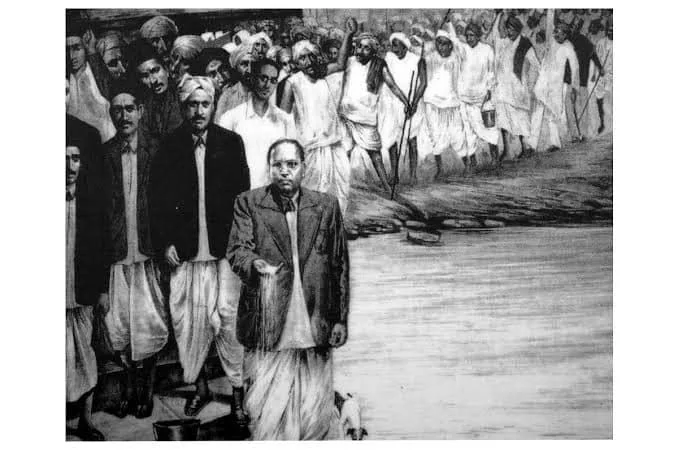
On March 20, 1927, B.R. Ambedkar led thousands of Dalits to the Chawdar tank in Mahad, on the Konkan coast of Maharashtra. The tank was public. The municipal council had formally voted, five years earlier, to open it to all castes. And yet the upper-caste residents had continued to deny Dalits access to it through social pressure and threats of violence. Ambedkar and the gathered crowd walked to the tank, and they drank the water, confronting everything around it.
The response was immediate. Upper-caste Hindus “purified” the tank with cow urine and cow dung, declaring it contaminated by the fact that Dalit lips had touched the water. Not vandalized. Not fenced off. Purified. A formal ritual act, applied to a public resource, to erase the fact that a human being, the caste order considered impure, had used it.
 Ninety-nine years later, a political rally ground is allegedly subjected to a purification ritual, days after a Dalit leader spoke on it. Whatever the specific facts turn out to be in Haldwani, the vocabulary itself is the story. Nobody had to invent a new word for what allegedly happened. The old word shuddhikaran, purification was sitting there, unused for decades in this particular application, waiting to be picked up again. That is what should disturb anyone following this story, regardless of which political side they are inclined to believe.
Why the Ritual Survives When the Law Doesn’t
India’s Constitution abolished untouchability under Article 17 in 1950. It is one of the most unambiguous lines in the entire document. There is no legal gray area about whether treating a person as ritually contaminating on the basis of birth is permitted. It is not.
And yet Ambedkar, in the book that gives this whole debate its intellectual foundation Annihilation of Caste, the speech he wrote for a 1936 Lahore conference that cancelled itself rather than let him deliver it, made an argument that explains exactly why a constitutional prohibition and a live social practice can coexist for a century without their contradictions ever being resolved in practice.
His argument was that caste is not primarily a legal arrangement. It is not even primarily a social habit that etiquette and law can gradually smooth away. It is a religious institution, sustained by scripture, administered by a priesthood, and reproduced through ritual practice that exists entirely outside the reach of statute. You can outlaw discrimination. You cannot outlaw a havan. The law addresses the injury. It does not touch the belief system that manufactures the impulse to inflict it. Ambedkar’s phrase for this was precise: caste is sustained by religious authority, by the texts that declare it divine, by the priesthood that benefits from it, by the social custom that draws its legitimacy from scripture. A ritual of purification is that custom, functioning exactly as designed, ninety years after the man who diagnosed it burned the text that codified it.
Graded Inequality, Applied to a Party President
There is a second argument in the book worth bringing to this story, because it explains something the news cycle keeps missing: why a man of Kharge’s stature, a former Union minister, a Rajya Sabha member, the sitting president of a national party, leader of opposition would not be exempt from this, if the allegation holds up.
Ambedkar’s account of caste was not a simple ladder with the untouchables permanently and uniquely fixed at the bottom regardless of achievement. He called it a system of graded inequality: every group in the hierarchy holds a position not just relative to those below it, but relative to those above it, and that position is assigned at birth, not earned or lost through office, education, or accomplishment. Political power, ministerial rank, national visibility none of it re-grades a person within a system whose entire logic is that grading happens at birth and stays fixed for life.
This is the uncomfortable part of the argument that even sympathetic commentary tends to skip past. If the allegation in Haldwani is accurate, it demonstrates the point with unusual clarity: a man who holds one of the highest offices in Indian political life can still, in the logic of caste, be treated as a source of ritual contamination requiring correction. Formal position and informal purity status are simply not the same currency, and caste has never claimed they were.
The Data Behind the Ritual
Skeptics will reasonably ask whether an isolated, disputed incident tells us anything about the state of the country. It shouldn’t, on its own. But it doesn’t stand alone.
 The 2007 Human Rights Watch shadow report Hidden Apartheid, based on a survey of Indian villages seven decades after Independence, found that in 64% of surveyed villages Dalits were prevented from entering temples, and in 48% they were stopped from drinking from common water sources, the same specific denial that drove the Mahad Satyagraha in the first place. NFHS-5 data from 2019–21 shows that 94.6% of Indian marriages remain within caste, essentially unchanged across generations of urbanisation, education, and constitutional guarantee. None of this is folklore. It is the measured, present-tense condition of a country that abolished untouchability in law seventy-six years ago.
A purification ritual at a political rally ground is not an anomaly against this backdrop. It is a data point consistent with the rest of them.
And the pattern extends past temples and water tanks. Sukhadeo Thorat and Paul Attewell’s landmark 2007 correspondence study sent identical CVs to Indian employers, varying only the applicant’s name to signal caste. Applications carrying upper-caste names received meaningfully more callbacks than identical applications with Dalit names, in Mumbai and Delhi, the country’s most self-consciously cosmopolitan cities. Surinder Jodhka’s research on urban caste networks shows the same logic operating in access to credit, mentorship, and contracts in the modern corporate economy. What changes across a century is not whether the purity-and-pollution instinct survives contact with the city, the office, or the ballot box. What changes is only its costume.
What the Argument Actually Demands
Here is where I want to be careful, because it is easy to turn this into a partisan point-scoring exercise, and Ambedkar’s argument was never really about which party is in office. It was about whether a society’s religious and social architecture, not just its statute book, treats a person’s body as clean or unclean by birth. That architecture predates the BJP, predates the Congress, predates the Republic itself. Every party that has held power in India has, at some point, been the party in whose watch a Dalit was denied a well, a temple, a horse at his own wedding, or a rally ground unmarked by ritual insult.
Ambedkar’s answer to this was never “elect better people.” His answer was structural: you cannot legislate fraternity into existence, and you cannot outsource the destruction of a purity-and-pollution worldview to whichever government happens to hold office in a given decade. The worldview survives elections. It has survived, so far, ninety-nine years since Mahad.
What the Haldwani controversy actually deserves, regardless of how the FIR question resolves, is not another news cycle of accusation and denial that fades in a week. It deserves the recognition that the ritual on display, whoever performed it, whatever their stated intent, is not a new phenomenon requiring a new vocabulary. It is the oldest trick in the caste system’s playbook, applied to newest possible target: a sitting president of a national political party, on a rally ground, in 2026.
Ambedkar burned the text that gave that trick its authority in 1927. The trick, evidently, kept a copy.