THE ASIAN INDEPENDENT UK
By Sat Pal Muman, 30th August 2026
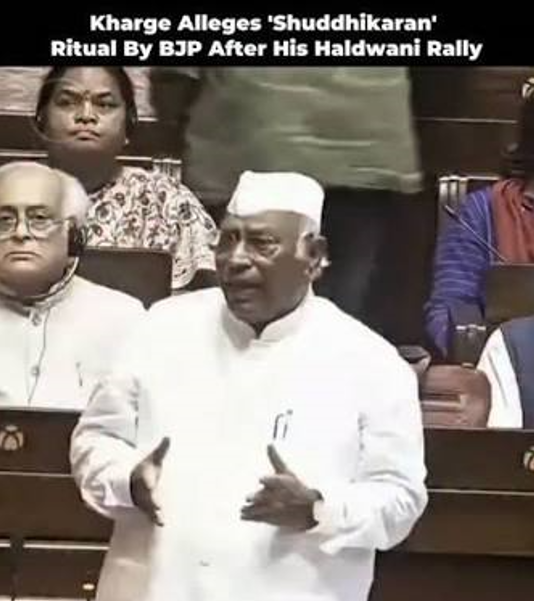
As reported by various media outlets in India, a political controversy in a land of many controversies and contradictions has resurfaced, once again exposing the deeply entrenched and overlapping nature of politics and religion, this time centring on the treatment of Indian National Congress President and Rajya Sabha Leader of the Opposition, Mallikarjun Kharge.
In India, politics and religion overlap almost daily, creating a volatile environment in which the two are virtually indistinguishable. Religion is frequently weaponised as a tool to settle political scores, while politics is simultaneously utilised to stoke religious hatred and mobilise vote banks. This disturbing pattern has continued and intensified under the Modi government, which has routinely exploited religious divisions to maintain its grip on power. If Muslims happen to be the primary targets of this divisive political climate, Dalits also appear to be the targets, highlighting a shifting yet familiar playbook of marginalisation.
The epicentre of this latest controversy is Haldwani, Uttarakhand, India, where Kharge addressed a public rally at the Ramlila Ground on August 8, 2026, as part of his party’s preparations for the 2027 state assembly elections. Allegedly, after his departure, members of a local right-wing organisation known as the Shri Ram Sena Dharmarth Seva Nyas conducted a purification ritual on the stage and grounds where the Dalit leader had stood. Whilst the act is obnoxious by any measure of decency, conducting this purificatory ceremony at the Ram Lila ground, reportedly three days after the conference ended, raises a perplexing logistical and theological question: after how many days or weeks should the act of purification be conducted after the initial impurity? Perhaps those conducting the purificatory ceremony can explain their obnoxious actions?
As reported, the stated motives and justifications provided by the offenders are riddled with glaring logical contradictions. Representatives of the organisation claimed that the Ramlila Ground is exclusively a “cultural and religious” platform and should not be used for political events by any party. Furthermore, it was alleged that the purification was triggered specifically because “objectionable slogans” were raised during Kharge’s rally, with claims that these slogans “sounded like Islamic slogans” and references to Kharge’s past remarks about the BJP and the RSS.
However, this defence completely ignores the venue’s history. Political campaigns, including general and state assembly election rallies by major political parties such as the Indian National Congress and the Bharatiya Janata Party, as well as regional outfits, have been held at this very ground for decades without ever triggering such a ritual. No public record or historical precedent shows a purifying ritual taking place at the Ramlila Ground before this August 2026 event. This glaring double standard raises critical questions about ownership and authority: is the Ram Lila ground a sanctified Hindu ground, and is there an attempt to assume ownership of the place on religious grounds to shut everyone else out? One must ask who truly owns the Ram Lila ground, and what right these individuals had to perform such a ceremony there. Does the mere name of “Ram Lila” alone suffice to give these fringe elements religious and legal legitimacy to dictate who can and cannot speak there?
The group’s specific claim that “objectionable slogans” necessitated a religious purification is highly suspect and warrants intense scrutiny. Could the objectionable slogans genuinely be grounds for the religious purification ceremony? It is vitally important to know, and for the offenders to tell us, exactly which specific act should provoke a purificatory ritual based on their religious belief. If we take their claim at face value, it would represent perhaps the first modern case of a political slogan (a spoken word) being deemed a legitimate cause for a purificatory religious ritual.
In reality, these flimsy defences suggest a far more sinister motive rooted in caste prejudice. This episode suggests that untouchability in modern India is not merely “touch-me-not-ism” but something far deeper. The incident demonstrates how offenders have exploited religious sentiment to degrade another human being on the basis of caste. The act appears to revive the ancient, discriminatory notion that the mere presence or touch of a person from a historically marginalised caste can render a place impure and in need of religiously sanctified ritual cleansing.
 This purificatory ritual clearly violated India’s anti-untouchability laws. Crucially, these actions constitute cognisable and non-compoundable offences under Indian law. A cognisable offence means the police have the legal authority to act immediately, investigate without court orders, and arrest the accused without a warrant. A non-compoundable offence means the crime is so severe and against the public interest that it cannot be privately settled or compromised between the victim and the accused to drop the charges; the trial must proceed regardless. Because these offences are viewed as crimes against the State and society at large, a formal complaint need not come from the victim. Any citizen can lodge a First Information Report (FIR), and police officers are duty-bound to act upon receiving credible media reports or evidence. It is even more surprising that the police have failed to act and that a formal complaint has not yet been lodged.
Despite this extensive statutory power and clear judicial mandates, the authorities have hesitated. The police have not taken the suo moto action they are fully empowered to take, raising serious questions about the integrity of law enforcement in politically sensitive cases. By avoiding swift legal consequences, the offenders have effectively blown the proverbial raspberry at the authorities, mocking the legal system and turning a religious act of purification into a toxic display of political rhetoric. This inaction underscores a stark gap between India’s constitutional principles and entrenched religious bias.
To preserve the integrity of India’s democratic framework and its foundational constitutional promise to protect citizens from untouchability, offenders must be punished. The authorities must act immediately and decisively to apprehend offenders. Filing an FIR and launching a stringent investigation are not merely political demands but non-negotiable legal obligations under the SC/ST Act and the Protection of Civil Rights Act. Arresting those who orchestrate such degrading rituals is essential to send an unambiguous signal across the country that such discriminatory actions blatantly violate the law and will not be tolerated under any pretext. Until the legal machinery forcefully rejects these inherited notions of hierarchy and exclusion, the constitutional abolition of untouchability will remain a hollow promise for millions of citizens.