By Surjit Singh Flora

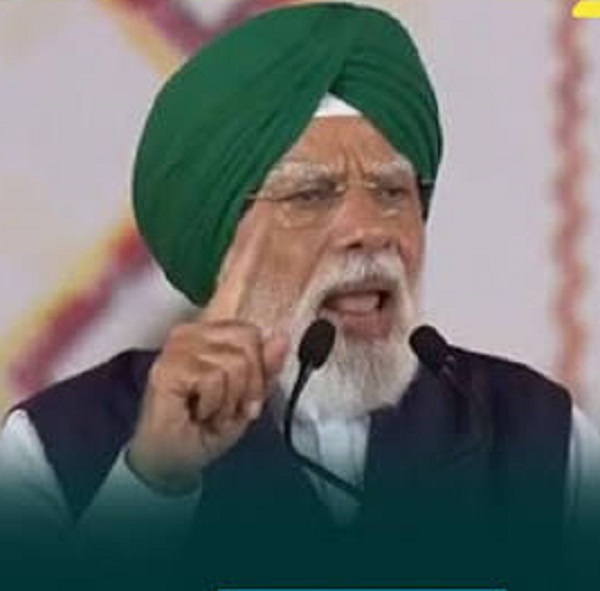
(Asian independent) Prime Minister Narendra Modi’s one-day tour of Haryana, Chandigarh and Punjab brought infrastructure, public services, culture and election politics together. Infrastructure, public services, cultural identity and election politics all lived on stage on that same canvas.
In Jalandhar, Punjab’s programme targeted railway service, upgrade of Jalandhar Cantonment Station, major roadworks and a planned Sikh Museum in Kurukshetra. The projects were valued at a combined value of roughly Rs 5,470 crore. It is not worth the size of the notifications but passenger, patient, worker, trader, farmer and pilgrim experiences that will determine their importance once construction is completed.
To Punjab, the visit was not strictly a ceremonial one. Modi used the platform to make a political argument about governance, public safety, and for the 2027 Punjab Assembly election. His complaints against the Aam Aadmi Party government were in line with that campaign. But such infrastructure projects also have practical and lasting repercussions, no matter were in party politics.
The Jalandhar programme put the transport as the focal point of Punjab’s development rhetoric. Modi virtually dedicated railway and road projects worth about Rs 5,470 crore, with the stated aim of improving mobility across Punjab and North India. One big highlight was the updated Jalandhar Cantonment railway station. For passengers, improved facilities mean safer stations, easier access, cleaner surroundings, and less confusion during long journey. A railway station may be the first public face of a city. Its condition tells passengers whether basic infrastructure is being properly maintained.
New services also gained attention in transportation. One route links Amritsar with the main religious and cultural city Varanasi. Another connects Daulatpur to Kartoli. These services will help families, students, traders, workers and pilgrims who still take trains out of town for cheap travel. Road connectivity was also given equal consideration.
The Ludhiana Bypass Junction and Delhi-Amritsar-Katra Expressway will reduce travel time from Delhi to Amritsar from over eight hours to four thanks to the plans. Travel time from Delhi to Katra could drop from about fourteen hours to six. The Ambala-Kala Amb highway provides further access to the regional road network. The economy of Punjab cannot operate in isolation from its neighbours. Farmers need access to markets. Manufacturers must rely on reliable freight routes. Traders, transporters and workers rely on links to Haryana, Himachal Pradesh, Jammu and Kashmir, Delhi and the rest of North India. Roads and railways are important when they save time, money and make traveling around the country a little less challenging.
Announcements can’t provide those benefits on their own. Jalandhar specializes in sports-goods. Indian manufacturers, suppliers, workers and buyers require reliable access to markets. Improvements in railway services, station facilities and expressway access should ease delays in transportation of people and goods.
Visitors visiting the city also come to Amritsar, Jammu and Kashmir and religious places throughout the north of India. Facilitating travel could uplift hotels, restaurant chains, taxi drivers, small traders and other local businesses. But for workers and families, a safer and more comfortable trip can be as important as a new highway.
The envisaged Sikh Museum in Kurukshetra added a cultural dimension to a visit dominated by infrastructure. PM Modi said the museum would keep the teachings, sacrifices and legacy of the Sikh Gurus alive. He also paid tribute to Teja Singh Samundri and declared Punjab the land of Maharaja Ranjit Singh.
The proposal links public development with memory, faith and regional roots. Punjab’s history is not a footnote in economic planning. Punjab was part of a larger itinerary comprising Jind in Haryana and Chandigarh. The visit presented the projects as components of a common regional plan, rather than as a series of separate statements. Modi launched what was called India’s first hydrogen-powered train heading to Sonipat in Jind. Indigenously powered with hydrogen cells, no carbon emissions occur at the point of operation on that train. It places cleaner transport within the national conversation on reducing our dependence upon diesel and its associated emissions.
Hydrogen rail technologies are still at an early stage for more widespread implementation. The extent of its use will depend largely on fuel provision, maintenance needs, operating costs and safety systems. And while the launch will get the technology public, its long-term success will hinge on whether it can run reliably and affordably. Both railway electrification and infrastructure conversion already reduced diesel consumption on most routes.
Hydrogen trains might be another choice, but the public will assess by how they perform, not by what they look like. At Chandigarh, Modi set up a series of foundation stones and set up more than Rs 4,700 crore worth of projects. The projects spanned healthcare, education, roads, digital governance, smart traffic systems, urban facilities. Chandigarh, which is important to Punjab, Haryana, Himachal Pradesh, Jammu and Kashmir, and nearby districts, is important. Hospitals, colleges, offices and roads serve people out and about far beyond the city.
PM Modi also referred to the implementation of Bharatiya Nyaya Sanhita from Chandigarh as an important feature of the city’s administrative life. Expanding PGIMER Chandigarh was a key element of course for the program. It includes the Advanced Mother and Child Centre, Advanced Neuroscience Centre, Critical Care facilities all within a single building.
There was also news of approval for a new MBBS college. These enhancements might decrease the number of patients required to travel outside the area for specialist care. They might also offer more training experiences for their students and young doctors. The medical relevance of Chandigarh is that it is possible to treat patients from throughout North India and not just those living in the city.
The six-lane greenfield highway from IT City to Kurali was inaugurated to relieve road pressure from airport. Modi also kicked off the vision of the PR Seven Spur, which is being worked on to enhance regional commuting. Part of Chandigarh’s urban agenda was the Integrated Command and Control Centre, Smart Traffic Management, and digital governance projects. The purpose is cited as enhanced traffic movement, faster access to public services and better planning.
The hydrogen train included a more clean aspect of transport within the overall program. The Punjab event was a government initiative, but it involved political actions as well. At the centre, Modi has said that the BJP, though not the leader of state government, is still supporting Punjab’s development. He repeated the call for a “double-engine” government, the BJP’s term for the several states in which the same party governs at the center and the states. The argument is simple: better political coordination, the BJP argues, can expedite projects and improve public services.
PM Modi denounced the Aam Aadmi Party government over law and order, drug smuggling, corruption, debt, unappreciated central spending, commitments of farmers and schemes aimed at women. Such were political charges the prime minister leveled against. They were not “settled” results announced at the event. The speech sent a stark message to BJP employees ahead of the expected 2027 Punjab Assembly election. The party’s Punjab pitch is now based on public safety and accountability, infrastructure and cooperation with the central government.
Voters in Punjab will compare that with their own experience of it. Political slogans fly fast. Public trust takes longer. These establishment of foundation stones and inaugurations create expectations. Now, residents now need timely construction, safe transport services, low transport fares, working hospitals and regular maintenance. Real practical benefits of these things for small businesses, farmers, workers, patients, and students must be seen. Public money deserves to be used transparently. Jobs, access to hospitals, road safety, travel time and crime control all require demonstrable improvement. Public scrutiny is necessary of the central government’s purported development claims just as the state government’s answers are.
Successful project will happen only when cameras are gone, it turns out. The new station must be clean and accessible. A motorway must be safe and well-kept. An expansion to a hospital should be an expansion of treatment capacity. A train service has to run on time and be affordable. Part of PM Modi’s visit to Punjab included rail and road connectivity, green transport, healthcare, education, cultural preservation, and direct political appeal. And Jalandhar and the surrounding areas were promised faster, infrastructure-led growth. The hydrogen train and Chandigarh projects linked local necessities to the broader Viksit Bharat agenda. Yet the ultimate verdict is going to depend on execution, access, safety and accountability. Punjab has heard its promise. It will be judged by the performance from its citizens.