Nava Thakuria

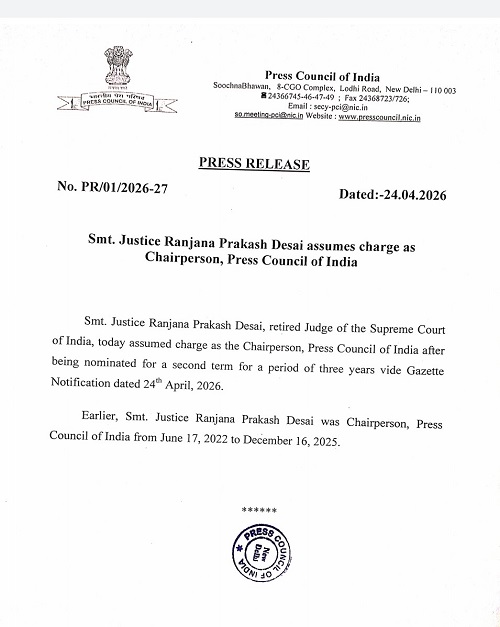
(Asian independent) After months of uncertainties, the Press Council of India (PCI) recently got its chairman, but the space of 13 working journalists remains vacant till date. Justice Ranjana Prakash Desai, who served as the PCI chairman from 17 June 2022 to 16 December 2025, assumed the charge on 24 April 2026 once again. The retired judge of the Supreme Court of India was nominated for another term of three years. But the quotas for working journalists remain vacant as seven members, to be represented by professional scribes (other than editors) and six members, to be represented by journalist-editors, are yet to be picked up to complete the 15th council (https://presscouncil.nic.in/
Mentionable is that two months back, Rajya Sabha member Sasmit Patra urged the Union government in New Delhi to complete the current press council to safeguard democratic principles and strengthen media accountability. Speaking in the upper house of Parliament on 10 February, the Biju Janata Dal leader asserted that the constitution of full-fledged council after the term of 14th council expired on 5 October 2024 was necessary for a free, fair and responsible press. Patra specifically emphasized on appointing the new chairperson, as the PCI remained headless since 17 December last year, to pave the way for completing the council of the statutory, quasi-judicial and autonomous body. Earlier, the Union information & broadcasting minister Ashwini Vaishnaw informed the Parliament that the process of nomination for these members (under the category of working journalists) was sub-judice before Delhi High Court.
Currently the PCI has functioning members namely Sudhanshu Trivedi, Brij Lal (Rajya Sabha lawmakers), Sambit Patra, Naresh Mhaske and Kali Charan Munda (Lok Sabha members), Ashwini K Mohapatra (University Grants Commission), Manan Kumar Mishra (Bar Council of India), K Sreenivasarao (Sahitya Akademi), Sudhir Kumar Panda, MV Shreyams Kumar, Gurinder Singh, Arun Kumar Tripathi, Braj Mohan Sharma and Arti Tripathi (who either own or carry on the business of management in big/ medium/ small newspapers). Initiatives continue to fill up the remaining 14 seats even though different hurdles have surfaced in the recent past.
The 29-member media watchdog, which was initially set up in 1966 under the Press Council Act 1965 and later re-established in 1979 following the Press Council Act 1978 with an objective to improve the standard of newspapers and news agencies in the billion plus nation, should have 13 individuals representing the professional journalists (out of whom 6 need to be editors and 7 working journalists of newspapers/news agencies), but those seats remain vacant till date. Months back, a good number of media organizations demanded to rejuvenate the PCI with more power to its ambit.
The crisis started as many national journo-bodies opposed a change in the PCI rules to pick up members from various press clubs instead of the national union of working journalists. They argue that the press clubs are basically recreational bodies and their coverage areas normally stick to a particular region, city or town. Many press clubs offer memberships to non-working journalists (like academicians, writers, film personalities and also diplomats) to enhance their influences, and hence their members may not do justice to the professional media personnel in various crucial junctures. More precisely the press club/press guild/ media club cannot have an all India body (nonetheless the nomenclature Press Club of India) with representatives from various parts of the vast country. On the other hand, they argued that recognized journalist-unions usually comprise members from different parts of India. Indian Journalists Union and All India Working News Cameramen’s Association had even approached the court seeking justice for the media professionals.
As the PCI became headless for months (it happened for the first time in the history of PCI), the question arose who was taking care of the robust Indian print media fraternity (comprising over 100,000 publications, endorsed by the Registrar of Newspapers for India, in various frequencies and languages)? The PCI is authorized to accept complaints against any newspaper/news agency or an editor/working journalist for their professional misconduct deteriorating the standard of journalistic behaviours. But it has limited power to enforce its guidelines by penalizing print outlets as well their editors and working journalists for the violation.
Besides the newspapers, the billion plus nation also supports nearly 400 satellite news channels along with millions of portals, whatsapp and other digital media outlets. But those are not yet under the purview of the PCI. In reality, all modern technology-driven news outlets remain out of its purview. As the PCI enjoys the authority to make observations whenever the conduct of any government is found inappropriate while ensuring freedom of the press. So the demand to bring all the news channels, radio and digital platforms under the PCI’s jurisdiction and its subsequent empowerment continues to grow.
Can the media fraternity of India expect an empowered and full-fledged PCI with an enhancing coverage area in the coming days ?