

THE ASIAN INDEPENDENT UK

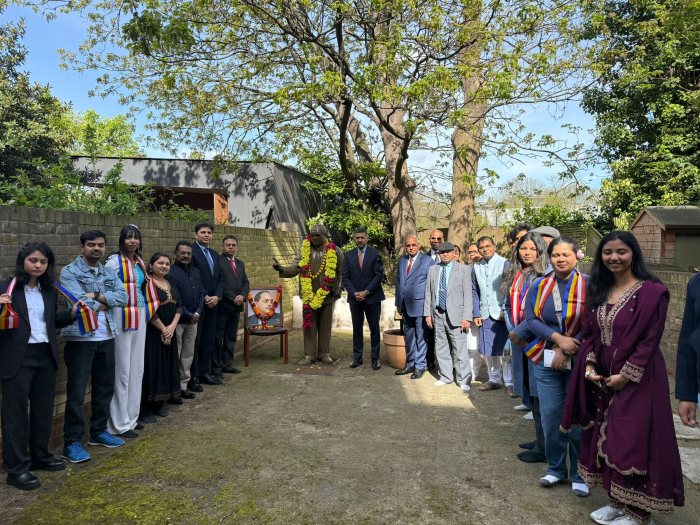
The three-day-long Ambedkar Jayanti celebration commenced with a floral tribute at the Dr Ambedkar Museum at 10 King Henry’s Road, where His Excellency Shri Vikram Doraiswami of India was followed by various members and office bearers of the Federation of Ambedkarite Buddhist organisations, and large numbers of the Indian community, research scholars, academicians, and professionals participated at the museum. They paid their due respect and floral tribute to Babasaheb Ambedkar’s life-size statue in the garden.
For this auspicious occasion, many members travelled from across the country, including the UK Midlands, Scotland, and Wales, and some also came from India, paying their respects to Babasaheb on his Jayanti day. Throughout the day, the programme continued, and people began to pour in. The whole Ambedkar Museum, from the ground floor to the third floor, was packed, with people enjoying themselves. They were greeting each other and talking, creating a vibrant environment. Babasaheb had a dream of a happy and enlightened future for his children. That dream could be seen on the faces of the younger generation and on those of young and old people across the country, showing that Babasaheb’s dream was being fulfilled.
The efforts made and the difficulties faced in acquiring museum status have been successful. Throughout the day, people stayed until 5:30 pm to pay their respects. This marks the beginning of the museum programme. There was an exchange of views and greetings among a large number of people across the various floors, with flowers everywhere in the main building and at the bust and life-size statues in the garden. It was a very happy occasion overall.

BHIM JAYANTI CELEBRATION, AMBEDKAR CENTRE, SOUTHALL
The Ambedkarite Buddhist function of followers and admirers of Babasaheb Ambedkar was held in the evening at Ambedkar Centre, Southall, with music, cake, speeches, and more. People really enjoyed, particularly the cake on which was written “135th birth anniversary of Babasaheb Dr B. R. Ambedkar.” One could see that the youngsters, particularly children, were very happy and enjoyed the event, the cake, and the food. All these items, including various delicious foods and cake, were contributed by volunteers and community family members for the evening, which everyone enjoyed. At this event, we had more people than expected, and everyone had a good time. On this auspicious occasion, various eminent people spoke at this event, including the mayor, a senior Ambedkarite activist, legal professionals, artists, academicians, and research scholar.


HC OF INDIA, HIS EXCELLENCY VIKRAM DORAISWAMI, SPEECH ON THE 135TH COMMEMORATION OF THE BIRTH ANNIVERSARY OF BABASAHEB AMBEDKAR.
On the occasion of the 135th commemoration of the birth anniversary of Babasaheb Ambedkar. This is obviously the last occasion on which I will be greeting all of you here on this particular anniversary, but I did want to recall that the commemoration of Babasaheb’s life and work in this High Commission and in this city is very special because obviously of his connection with the United Kingdom and the journey that he set out on. Of course, Columbia and New York are important in that context, but the framing of his mission and the trajectory of his future career really were shaped here, both as an economist and as a lawyer. And so I think it’s really appropriate that our community, Indian people of Indian origin, and indeed the world, need to know more about Babasaheb and his work from London.
In that context, I have a few personal reflections to share. The first was, for me, an important part of the start of my innings here to pay respects to Babasaheb on the day I arrived. And I mean that literally. My wife and I arrived here at 7.30 in the morning. I came straight from the airport to pay my respects at Mahatma Gandhi’s statue and at the Babasaheb Ambedkar Museum. This is not about me, and I want to be clear about this: I’m not seeking affirmation of this for myself. The point, I think, is that for any High Commissioner here, for anybody in the High Commission here, in many senses, Gandhiji and Dr Ambedkar Sahib, Baba Saheb, have defined our journey as a nation, and they’ve defined our relationship with the UK and the world. Who we are is very much the result of what they did. And so, from that perspective, we often think of Baba Saheb’s work as transformative, which it was, but purely in the sense of what he did for communities that had faced millennia of oppression. That it was, and of course it was, but we should recognise today that his impact was even more on everybody else. Today, we are, maybe not all of us, but the vast majority of us, are better human beings as a result of what he did. His message to us about the essence of democracy being rooted in the idea that we treat people equally, all people equally, is central to what a modern nation must be. And of course, it’s a journey that is still very much in progress, not just in India, but across the world. We live in an era of continuing inequality, continuing acts of violence. across gender and social lines, but that truism that Babasaheb left us with cannot be wished away or forgotten. That, I think, is transformative.
When His Honour, the Chief Justice of India, was here last summer, he gave a special address at Gary’s INN in memory of Babasaheb, and he made the point that we sometimes don’t fully recognise how much he transformed every Indian’s understanding of our history and our society. Is it a job done and mission concluded? Of course not. But see the remarkable impact he had that in circumstances of dire poverty, great illiteracy and ignorance, age-old prejudice, within two and a half years of independence, we produced, he produced, a constitution that made us the first democracy in the world to become a democracy for all people in conditions of poverty. No other democracy in the world did that, and that is Babasaheb’s legacy. We should be grateful for that, most of all, because the lesson of democracy is meaningless if it is a democracy only for some, or a democracy only for the privileged, the moneyed, the titled. And democracies across this world have been so, with the exception of the one that Babasaheb helped create. That is a magnificent achievement, and it is one that I still believe we do not give enough credit. To him, not to us the people have given us yet enough credit for that. It’s not our credit, of course, it is what we inherited, but it is a remarkable thing to think about.
Second, I think we should bear in mind the international impact of what he said and did. If today there is, there has been a tradition of trying to move the arc of history towards justice, social, economic, and political, it is because of him. His understanding into human nature and his argument with structural inequality led him to challenge many of the things that we today think are, were right to be challenged, but were definitely well ahead of their times, 80 years ago. That included the notion that when we talk about humanity, we talk about mankind, thereby leaving out 50% of the world. It is amazing that his experience of oppression led him not to withdraw into himself, but to actually see oppression in all its forms and all its dimensions. That is the hallmark of a truly great soul. And it is, to our very great credit, that we have had the opportunity to be inspired by him.
Today, I know I am a better human being. I am better, but from the ability to read what he said, to study what he studied, and what he left for us. But most of all, to see his vision. And it is, in fact, reflected, as we heard today, in the faces of young students from India who recognise, and some of you are here, who recognise how much their world and their futures have been changed because of that one man. And for that, we should recognise him as not a man of a million, but a man of one and a half billion. In his memory, therefore, I can only say we can thank whomever our creator is for what he brought to us. Thank you very much.
FAREWELL TRIBUTE TO HIS EXCELLENCY SHRI VIKRAM KUMAR DORAISWAMI
As we bid a respectful and heartfelt farewell to His Excellency Shri Vikram K. Doraiswami, we take this opportunity to reflect on his distinguished tenure as the High Commissioner of India to the United Kingdom and his exemplary service to the nation.
H.E. is a distinguished Indian diplomat of the Indian Foreign Service (IFS) (1992 Batch), who is going to serve as the Indian Ambassador to the People’s Republic of China.
During his tenure in London, H. E. demonstrated the highest standards of professionalism and statesmanship. His unwavering commitment to strengthening India–United Kingdom relations significantly advanced bilateral cooperation, particularly in trade and economic engagement. These efforts culminated in the successful conclusion of the India–United Kingdom Comprehensive Economic and Trade Agreement, a landmark achievement that will continue to benefit both nations for years. We especially want to mention his effort in establishing the campuses of the UK universities in India.
Beyond his diplomatic accomplishments, he will be especially remembered for his inclusive approach and meaningful engagement with diverse communities. His continued support for the Indian diaspora, especially the Ambedkarite Buddhist, Ravidassia, and Valmiki communities, fostered a deep sense of respect and spirit of inclusion. Under his leadership, numerous cultural, social, and community programs were organised to promote unity, mutual respect, and a shared identity. His gracious personal presence at community events, particularly birth and death anniversaries of Babasaheb Ambedkar and Guru Ravidass, along with sincere encouragement have left a lasting positive impact.
As H.E. embarks on his new role as the Ambassador of the Republic of India to the People’s Republic of China, on behalf of FABO, we extend our heartfelt gratitude for his service and wish him continued success. His dedication, vision, and ability to connect across cultures will undoubtedly continue to serve India with distinction.
With the highest regards, sincere appreciation, and best wishes for the coming years.
Federation of Ambedkarite and Buddhist Organisations (FABO) UK