

Sumana Adak, UK

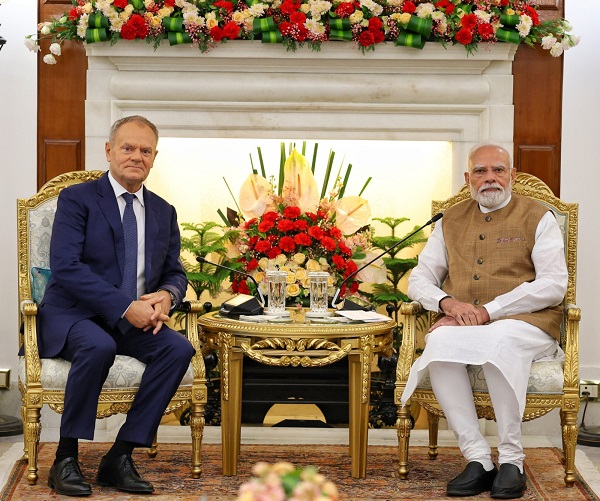
(Asian independent) Polish Prime Minister Donald Tusk’s visit to India marks more than another step forward in Warsaw-New Delhi relations. It points to a wider opportunity for Central and Eastern Europe (CEE) to redefine its engagement with India, moving from being largely a beneficiary of agreements negotiated in Brussels to becoming a partner. Tusk arrived in New Delhi on October 21, 2026, leading a delegation representing nearly 100 companies. The visit came at an important moment, following the conclusion of negotiations on the long-awaited EU-India free trade agreement. Talks began in 2007, stalled in 2013 and resumed in 2022 before concluding in January 2026. The agreement connects two economies that together account for roughly a quarter of global GDP. The European Commission expects EU goods exports to India to double by 2032, with tariffs eliminated or reduced on 96.6 percent of exports.
The breakthrough reflects changing geopolitics as much as economics. Tariff pressures from Washington and export controls from Beijing have encouraged both Europe and India to reconsider their dependencies. Speaking in Warsaw in September, Indian Foreign Minister Subrahmanyam Jaishankar described India’s approach to Europe as one of “de-risking and diversifying”. That calculation resonates strongly in CEE, where governments remain particularly sensitive to supply-chain vulnerabilities and security risks. Expectations, however, should remain realistic. Polish Indian trade reached about $5.7 billion in 2024, making Poland India’s largest trade and investment partner in CEE. Yet the figure remains modest compared with India’s trade with Western Europe’s largest economies.
Warsaw has also presented itself as a gateway for Indian businesses seeking access to the wider European market. But this raises a larger question: should Poland pursue that ambition alone, or could CEE countries gain greater influence by coordinating their approach to India? The emerging dialogue between India and the Visegrad group suggests there is scope for a broader regional partnership. Tusk’s visit also carried political significance for Poland’s G20 ambitions. The Polish prime minister said Modi supported Poland’s pursuit of a permanent place in the grouping, although the joint statement was more cautious, referring to cooperation in G20 tracks and workstreams in which Poland participates or may be invited to participate.
In return, Warsaw reiterated its support for a permanent Indian seat on an expanded UN Security Council and for India’s candidature for a non-permanent seat in 2028-29. Neither country can determine those outcomes alone, but the exchange raises a wider question about the representation of middle powers in international institutions. That debate echoes an argument made by Shashi Tharoor, the former UN Under Secretary General and chairman of the Indian Parliament’s Committee on External Affairs. A prominent advocate of stronger India-Europe relations, Tharoor has also stressed the importance of respecting India’s strategic autonomy. At the European Forum Alpbach, he argued that “Europe wins when it collaborates with smaller and middle powers”. His observation applies to Europe’s partners abroad, but it also resonates within Europe itself. Poland is the EU’s sixth-largest economy, yet it does not have an individual seat at the G20 table. One major complication remains for Russia. India’s long standing relationship with Moscow is particularly sensitive in CEE because of the war in Ukraine. Rather than expecting India to abandon that relationship, European governments are increasingly emphasising their ability to offer New Delhi alternative partnerships in areas such as technology and defence. The Delhi talks nevertheless demonstrated the limits of convergence. Poland continues to advocate a comprehensive, just and lasting peace based on the UN Charter and respect for sovereignty and territorial integrity. Tusk has also maintained that India could play a constructive role in influencing the course of the war. The EU-India agreement will not transform Central and Eastern European economies overnight. Its importance lies instead in the framework it creates for deeper engagement with a rising power seeking to diversify its international relationships.
For Poland and its neighbours, the real test will be converting diplomatic momentum into contracts, investment and sustained cooperation in technology, industry and security. Tusk’s visit has opened the door. Whether Central and Eastern Europe can seize the opportunity, individually or collectively, will determine whether the region emerges as a genuine strategic partner for India rather than simply a market for strategies shaped elsewhere.