

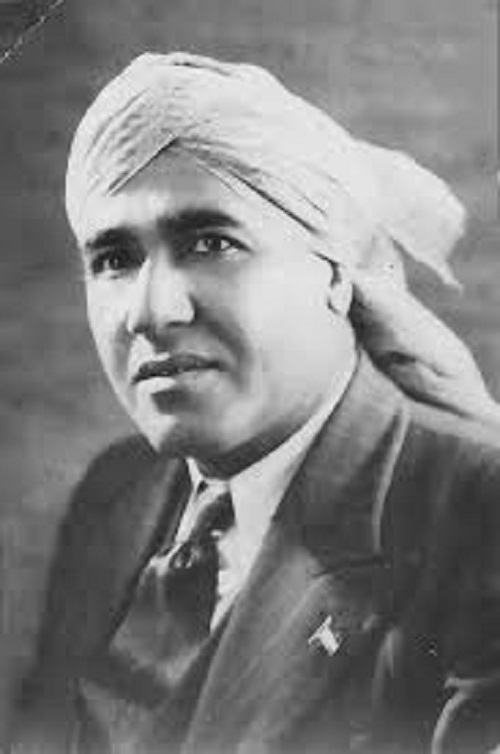
By Dr Ramji Lal
Social Scientist & Former Principal, Dyal Singh College, Karnal (Haryana), India

(Asian independent) Abstract: Mainstream historiography in both India and the United Kingdom has frequently flattened Shaheed-e-Azam Udham Singh (1899–1940) into a singular archetype: the patient avenger of the 1919 Jallianwala Bagh massacre. While his assassination of Sir Michael O’Dwyer at Caxton Hall, London, on March 13, 1940, remains the defining climax of his life, declassified British intelligence dossiers (MEPO 3/1743 and KV 2/2178–2179), North American municipal records, prison correspondence, and subaltern diaspora studies reveal a far more complex, transnational figure. Drawing upon primary archival sources alongside the author’s prior historiographical studies published in Samaj Weekly (UK), The Asian Independent (UK), and Pratibimb Media, this comprehensive study bridges Indian nationalist historiography with British working-class and South Asian diaspora history. It examines Singh’s formative years at the Central Khalsa Orphanage in Amritsar, his World War I service in Mesopotamia, his integration into California’s Punjabi-Mexican community via his marriage to Lupe Hernandez, his mentorship under Shaheed Bhagat Singh, his clandestine movements across the Soviet Union and Weimar Germany, his strategic employment in British imperial cinema at Denham Studios, and his labour organising with the Indian Workers’ Association (IWA) in Coventry and London alongside Irish Republicans. Ultimately, Singh emerges not as an isolated vigilante but as a peripatetic proletarian intellectual whose chosen identity—Ram Mohammad Singh Azad—transformed a London courtroom into a timeless indictment of British imperialism and a shared heritage for contemporary democratic societies in both India and Britain.
Keywords: Shaheed-e-Azam Udham Singh, Ram Mohammad Singh Azad, Jallianwala Bagh Massacre, Ghadar Party, Bhagat Singh, Indian Workers’ Association (IWA), Anti-Imperialism, Secularism, British Colonialism.
1. Historiographical Introduction: Bridging Indian and British Perspectives
In conventional narratives of the Indian independence movement—as well as in British imperial histories—Shaheed-e-Azam Udham Singh is framed almost exclusively through the lens of retributive justice: a survivor of the April 13, 1919 Jallianwala Bagh atrocity who waited twenty-one years to execute Sir Michael O’Dwyer, the former Lieutenant Governor of Punjab, in the heart of the British Empire. While factually accurate, this teleological framing obscures the rich socio-political texture of the intervening two decades and diminishes his ideological sophistication. As I have argued across my prior essays in Samaj Weekly (UK), The Asian Independent (UK), and Pratibimb Media, reducing Udham Singh to an emotional nationalist driven by a personal vendetta erases his standing as a patient, realistic, and deeply committed socialist revolutionary, self-taught Marxist, secular humanist, and transnational labour organiser.
For readers in both India and the United Kingdom, Udham Singh occupies a uniquely shared historical space. In India, he is revered alongside Shaheed-e-Azam Bhagat Singh as a symbol of supreme sacrifice and communal harmony; in Britain, he represents an early pioneer of South Asian working-class activism, anti-racist solidarity, and anti-colonial resistance within the imperial metropole. Utilizing declassified Metropolitan Police Special Branch files, MI5 surveillance logs, Old Bailey court transcripts, and oral histories, this paper reconstructs both the celebrated milestones and the lesser-known subterranean chapters of Singh’s life. Far from living in monastic isolation, Singh inhabited the vibrant, precarious world of early twentieth-century Global South migrations—synthesising the militant nationalism of the Ghadar movement with Marxist-Leninist internationalism and articulating an uncompromising vision of Hindu-Muslim-Sikh unity under the composite name Ram Mohammad Singh Azad.
2. Orphanage Pedagogy, World War I Service, and Early Precarity
Udham Singh was born on December 26, 1899, in the Pilbad neighborhood of Sunam, located in the erstwhile princely state of Patiala (now Sangrur district, Punjab). Born into a Kamboj Sikh family to Sardar Tehal Singh—who worked as a railway crossing watchman in the nearby village of Upalli—and Mata Narayani Kaur (also recorded as Narain Kaur), he was originally named Sher Singh. His formative years were marked by severe personal bereavement and structural socio-economic hardship. His mother passed away around 1901–1902, followed by his father in 1907, leaving Sher Singh and his elder brother, Sadhu Singh, destitute.
With the assistance of Kishan Singh Ragi, the orphaned brothers were admitted to the Central Khalsa Orphanage in Putlighar, Amritsar, on October 24, 1907. Following Sikh baptismal rites (Amrit Sanskar) at the institution, Sher Singh was renamed Udham Singh (symbolising upheaval, exertion, or turmoil), while Sadhu Singh became Mukta Singh. Peers affectionately called him “Ude”, an alias he retained throughout his underground career.
An often-overlooked dimension of his youth is the dual nature of the Central Khalsa Orphanage’s curriculum. Alongside religious instruction and elementary academics, the institution emphasised artisanal and vocational trades—specifically carpentry and sign-painting—practical skills that later enabled Singh to survive undercover across four continents without relying on nationalist patronage. However, personal tragedy struck again in 1917 when his beloved brother Mukta Singh died, deepening Udham Singh’s sense of solitude.
After completing his matriculation in 1918, acute economic necessity compelled the young man to enlist in the British Indian Army’s labor and engineering corps during the final stages of World War I. Deployed to Mesopotamia (modern-day Iraq), Singh experienced firsthand the stark racial hierarchies of the imperial military machine—where Indian soldiers and laborers risked their lives for British geopolitical dominance while facing systemic discrimination, wartime inflation, forced recruitment, and the denial of self-determination at home. Returning to Amritsar shortly before Baisakhi in April 1919, his disillusionment with the British Empire was already deeply primed before Brigadier-General Reginald Dyer’s troops marched into Jallianwala Bagh.
3. The Jallianwala Bagh Massacre and Revolutionary Awakening:
The defining turning point in Udham Singh’s political consciousness occurred on April 13, 1919 (Baisakhi), at Jallianwala Bagh in Amritsar. On that fateful afternoon, Brigadier-General Reginald Dyer ordered troops to block the narrow exits and open fire without warning on a peaceful, unarmed gathering of thousands of men, women, and children protesting the draconian Rowlatt Act and the arrest of popular nationalist leaders Dr Saifuddin Kitchlew and Dr. Satyapal. Hundreds—and by nationalist estimates, well over a thousand—of innocent civilians were slaughtered in minutes.
Sir Michael O’Dwyer, then Lieutenant Governor of Punjab, fully endorsed Dyer’s brutality, telegraphing his approval and describing the massacre as a necessary measure to crush rebellion. Having witnessed the carnage, assisted in serving water to the gathering, and helped tend to the wounded, the nineteen-year-old Udham Singh pledged to hold the architects of the atrocity accountable. Crucially, Singh harbored no petty personal hatred toward O’Dwyer as an individual; instead, O’Dwyer represented the apex of an unaccountable, bloodthirsty imperial apparatus that rewarded mass murderers with titles, honours, and pensions while subjecting millions of Indians to famine and subjugation.
4. Global Odyssey: East Africa, the Punjabi-Mexican Nexus, and the Ghadar Party
To fulfill his pledge and build transnational support for Indian liberation, Udham Singh embarked on an extraordinary twenty-year global odyssey spanning East Africa, North America, the Soviet Union, Continental Europe, and Great Britain.
· East Africa and Clandestine Entry into North America: Between 1920 and 1924, Singh’s trajectory mirrored that of thousands of subaltern Punjabi migrants seeking livelihood across the Indian Ocean and Pacific worlds. Traveling first to East Africa, he worked as a labourer on the Uganda Railway before making his way across the Atlantic and entering the United States clandestinely via Mexico.
· The Ghadar Movement: In California, Singh immersed himself in the Ghadar Party, the militant anti-colonial organization founded in 1913 by expatriate Indians such as Lala Hardayal, Sohan Singh Bhakna, and Baba Jawala Singh. Advocating armed insurrection to overthrow British rule, the Ghadar movement provided Singh with both an organizational network and radical political literature.
· Domesticity within California’s Punjabi-Mexican Community: One of the least discussed facets of Singh’s American sojourn is his domestic life within California’s Punjabi-Mexican community. Confronted with the United States’ draconian anti-Asian exclusion laws—culminating in the Johnson-Reed Immigration Act of 1924 and the United States v. Bhagat Singh Thind (1923) Supreme Court ruling that stripped Indians of citizenship and land-ownership rights—many Punjabi men formed unions with Mexican and Mexican-American women. In 1923, while residing in Claremont, California, and working under the alias “Frank Brazil”, Singh married Lupe Hernandez, a Mexican-American woman, with whom he reportedly had two children. Navigating the perilous intersections of racialised immigration surveillance and underground activism, Singh worked in lumber mills, factories, and maritime shipping across San Francisco, Detroit, Chicago, and New York while distributing Ghadar literature.
5. Return to India, Mentorship of Bhagat Singh, and Clandestine Escape:
The 1925 publication of Sir Michael O’Dwyer’s memoir, India As I Knew It, in which the former Lieutenant Governor unapologetically defended his administration and the Jallianwala Bagh massacre, re-ignited Singh’s revolutionary urgency. In 1927, responding to the call of revolutionary comrades—most notably Shaheed Bhagat Singh—Udham Singh made the agonizing decision to leave his family in California and return to India to smuggle arms and coordinate underground resistance alongside the Hindustan Socialist Republican Association (HSRA).
In July 1927, British police raided his premises in Amritsar and arrested him under Section 20 of the Arms Act. Authorities seized revolvers, ammunition, and copies of proscribed Ghadar publications such as Ghadr-di-Gunj (“Voice of Revolt”). Sentenced to five years of rigorous imprisonment (serving four years), Singh was explicitly classified in colonial intelligence dossiers (KV 2/2178) as a “Sikh Punjabi Marxist” who harbored deep sympathies for Russian Bolshevism.
During this period, Udham Singh forged a profound ideological bond with Shaheed Bhagat Singh, whom he regarded as his political guru, close comrade, and mentor. While Udham Singh was incarcerated, Bhagat Singh, Sukhdev, and Rajguru were executed in Lahore on March 23, 1931. Deeply moved by their supreme sacrifice, Udham Singh carried Bhagat Singh’s portrait in his wallet for the rest of his life and vowed to complete their unfinished anti-imperialist mission.
Released from prison in late 1931 under strict police surveillance, Singh briefly opened a signboard painting shop in Amritsar, boldly displaying the name “Ram Mohammad Singh Azad” on his storefront. In 1933, he executed a daring escape from British intelligence surveillance, slipping into Kashmir and traversing Afghanistan, the Soviet Union, and Weimar Germany before reaching Britain around 1934. His clandestine transit through the USSR deepened his commitment to socialist egalitarianism and proletarian internationalism.
6. Underground Life in Britain: Imperial Cinema, Labor Organizing, and Solidarities
From 1934 to 1940, Udham Singh constructed a remarkably agile underground existence in Britain, documented extensively in London Metropolitan Police File MEPO 3/1743 and MI5 files KV 2/2178–2179. Discarding outward religious markers and adopting Western attire, he operated under multiple pseudonyms—including Frank Brazil, Ude Singh, Sher Singh, and Mohammad Singh Azad—while inhabiting a world of dual identities and cross-movement solidarity:
· Subverting Imperial Cinema: Utilizing his charismatic presence and need for flexible income, Singh worked as a background extra at Denham Film Studios in Buckinghamshire in British colonial adventure films—most notably Alexander Korda’s Elephant Boy (1937) and The Four Feathers (1939). Ironically, Singh used wages earned from cinematic productions that glorified the British Empire to finance his underground anti-imperialist activities.
· Proletarian Activism and the Indian Workers’ Association (IWA): Earning his living as a carpenter, electrician, peddler, and sign painter, Singh actively organised among Indian lascars (merchant seamen), factory workers, and peddlers across London and the English Midlands. He became closely associated with the Indian Workers’ Association (IWA) in Coventry—founded in 1938 to champion the rights of South Asian laborers and Indian independence—and established his own radical circle, the Azad Party. For the British South Asian diaspora today, Singh remains a foundational figure in the history of trade unionism and anti-racist organizing in the UK.
· Transnational Anti-Colonial Alliances: Recognizing that colonial exploitation was intertwined with global capitalism, Singh forged solidarity links with British trade unionists, left-wing intellectuals, and Irish Republican Army (IRA) cells in London, viewing the Irish and Indian freedom struggles as interconnected fronts against British imperial hegemony.
· Deceptive Surveillance Evasion: Demonstrating remarkable tactical tradecraft, Singh routinely visited India House in London—a hub closely monitored by Scotland Yard—posing as an apolitical, slightly eccentric artisan seeking travel endorsements, thereby deflecting police suspicion while patiently tracking Sir Michael O’Dwyer’s public schedule.
7. Ideological Framework: Socialism, Secularism, and Humanism
A rigorous examination of Singh’s prison correspondence from Brixton and Pentonville prisons in 1940, alongside his courtroom declarations, reveals a coherent, forward-looking political philosophy anchored in three foundational pillars:
1. Socialist Egalitarianism and Constructive Reform: Influenced by Marxism-Leninism, the Bolshevik Revolution, and the HSRA manifesto, Singh viewed political independence as hollow without radical socio-economic transformation. In his prison letters to friends such as Shiv Singh Johal, he articulated a constructive blueprint for independent India: eradicating hunger, poverty, illiteracy, and disease; ensuring fair wages and dignity for peasants and workers; and redirecting wasteful communal and ritual expenditures toward public schools, libraries, colleges, and parks for children. He expressed profound admiration for revolutionary predecessors such as Ram Prasad Bismil and Bhagat Singh.
2. Working-Class Internationalism: Singh consistently distinguished between the British imperial ruling class and ordinary British working people. Throughout his trial, he reiterated that he held no malice toward English workers, noting that they too were exploited by the same capitalist and aristocratic elite that starved millions in India.
3. Uncompromising Secularism (“Ram Mohammad Singh Azad”): Perhaps Singh’s most enduring ideological contribution was his adoption of the composite name Ram Mohammad Singh Azad. Deliberately fusing Hindu (Ram), Muslim (Mohammad), and Sikh (Singh) identities with the Urdu-Persian concept of freedom (Azad), he argued that because people of all faiths had bled together at Jallianwala Bagh, their resistance and future nationhood had to be indivisible. At a historical moment when communal politics was fracturing the nationalist movement, Singh’s chosen name stood as a living manifesto of pluralistic harmony.
8. Caxton Hall, the Old Bailey Trial, and Supreme Martyrdom
On March 13, 1940, Sir Michael O’Dwyer addressed a joint meeting of the East India Association and the Royal Central Asian Society at Caxton Hall, Westminster, London. Concealing a six-chambered revolver inside the hollowed-out pages of a thick book, Udham Singh attended the meeting, approached the platform at the conclusion of the session, and fired multiple shots. O’Dwyer was killed instantly, while Lord Zetland (Secretary of State for India), Lord Lamington, and Sir Louis Dane sustained injuries.
Making no attempt to flee, Singh courted arrest so he could transform the British judicial system into an international tribunal against colonialism. Remanded to Brixton Prison, he undertook a gruellings 42-day hunger strike to demand political prisoner status and protest prison treatment, enduring painful forced tube-feeding.
His trial opened on June 4, 1940, at the Central Criminal Court (Old Bailey) before Justice Cyril Atkinson. Defended by V.K. Krishna Menon and St John Hutchinson, Singh refused to plead for clemency or accept a defence based on insanity. When prosecutors attempted to portray him as mentally deranged, Singh retorted: “I am not mad; your laws are mad. You rule over people and call it civilisation—that is madness.” Thumping the rail of the dock, he delivered a fiery anti-imperialist indictment:
“I do not care about the sentence of death. It means nothing at all… I am dying for my country. I have seen people starving in India under British imperialism. I did it; the pistol went off three or four times. I am not sorry for protesting. It was my duty to do so.”
Fearing that Singh’s uncompromising anti-colonial testimony would ignite mass unrest across India during World War II, Justice Atkinson imposed a strict press censorship order suppressing his courtroom speech. Sentenced to death on June 5, 1940, and following the dismissal of his appeal on July 15, Shaheed-e-Azam Udham Singh was executed by hanging at Pentonville Prison, London, on July 31, 1940.
9. Repatriation of Remains and Enduring Indo-British Legacy
Buried in an unmarked grave within the grounds of Pentonville Prison, Singh’s remains lay in Britain for thirty-four years until sustained diplomatic and public advocacy—spearheaded by Punjab MLA Sadhu Singh Thind and Chief Minister Giani Zail Singh—secured their repatriation in July 1974. Received in New Delhi by Prime Minister Indira Gandhi and Congress President Dr. Shankar Dyal Sharma, his remains were cremated with full state honors in his hometown of Sunam. On August 2, 1974, his ashes were divided into seven urns and immersed or enshrined at major national and religious sites across India, including Haridwar, Kiratpur Sahib, Rauza Sharif, the Jallianwala Bagh museum, and Sunam.
As Jawaharlal Nehru observed in 1962, “I salute Shaheed-i-Azam Udham Singh with reverence, who kissed the noose so that we may be free.” Re-examining the totality of Udham Singh’s life—from his World War I service in Mesopotamia and his family life within California’s Punjabi-Mexican diaspora to his clandestine Soviet travels, anti-colonial film work, labor organizing in Britain, and martyrdom at Pentonville—reinstates him as a foundational subaltern internationalist. For contemporary audiences in both India and the United Kingdom, his chosen identity—Ram Mohammad Singh Azad—remains an enduring beacon of secular solidarity, multicultural coexistence, and democratic social justice.
References:
A.Primary & Archival Sources (UK & India)
1. The National Archives (UK), Kew, London: Metropolitan Police File MEPO 3/1743 (Report dated March 16, 1940, on the assassination of Sir Michael O’Dwyer and Udham Singh’s aliases).
2. The National Archives (UK), Kew, London: Security Service Personal Files KV 2/2178 & KV 2/2179 on Udham Singh (MI5 surveillance and intelligence assessments).
3. British Library, London: India Office Records IOR/L/PJ/12/485 (Caxton Hall Shooting and Press Censorship, 1940).
4. Old Bailey Proceedings Online: The King versus Udham Singh, Central Criminal Court, London, June 4–5, 1940 (Ref: t19400401-47).
5. National Archives of India, New Delhi: Home Department, Political (General), 1940, File No. 41-G/40.
6. Prison Correspondence of Udham Singh: Letters written from HM Prison Brixton and HM Prison Pentonville to Shiv Singh Johal (March–July 1940), preserved in the Shaheed Udham Singh Memorial Museum, Sunam, and reproduced in Grewal & Puri (1974) and Navtej Singh (1998).
B.Prior Research Articles by Dr. Ramji Lal (Samaj Weekly UK, The Asian Independent UK & Pratibimb Media)
7. Lal, Ramji, Dr. (2025, August 4). Shaheed-e-Azam Udham Singh: My Tribute. Samaj Weekly UK.
8. Lal, Ramji, Dr. (2025, December 25). Shaheed-e-Azam Udham Singh: A Socialist Revolutionary. Samaj Weekly UK / The Asian Independent UK.
9. Lal, Ramji, Dr. (2025, December 25). Shaheed-e-Azam Udham Singh: A Realistic Socialist Revolutionary. Pratibimb Media.
10. Lal, Ramji, Dr. (2026, April 14). Jallianwala Bagh Pre-Planned Massacre and Shaheed-e-Azam Udham Singh: A Review. The Asian Independent UK.
11. Lal, Ramji, Dr. (2026, July 18). I Pay Tribute to the Great Martyr and Revolutionary Shaheed-e-Azam Udham Singh. The Asian Independent UK.
12. Lal, Ramji, Dr. (2026, July 30–31). Shaheed-e-Azam Udham Singh (26 December 1899 – Martyrdom Day: 31 July 1940) – Ideology and Perspective: An Overview (also published in Hindi as शहीद-ए-आज़म ऊधम सिंह– विचारधारा और दृष्टिकोण: एक अवलोकन). Pratibimb Media.
13. Lal, Ramji, Dr. (2026, August 2). Shaheed-e-Azam Udham Singh’s Historic Statement at the Old Bailey: An Examination of British Imperialism. Samaj Weekly UK / The Asian Independent UK / Pratibimb Media.
14. Lal, Ramji, Dr. (2025). Revolutionary Galaxy: Beams of Light: Great Personality and Ideology (क्रांतिकारी आकाशगंगा: प्रकाश की किरणें: महान व्यक्तित्व और विचारधारा). Delhi: Open Search, p. 4.
C .Books & Secondary Scholarship:
15. Fenech, Louis E. (2020). Death in the Punjab: Revisiting the Story of Udham Singh. Oxford University Press.
16. Grewal, J.S., & Puri, H.K. (Eds.). (1974). Letters of Udham Singh. Amritsar: Guru Nanak Dev University.
17. Leonard, Karen Isaksen. (1992). Making Ethnic Choices: California’s Punjabi Mexican Americans. Temple University Press.
18. Singh, Navtej. (1998). Challenge to Imperial Hegemony: The Life Story of a Great Indian Patriot Udham Singh. Patiala: Punjabi University.
19. Singh, Sikander. (1998). Udham Singh, Alias, Ram Mohammed Singh Azad: A Saga of the Freedom Movement and Jallianwala Bagh. Amritsar: B. Chattar Singh Jiwan Singh.