THE ASIAN INDEPENDENT UK

Dr. Ramjilal, Social Scientist, Former Principal,
Dyal Singh College, Karnal (Haryana – India)
Email: [email protected]
It is essential for our readers to understand the critical background of the Jallianwala Bagh massacre. During World War I (1914-1918), the British government audaciously claimed it was fighting for democracy. Meanwhile, Indians provided invaluable support, contributing approximately 110,000 out of 192,000 Indian soldiers from Punjab alone. The Indian public not only volunteered soldiers but also raised a staggering Rs 2 crore in war donations and Rs 10 crore as loans. The British imperialist government, exhibiting both greed and coercion, forced donations from the Indian populace, further exploiting their sacrifices.
Simultaneously, revolutionary attacks erupted in Bengal and Punjab, a planned mutiny festered within the British Indian Army in February 1915, and countless uprisings were orchestrated by Indian nationalists across India, the United States, and Germany between 1914 and 1917. The looming threat of the Ghadar revolutionary movement, the instability of the British administration, the unlawful arrests of prominent Ghadar revolutionaries, and challenges to British war efforts created an environment ripe for the Defence of India Act 1915, which brutally curtailed civil and political liberties for Indians. The then Lieutenant Governor, Michael O’Dwyer, fervently supported this draconian Act, recognising the escalating Ghadarite threat in Punjab.
Impact of War:
The war resulted in the tragic loss of 43,000 soldiers, plunging military families into dire economic conditions. The combination of forced collection of donations, rampant inflation, soaring unemployment, starvation, crippling public debt, epidemics, erratic monsoons, and economic recession led to acute public dissatisfaction. The rising influence of the Ghadar Party’s revolutionary movement and the Pan-Islamic Movement in Turkey intensified this unrest.
The Anarchical and Revolutionary Criminal Act, 1919:
In a desperate attempt to stifle dissent, the government enacted the Anarchical and Revolutionary Criminal Act of 1919—widely known as the Rowlatt Acts. This repressive legislation granted the government sweeping powers to control the press, suppress independent movements, detain leaders without trial, arrest citizens without warrants, and establish special tribunals to silence opposition.
India’s Reaction to the Rowlatt Act, 1919:The Black Laws
The reaction to the Rowlatt Act was overwhelmingly forceful. Muhammad Ali Jinnah, in a bold act of defiance, resigned from his seat in Bombay in protest. He unequivocally stated to the Viceroy, “I, therefore, as a protest against the passing of the Bill and the manner in which it was passed, tender my resignation… a government that passes or sanctions such a law in times of peace forfeits its claim to be called a civilised government.” Likewise, Mahatma Gandhi, once an ally of British war efforts, rose in opposition, calling for mass protests against the Act. This response ignited an unprecedented public uprising, encapsulated by the powerful slogan “No appeal, no plea, no lawyer,” which reverberated across India, from remote villages to the heart of New Delhi. The people were resolute, demanding their rights and justice in the face of brutal oppression.
On April 10, 1919, a significant protest erupted at the residence of Miles Irving, who served as the Deputy Commissioner of Amritsar. This gathering was sparked by the demand for the release of two prominent national leaders, Satyapal and Saifuddin Kitchlew, who had been arrested for opposing the Rowlatt Acts. By the evening of April 12, tensions were escalating; an announcement was made inviting the public to gather for a protest meeting on April 13 at 4:30 PM in the historically rich Jallianwala Bagh, a serene park near the revered Golden Temple, the holiest site of the Sikh faith. However, unbeknownst to the peaceful protesters, the British government had already imposed martial law in Punjab that very day, foreshadowing the tragic events to come.
The Vaisakhi Day, April 13, 1919: The Pre-Planned Massacre of Jallianwala Bagh.
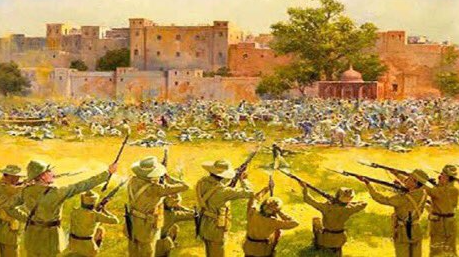
On the day of Vaisakhi, an important harvest festival, approximately 20,000 individuals converged in Jallianwala Bagh. They gathered not only to celebrate ,but also to voice their indignation against the oppressive Rowlatt Acts. The atmosphere was charged with a sense of solidarity and determination among the crowd, which included men, women, and children. However, within this gathering of hope and peaceful protest, a horrific plan was set in motion. Brigadier-General Reginald Edward Dyer, acting on stringent orders, orchestrated an abhorrent act of violence. At precisely 5:15 PM, he surrounded the peaceful assembly with a contingent of Gurkha soldiers of Nepalese origin and Sikh infantrymen from the British Indian Army. Without any forewarning, he commanded them to open fire into the throng of unarmed civilians.
The brutal onslaught unfolded as approximately 1,650 rounds of ammunition were unleashed upon the terrified crowd, creating a chilling atmosphere of chaos, fear, and despair. The relentless gunfire continued until the soldiers had exhausted their ammunition, leaving devastation in their wake. Dr. Smith, a Civil Surgeon from Amritsar, later reported a staggering death toll: around 1,800 lives lost in a mere span of 15 minutes. Among the victims were 41 boys and even a 6-week-old infant, while about 1,200 others sustained injuries, many of them grievous. The British government responded with mass prosecutions, charging 581 individuals; among them, 108 were sentenced to death, 265 received life sentences, and many more were subjected to various humiliations. The unthinkable cruelty of the Jallianwala Bagh massacre marked a defining moment of horror, kindling profound outrage across India and igniting a fervent spirit of resistance against British imperialism, which was now undeniably in decline.
Jallianwala Bagh Massacre: Shaheed-e-Azam Udham Singh
Jallianwala Bagh Massacre: The Legacy of Shaheed-e-Azam Udham Singh
Udham Singh ( Childhood name – Sher Singh born December 26, 1899 – martyred on July 31, 1940) was an eyewitness to the Jallianwala Bagh massacre. He vowed to take revenge for this national insult stands as a symbol of courage and resolve against the Jallianwala Bagh massacre. Singh was born to Sardar Tahal Singh Kamboj and Narayan Kaur. His childhood name was Sher Singh, and he had a brother named Sadhu Singh. Orphaned at a young age—losing his mother in 1901 and his father in 1907—Sher Singh and his brother Sadhu Singh were admitted to the Central Khalsa Orphanage in Putlighar, Amritsar. They were given new names in line with Sikh tradition, transforming Sher Singh into Udham Singh and Sadhu Singh into Mukta Singh. After excelling academically, Udham left the orphanage, ready to carve his path.
In his quest for revenge, Singh initially sought to assassinate Brigadier General Dyer, who had ordered the massacre, but died in 1927 before he could carry out his intention. Instead, he fulfilled his pledge by assassinating targeting Michael O’Dwyer, the former Lieutenant Governor of Punjab, during a speech at Caxton Hall in London on March 13, 1940. After committing the act, Singh willingly surrendered, firmly believing in the importance of his mission. He was ultimately executed on July 31, 1940. In 1952, the then Prime Minister of India, Jawaharlal Nehru, recognised Singh’s sacrifice, honouring him as “Shaheed-e-Azam Udham Singh.” Nehru expressed his admiration, stating, “I pay my respectful homage to Shaheed-e-Azam Udham Singh, who kissed the noose so that we may be free.”
In summary, the Jallianwala Bagh massacre on Vaisakhi Day was a cataclysmic turning point in the Indian struggle for independence. The life of Udham Singh, marked by resilience, sacrifice, and fierce nationalism, continues to inspire future generations. We honour the legacy of Shaheed-e-Azam Udham Singh and the immortal martyrs of Jallianwala Bagh, commemorating their bravery and sacrifice .