

THE ASIAN INDEPENDENT UK

Bal Ram Sampla
Geopolitics
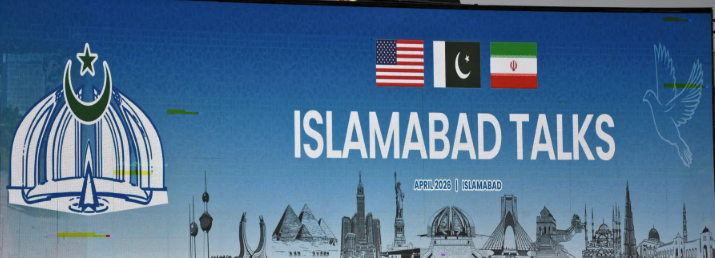
Twenty-one hours of talks. The peace talks between the United States and Iran, hosted by Pakistan in its capital, collapsed without an agreement. The reasons are many. But at the heart of it lies a simple truth: Pakistan was never truly in charge.
The Illusion of the Honest Broker
For a mediator to succeed, it must be able to do two things:
(1) it must be genuinely trusted by both sides.
(2) it must have the power to move both sides — to offer incentives, apply pressure, or at minimum hold a credible threat that walking away will cost them something.
Pakistan had the first quality in modest measure. It had the second almost not at all. Pakistan’s credentials as a go-between were real enough on paper. It shares a nine-hundred-kilometre border with Iran. It has deep cultural and religious ties to Tehran. It has close military and economic links with Washington. And it maintains what diplomats call an “iron brotherhood” with Beijing. These overlapping relationships made Islamabad the only city where both the American and Iranian delegations were willing to sit down. That is not nothing. Getting enemies into the same room is itself a feat. But getting them into the same room is not the same as getting them to agree.
A true mediator — think of the Norwegians in Oslo, or the Qataris in Doha — operates with a degree of autonomy. They carry proposals of their own. They test both sides, probe for flexibility, and construct creative compromises from the gaps they find.
Pakistan did none of this with any real independence. Instead, it relayed American demands to Iran and Chinese preferences back to Washington. It was not a bridge. It was just a postman. And postman do not negotiate.
Serving Two Masters
The deeper problem was that Pakistan was not even serving one master — it was serving two. On one side stood the United States, whose core demand was unambiguous: Iran must permanently and verifiably give up its pursuit of nuclear weapons. Trump said it plainly before Vance even boarded his plane. Vance repeated the same message when the talks collapsed.
On the other side stood China, whose interest was narrower and more commercially urgent: reopen the Strait of Hormuz. China imports roughly 12% of its total oil from Iran, and the Strait carries nearly a fifth of global petroleum supplies. Every day the waterway remained closed, Beijing felt the economic pain. So China used Pakistan as its diplomatic instrument, pushing for a framework that would restore shipping while leaving Iran’s sovereignty — and leverage — intact.
Pakistan’s foreign minister flew to Beijing, met Wang Yi, and together they produced a joint five-point peace plan whose central plank was the reopening of the Strait.
In simple terms, China’s agenda was delivered in Pakistan’s name. America’s demands were relayed through Pakistan’s mouth. Islamabad had no voice of its own.
America’s agenda was nuclear disarmament. China’s agenda was Hormuz.
Iran’s agenda included both — keep the Strait, keep the bomb. These positions were not close to compatible. And Pakistan, squeezed between Washington and Beijing, had no independent proposal of its own powerful enough to bridge the gap. It was sandwiched, unable to please either master and powerless to forge a third way.
Iran Held All the Cards
What made Pakistan’s position even weaker was that Iran arrived in Islamabad with genuine leverage. Tehran controls the Strait of Hormuz. As long as it does, the global economy flinches at its every move. Iranian officials knew this. They moved slowly, projected calm, and made demands rather than concessions. Their delegation of seventy officials arrived dressed in black, carrying photographs of children killed in American airstrikes — a carefully staged act of moral pressure. They demanded:
(1) a ceasefire in Lebanon,
(2) the release of frozen assets,
(3) the lifting of all sanctions,
(4) the right to enrich uranium.
These were not opening bids designed to be bargained down. They were statements of position.
Against this, Pakistan had nothing to offer Iran that Iran could not get elsewhere or already had. No security guarantees. No economic lifeline. No threat of consequences if Iran walked away.
Even when US warships passed through the Strait during the talks — a deliberately provocative move — Pakistan could do nothing but appeal to both sides to maintain the ceasefire. It was a bystander to the very provocation unfolding at its own negotiating table.
A Doomed Assignment
It would be unfair to call Pakistan a poor host in the conventional sense. The logistics were managed, the security was tight, the diplomatic courtesies were observed. Prime Minister Sharif worked hard. Army chief Asim Munir played a genuine role in bringing both sides to a ceasefire two weeks earlier. Pakistan’s achievement in getting the two parties to sit face-to-face — the first direct engagement since 1979 — should not be dismissed.
But hosting is not mediating. And mediating without leverage is not diplomacy — it is ceremony.
Pakistan was always going to struggle to bridge a gap this wide, between an America demanding nuclear surrender and an Iran willing to accept nothing less than full sovereignty and economic relief. What made it worse was that Pakistan was never free to be creative. It was bound by Washington’s red lines on one side and Beijing’s commercial priorities on the other.
The Islamabad talks did not fail because Pakistan was a bad host. They failed because the conflict was not yet ripe for resolution, because neither the United States nor Iran was ready to genuinely concede, and because the country asked to bridge them had no real power to do so. Pakistan was handed an impossible task: serve two masters, satisfy neither, and call it peace.
References
1.https://www.aljazeera.com/news/2026/3/31/will-china-join-pakistan-led-efforts-to-mediate-us-iran-peace
2.https://nationalinterest.org/blog/silk-road-rivalries/how-pakistan-became-the-mediator-between-the-us-and-iran
3.https://www.fmprc.gov.cn/eng/wjbzhd/202603/t20260331_11884511.html
4.https://www.dawn.com/news/1985906
5.https://www.bloomberg.com/news/articles/2026-03-31/china-pakistan-issue-joint-call-for-ceasefire-reopening-hormuz
6.https://en.wikipedia.org/wiki/2026_Strait_of_Hormuz_crisis