

THE ASIAN INDEPENDENT UK
Indian Workers Association Warns British Public to Remain Vigilant Against Divisive Politics and Growing Extremism
Britain’s political landscape has been dramatically shaken following the 2026 local elections in England and parliamentary elections in Scotland and Wales, with Reform UK emerging as the biggest winner and both Labour and the Conservatives suffering major setbacks.
The elections, widely seen as a major political test for Prime Minister Sir Keir Starmer’s Labour government, reflected growing public frustration over the rising cost of living, pressure on the NHS, housing shortages, low wages, and dissatisfaction with mainstream politics.
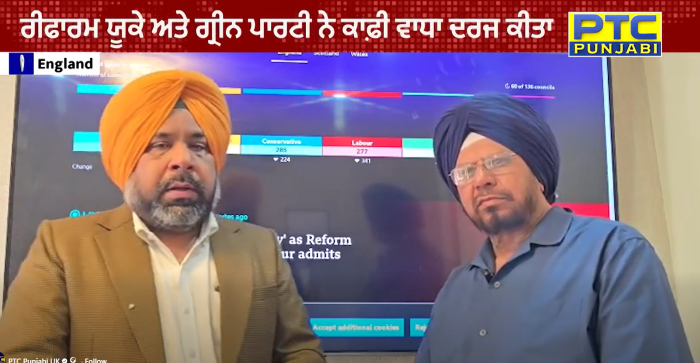
With results declared in 131 out of 136 English councils, Reform UK secured 1,448 councillor seats and took control of 14 councils — a historic breakthrough for Nigel Farage’s party, which held only two comparable council seats in 2022.
Labour suffered severe losses, losing 1,430 councillors and falling to 1,023 seats. The Conservatives also endured another damaging night, with the party losing 561 councillors and finishing on 788 seats, as many traditional Conservative voters shifted towards Reform UK.
Meanwhile, the Liberal Democrats and Green Party both strengthened their positions. The Liberal Democrats gained 154 councillors to reach 842 seats, while the Green Party achieved one of its strongest performances ever, gaining 393 councillors and rising to 539 seats.
In Scotland, the Scottish National Party (SNP) remained the largest party with 58 seats, although short of an overall majority. In Wales, Labour suffered a historic collapse after 27 years in power, falling to just nine seats, while Plaid Cymru emerged as the largest party and Reform UK secured 34 seats.
Political analysts say the results reveal growing public dissatisfaction with Britain’s traditional political system and increasing support for alternative political movements.
The Indian Workers Association (Great Britain) expressed concern over the growing influence of divisive right-wing politics and warned against attempts to blame immigrants and minority communities for Britain’s economic and social problems.
Sital Singh Gill, General Secretary of the Indian Workers Association (GB), said:
“These election results show that many ordinary people across Britain are deeply frustrated with the rising cost of living, pressure on public services, housing shortages, and growing economic insecurity. Both Labour and the Conservatives have failed to properly address many of the real concerns facing working people.”
He added:
“We are very concerned about the growing influence of divisive right-wing politics that attempt to blame immigrants and minority communities for Britain’s wider economic and social problems. Immigrants have made enormous contributions to this country economically, culturally, and socially for generations.”
Mr Gill said many of the same political forces now promoting anti-immigration rhetoric had also misled the public during the Brexit campaign.
“Brexit has caused serious long-term damage to the British economy. Ordinary working people are paying the price through rising living costs, inflation, weaker public services, and declining economic security,” he said.
“Economic studies now suggest that Brexit is costing the British economy between £65 billion and £90 billion every year, while many ordinary people are thousands of pounds worse off annually because of weaker economic growth and reduced investment.”
He warned that increasingly hostile immigration policies could damage Britain’s future economically and socially.
“If Britain becomes seen as unwelcoming towards migrants, workers, and international students, the country risks harming its own economy and weakening the values of fairness, diversity, and democracy that have always been Britain’s strength.”
Mr Gill also called for unity and social cohesion instead of division.
“We reject politics based on hatred, racism, fear, and division. We want to replace it with something hopeful, fair, and built together for the betterment of the whole society. Working people of every background face many common struggles, and these problems can only be solved through unity, social justice, and investment in communities.”
Political observers believe the 2026 elections may represent a turning point in modern British politics and an early indication of the major political battles likely to shape the next UK General Election expected in 2029.