THE ASIAN INDEPENDENT UK

Bal Ram Sampla
Geopolitics
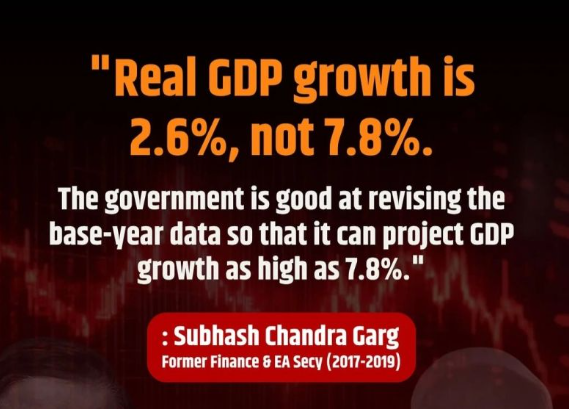
The controversy over India’s 7.8% GDP figure boils down to a elementary math blunder by former Finance Secretary Subhash Chandra Garg, which was immediately weaponized by opposition leaders.
Math Mistake
Garg claimed on national television that India’s real growth was actually 2.6%, not 7.8%. He arrived at this figure through a basic national accounting error. He mixed two entirely different statistical series.
(1) What Garg Did
He took the current quarter’s GDP from the new 2022–23 base series (₹88.3 lakh crore) and divided it by the previous year’s figure from the old 2011–12 base series (₹86.1 lakh crore).
88.3 –86.1
‐—–‐———– X 100 = 2.55 = 2.6%
86.1
(2) Why It Is Wrong
In economics, you cannot mix a numerator from a new series with a denominator from an old series. When statistical agencies update base years, all historical figures are recalculated. Using the correct, like-for-like comparison within the new series (₹80.0 lakh crore to ₹88.3 lakh crore) gives a 10.3% nominal growth rate, which equals 7.8% real growth after adjusting for inflation.
Garg essentially compared apples to oranges on live TV without double-checking the underlying math.
Political Opportunism and Unchecked Claims
Instead of verifying the math or consulting professional economists, Rahul Gandhi and senior opposition leaders blindly jumped on Garg’s flawed 2.6% claim.
(1) Reckless Statements
Opposition figures cited Garg’s claim to label the economy “dead” and accuse the government of “statistical gymnastics”.
(2) Failure of Due Diligence, Congress Scores an Own Goal
Neither Rahul Gandhi nor his economic advisors bothered to check if Garg’s calculation followed standard national accounting rules. By amplifying a mathematically invalid number purely to score quick political points, they demonstrated a complete lack of basic economic scrutiny.
The Real-World Impact
(1) Undermining Institutional Trust. Pushing a false “2.6% growth” narrative deliberately erodes public trust in India’s official statistical institutions.
(2) Creating Investor Uncertainty. Falsely claiming that national growth data is “fudged” creates unnecessary panic among foreign investors, markets, and local businesses.
(3) Ignoring International Validation. Multilateral institutions like the World Bank and the IMF use the government’s updated base-year series, explicitly rejecting Garg’s calculation and validating India’s position as the world’s fastest-growing major economy.
By blindly trusting a flawed TV interview over global statistical standards, the opposition chose political sensationalism over basic mathematical reality.
References
1.https://www.businesstoday.in/latest/economy/story/the-gdp-conundrum-economists-split-over-indias-faster-than-expected-7-8-percent-gdp-growth-rate-552811-2026-09-02?hl=en-
2.https://www.indiablooms.com/finance/who-is-subhash-chandra-garg-ex-finance-secretary-challenging-modi-govts-78-gdp-growth-claim/details?hl=en-
3.https://www.aninews.in/news/national/politics/apology-to-nation-is-in-order-bjps-pradeep-bhandari-hits-back-at-rahul-gandhis-dead-economy-jibe-after-indias-78-gdp-growth20260901083821/?hl=en-
4.https://m.economictimes.com/news/politics-and-nation/pr-can-polish-picture-of-gdp-but-not-economy-itself-congress-slams-modi-government/articleshow/133701101.cms?hl=en-
5.https://www.indiatoday.in/business/story/india-gdp-revisions-surjit-bhalla-no-evidence-political-manipulation-2986573-2026-09-03?hl=en-
6.https://www.fortuneindia.com/economy/explained-former-finance-secretary-subhash-garg-questions-indias-78-gdp-growth-why-economists-disagree/157264?hl=en-.