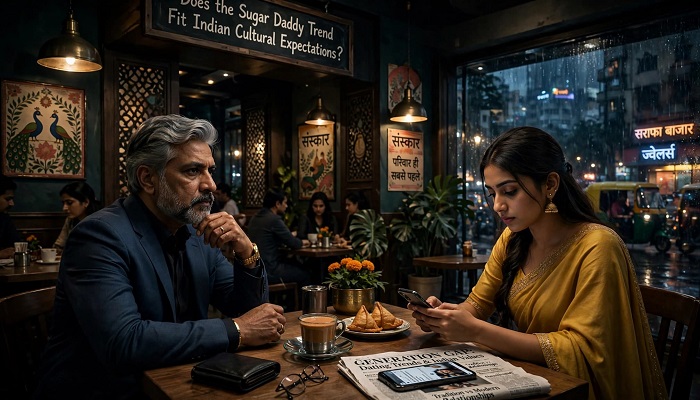
Indian public life includes couples with large age differences. Dilip Kumar was 44 when he married 22-year-old Saira Banu. Rajesh Khanna was 32 when he married 16-year-old Dimple Kapadia. Shahid Kapoor was 35 when he married 21-year-old Mira Rajput.
Surjit Singh Flora
 (Asian independent) Indian marriage is closely tied to family approval, religion, class, long-term commitment, and public reputation. The sugar daddy trend sits outside that familiar structure. That explains the curiosity, criticism, and silence around it. A sugar daddy is generally a financially secure adult who offers money, gifts, travel, lifestyle support, or mentorship to another adult. The recipient is often called a sugar baby. The wider arrangement is known as sugar dating or sugaring. The discussion involves consenting adults only. The subject needs neither mockery nor glamour. It needs an honest look at money, privacy, power, secrecy, and the distance between online fantasy and real-life risk.
What sugar dating actually involves
A sugar daddy arrangement usually combines companionship or dating with financial support. Intimacy may be part of the relationship, but it isn’t always. Every arrangement has different terms.
The sugar baby is often younger, but the familiar image of an elderly millionaire and a young woman is too narrow. A sugar daddy may be middle-aged, married, divorced, self-employed, or employed in business, medicine, law, or corporate management. The other partner may be a student, a working professional, or someone with an established career.
Money doesn’t prove consent. It also doesn’t automatically prove exploitation. Consent must be freely given, ongoing, and open to withdrawal. That remains true when rent, travel, gifts, or monthly payments are involved.
Sugar dating isn’t the same as an ordinary relationship, an age-gap marriage, paid employment, or sex work. Real relationships don’t always fit neat categories, though. Emotional attachment, intimacy, employment and financial dependency can overlap. A label can describe an arrangement, but it cannot settle its ethics or legality.
The phrase itself didn’t begin with social media. Popular culture gave it a polished image long before smartphones made private contact easier.
The phrase itself didn’t begin with social media. Popular culture gave it a polished image long before smartphones made private contact easier.
How film and television shaped the image
The 1953 film How to Marry a Millionaire helped carry the phrase into popular entertainment. Its dialogue connected a “sugar daddy” with help paying monthly bills, luxury, and financial security.
Films, celebrity culture, music, documentaries, and television later turned the term into shorthand for wealth and unequal power. The image was often glamorous: expensive hotels, designer clothing, older men, younger women, and an agreement nobody states aloud.
The 2020 Canadian drama Sugar Daddy presents a darker version. It follows a cash-strapped musician who joins a paid-dating website and discovers that financial support can come with emotional pressure. Screen stories aren’t proof of typical Indian relationships. They do shape the assumptions people bring to these arrangements.
Dating websites and social platforms have widened the vocabulary. A profile claiming to belong to a sugar daddy may actually belong to a young executive, a married man, a middle-class professional, or someone exaggerating nearly everything.
Age, income, marital status, and intentions are easy to falsify online. A photograph beside a luxury car proves nothing. Neither does a claim about overseas business, private wealth, or “no strings attached.”
The vocabulary also includes sugar mommies and sugar boys. The slang term “cougar” usually describes an older woman dating younger men. Outside dating slang, a cougar is a big cat. The label isn’t the main issue. The real questions are whether both adults understand the terms and whether both can leave safely.
Why the trend stays private in India
The sugar daddy trend in Indian culture is likely to remain private because relationships in India are rarely treated as purely private matters. Families may judge dating through marriage prospects, caste, class, religion, fidelity, and social standing.
For many households, a relationship built around financial support would seem inappropriate. “Daddy” usually means Appa, Papa, or Dad, depending on language and family background. It doesn’t describe a dating arrangement.
Not every Indian is against sugaring and not everyone is for it. You cannot judge the prevalence of the practice based on online presence and personal stories. Measurement is difficult in the presence of secrecy.
In big cities you get away from the family network and the familiar neighbourhood. Dating apps, Instagram, WhatsApp, encrypted messaging, nightlife, professional circles, digital payments can all help you make contact in private.
Some adults may be drawn to relationships with stated expectations due to education costs, debt, rent, lifestyle goals, loneliness, limited time, and career pressure. There is no one motive that explains it all. Sugar babies are not necessarily desperate. Sugar daddy isn’t necessarily lonely, sex-driven or wealthy.
Online access creates its own dangers. Fake profiles, romance scams, blackmail, and pressure to share intimate images may begin before two people meet.
Age gaps don’t prove a sugar arrangement
Indian public life includes couples with large age differences. Dilip Kumar was 44 when he married 22-year-old Saira Banu. Rajesh Khanna was 32 when he married 16-year-old Dimple Kapadia. Shahid Kapoor was 35 when he married 21-year-old Mira Rajput. Arjun Rampal, 48, has been publicly linked with 32-year-old Gabriella Demetriades.
Those examples don’t prove a sugar arrangement. They don’t establish a wider social trend either. An age gap, wealth difference, expensive wedding, or public attention cannot prove that money changed hands.
The Rajesh Khanna and Dimple Kapadia marriage also belongs to a different legal and social period. It must never be used to excuse relationships involving minors today. Sugar dating, as discussed here, involves adults only.
An age-gap marriage and a sugar relationship are separate subjects. Treating them as identical creates confusion instead of understanding.
Money can clarify expectations, but it can’t buy consent
Some adults are drawn to sugaring because of practical support. Others want companionship. The attraction may be direct, but the imbalance may be direct too.
A younger adult may seek help with tuition, housing, travel, career advice, gifts, or mentorship. Clear expectations may appear easier than traditional dating, especially if you have little free time.
A younger adult may seek help with tuition, housing, travel, career advice, gifts, or mentorship. Clear expectations may appear easier than traditional dating, especially if you have little free time.
An older or wealthier adult may want attention, romance, companionship, or intimacy without the expectations attached to marriage. Some may enjoy feeling needed. Others may prefer a relationship with boundaries they believe are clearly defined.
The trouble starts when one person hears “support” and the other hears “access.” A payment, gift, dinner, vacation, or rent transfer doesn’t buy consent.
Money can make an arrangement appear voluntary while making refusal harder in practice. A person who depends on monthly payments may feel unable to reject a date, trip, sexual request, or demand for more time.
Both adults remain responsible for honest communication. Neither person should hide a marriage, debt, financial limits, health information, or expectations about sex and exclusivity.
Written rules and verbal promises can reduce confusion. They can’t remove emotional risk. Either adult can change their mind, stop contact, or end the relationship. Respect for that decision is the minimum standard.
The safety risks are real
The sugar daddy trend in Indian culture is often discussed as a moral question. It is also a safety question. Online arrangements can expose people to fraud, coercion, and serious privacy loss.
Common scams include advance-fee demands, fake investment offers, stolen identity documents, account takeovers, and requests for payment before an allowance is sent. Some offenders use intimate images to blackmail people. Others secretly tape meetings, stalk their targets or lie about their marital and financial status.
In more serious cases, they may involve trafficking, sexual exploitation, intimidation or coercion. Abuse doesn’t make a relationship good. Indian laws may apply differently depending on the conduct including fraud, privacy breaches, online offences, trafficking, sexual exploitation and child protection violations.
All participants must be of legal age. Payment of any kind cannot legalize sexual coercion, exploitation, trafficking or abuse.
Someone facing immediate danger should contact the police. People dealing with cyber fraud or image-based blackmail should preserve messages, payment records, usernames, screenshots, and account details. India’s National Cyber Crime Reporting Portal and the 1930 cyber-fraud helpline may also help, along with local legal aid and trusted personal support.
A serious discussion needs less stigma
There is no single Indian culture with one view of dating. Regional, religious, class, gender, and generational differences matter. Even so, sugaring often clashes with familiar expectations around family approval, marriage, modesty, fidelity, financial responsibility, and reputation.
For many people, that clash is decisive. A private relationship centred on financial exchange may seem incompatible with the belief that marriage should unite families and provide lasting social recognition.
Others believe it is an adult decision based on the higher cost of living, independence in the city, and evolving norms around dating. This does not dismiss concerns about power or secrecy. It illustrates why a simple cultural judgment can miss the forces driving private choices.
Terms such as “gold digger,” “prostitute,” “predator,” “cougar,” and “victim” can reduce complicated situations to name-calling. They can also conceal abuse when a person cannot bring themselves to admit what occurred.
Many participants would never publicly call themselves sugar daddies, sugar babies, or sugar mommies. Family pressure, shame, and fear of exposure give people strong reasons to remain silent.
A better discussion asks harder questions. Was consent free and ongoing? Is person financially dependent? Are private images protected? Can either adult leave without fear, threats, or financial punishment?
Looks and social media updates can’t answer these questions. Sugar relationship isn’t about an age gap or expensive gifts. The standard is clearer: truthful expectations, privacy respected, personal safety and free consent at all stages.