Balram Sampla
Geopolitics

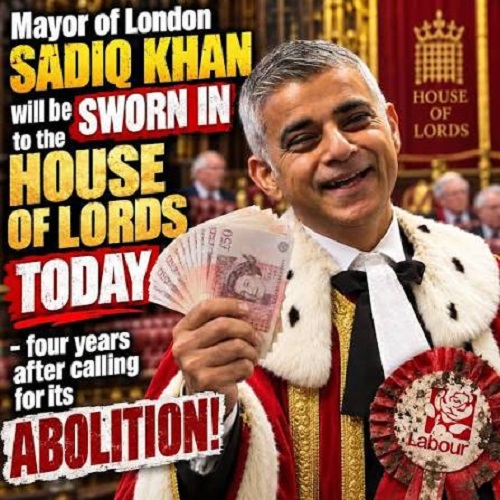
(Asian independent) Sadiq Khan will leave office as one of the most divisive mayors London has ever had, not because he governed boldly, but because of the gap between what he said and what he did. Two moments will define that gap more than any policy: his robed arrival in the House of Lords, and his years-long refusal to say plainly that grooming gangs operated in his city.
Start with the Lords. In 2022, sparring with Conservative Assembly Member Shaun Bailey, Khan didn’t just criticise the upper chamber. He called Bailey’s own appointment to it “proof, if it was ever needed, that we should abolish the House of Lords.” Four years later, he put on the robes himself and swore allegiance to the King in the very chamber he’d said shouldn’t exist.
Reform’s mayoral candidate Laila Cunningham asked the obvious question: what changed, his principles or his title? Khan has offered no real answer beyond a line about continuing to “bang the drum for London” as if a peerage were simply a louder microphone rather than the institution he once dismissed as illegitimate.
It is hard to read this as anything other than naked self-interest: abolish the Lords when you’re outside it, join it happily when you’re offered a seat.
But the Lords row is a matter of hypocrisy. What happened with grooming gangs is a matter of harm.
For years, Khan insisted London was different that the Rotherham, Rochdale and Telford pattern of organised abuse simply didn’t exist in the capital. Pressed eight separate times in January by Susan Hall on whether grooming gangs operated in London, he refused to answer directly, instead demanding she clarify her own question .
A level of evasiveness that reads less like confusion and more like a man who did not want the answer on record. His formal line to the Police and Crime Committee was that police briefings had found “no reported cases and also no indication” of that abuse model in London.
We now know how that claim has aged. The Metropolitan Police has identified more than 4,000 previously closed cases meeting the threshold to be reopened under Operation Beaconport, out of roughly 12,000 reports reviewed nationally. Those aren’t abstractions, they’re girls who reported abuse, whose cases were closed, and whose city’s mayor spent years telling the public there was nothing systemic to see. When his own Assembly colleagues tried to fund an independent inquiry into child exploitation in London, Labour, the Greens and the Lib Dems voted it down, 16 to 9.
A petition with over 40,000 signatures calling for his resignation over the handling of this issue followed.
Whether Khan actively shielded anyone, as some of his fiercest critics allege, is a claim the police review itself hasn’t settled. That’s a serious charge and it deserves to be tested on evidence, not asserted as fact. But minimisation has its own cost. Every “no indication,” every dodged question, every vote against scrutiny sent a message to a vulnerable population of girls that their mayor’s political comfort mattered more than their safety. That is the legacy: a politician who found principle inconvenient when a peerage was on offer, and clarity inconvenient when children needed him to have it.
Reference
1.https://www.spiked-online.com/2025/10/27/sadiq-khans-outrageous-denial-of-londons-grooming-gangs/
2.https://www.gbnews.com/politics/sadiq-khan-refusal-london-grooming-gangs-inquiry
3.https://www.zerohedge.com/political/sadiq-khan-said-there-were-no-grooming-gangs-london-police-investigating-4000-cases
4.https://youtu.be/7iezqb51chw?is=emje1e4D60FkiSBk