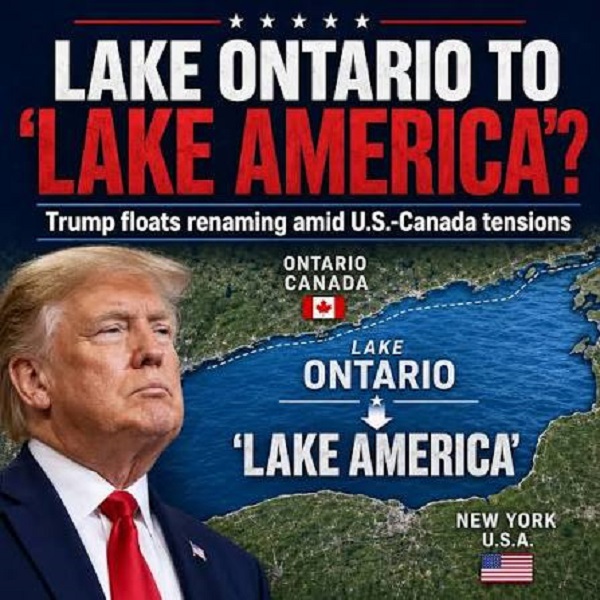
(Asian independent) Changing Lake Ontario’s name to “Lake America” accomplished one clear thing: it changed the terminology used by parts of the U.S. federal government. It didn’t change the lake itself, its borders, its history, or the name recognized by Canada and much of the world. A presidential directive can instruct executive agencies to use a particular label in federal maps, websites, records, and communications. If the Department of the Interior updates the Geographic Names Information System, federal documents may begin using “Lake America.” The order still can’t require Canada to alter its records, and it doesn’t bind international organizations, private mapmakers, universities, shipping companies, local governments, or news outlets.
That limitation matters because Lake Ontario is shared by the United States and Canada. The international boundary runs through the lake, while both countries manage navigation, water quality, fisheries, and shoreline development. Canada controls its own geographic records and charts. No domestic order from Washington can impose a new name on Canadian institutions.
The directive also can’t erase the established name from scientific research, schoolbooks, weather reports, treaties, historical records, or everyday speech. Mariners and researchers depend on common geographic references, especially in a region where transportation and environmental management cross an international border. If U.S. federal maps use “Lake America” while Canadian charts and commercial services continue to use “Lake Ontario,” the result is inconsistency, not clarity.
The change doesn’t affect navigation routes, water levels, fisheries, tourism, or research. A ship’s crew needs accurate charts, coordinates, weather information, and port regulations. A new federal label provides none of those things. Its practical effect is limited to paperwork, government language, and publicity.
The political symbolism is easier to identify. “Lake America” is short, memorable, and suited to headlines and television graphics. Supporters could view the name as an assertion of U.S. identity. Critics saw it as political theater or a provocation aimed at Canada, particularly the province of Ontario. The directive itself may not establish that motive, but the choice invited that interpretation because the lake is shared by both countries.
The argument also rests on a mistaken understanding of the name “Ontario.” The lake didn’t take its name from the Canadian province. The province took its name from the lake.
European mapmakers recorded related Indigenous names in the 17th century, long before the United States and Canada became independent countries or established their modern border. Historical explanations connect “Ontario” to Huron-Wendat and other Iroquoian-language terms. Translations vary, including “great lake,” “sparkling water,” “shining water,” and “beautiful water.”
Those differences show how difficult it is to translate older Indigenous names into a single English phrase. They also make one point clear: “Ontario” didn’t begin as a modern Canadian political label. Indigenous peoples had named and described the region before European settlement divided it into national territories.
Ontario became a Canadian province in 1867. The lake’s name was much older. Treating the name as a recent insult directed at the United States or as a Canadian claim over the water reverses that history.
Geographic names aren’t deeds. Shoreline length, surface area, depth, or volume doesn’t determine what a lake should be called. Lake Michigan lies entirely within the United States, yet its name comes from an Ojibwe word. A country’s control over a body of water also doesn’t give it unlimited authority over historical or international usage.
Established names endure because institutions and communities repeat them over generations. Lake Ontario appears in Canadian and U.S. records, archival documents, nautical charts, scientific papers, local businesses, and cross-border agreements. A federal agency may adopt “Lake America,” but repetition within one branch of one government won’t make it universal.
The renaming’s clearest accomplishment was publicity. It turned a symbolic dispute into international news while producing little measurable change on the lake. Washington can change what its agencies write. It can’t turn a shared body of water into presidential property or settle international terminology by decree.