By: Surjit Singh Flora

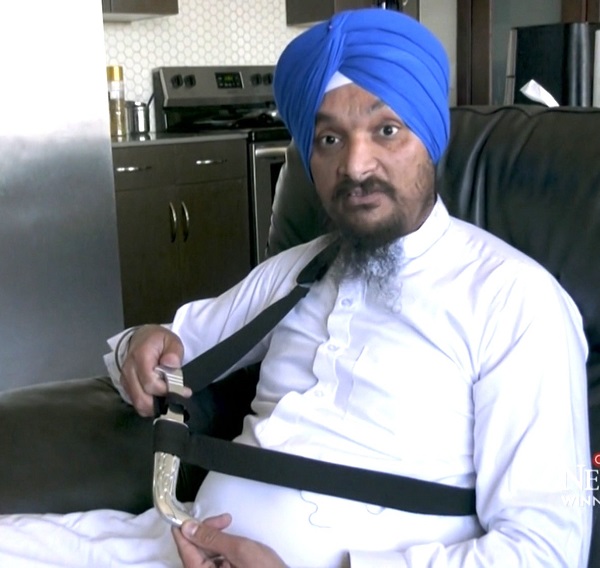
(Asian independent) Jaspal Singh Gill’s attempt to write a Winnipeg Police recruitment exam ended before the test began. In 2024, after gaining permanent residency, the Gill arrived ready to compete for a public job, then was told to remove his kirpan. He refused, saying the kirpan is a required article of faith, not a personal choice. The case matters beyond one applicant because it puts religious freedom, safety rules, and equal access under the same lens.
Gill went to Winnipeg Police headquarters expecting to sit for the recruitment exam. Instead, an officer raised a question about his kirpan and said he would need to remove it before entering the exam room. Gill tried to explain why he could not take it off. The police position was that secure storage was offered for the kirpan. Gill said the result was the same, he was kept from the exam and denied equal access.
That dispute turned a routine hiring step into a rights issue. For Gill, the exam was not a small appointment. It was the gateway to a career in policing.
The kirpan is one of the Five Ks worn by initiated, or (baptized) Amritdhari, Sikhs. It is a sacred article, tied to duty, courage, and defense of the weak. Sikh teaching treats it as a sign of discipline and moral responsibility.
For that reason, asking an Amritdhari Sikh (baptized Sikh ) to remove the kirpan is not a minor request. It asks the person to set aside a visible part of faith to enter a public building or take a test. That is why these disputes often feel bigger than the immediate setting.
Canada’s Supreme Court addressed this issue in 2006 in the Multani case. The court found that a total ban on the kirpan violated religious freedom protections under the Charter of Rights and Freedoms. It also backed reasonable accommodation instead of blanket exclusion.
The legal point is simple, a kirpan is treated as a religious symbol, not a weapon in the ordinary sense.
That ruling matters here because it set the standard for how public institutions should respond. Safety concerns can be real, but they do not cancel religious rights by default.
Gill’s case raises a wider question about who gets through the door of public service. Other police agencies in Canada have allowed Sikh officers to serve while wearing the kirpan, so a strict bar at the recruitment stage looks harder to justify.
The effect can reach well past one applicant. If young Amritdhari Sikhs see a test room become a barrier, they may decide not to apply at all.
Reasonable accommodation is meant to balance safety with rights. It does not ask a public body to erase religion. It asks for a practical solution when one exists.
Rigid rules can become discriminatory when safer options are already available. In this case, the question is whether policy protected the exam room, or simply shut out a faith practice.
Gill has said he plans to file a human rights complaint. That route will test how closely practice follows the law already set by the Supreme Court.
For Sikh youth, the message matters. If a police service says welcome, but still blocks a kirpan at the door, trust gets thin fast.
Gill’s dispute is not only about one exam or one article of faith. It is about whether a kirpan, a police test, and a public workplace can fit within the same country’s promise of inclusion. Canada has already said religious freedom cannot be dismissed by blanket rules. The harder question is whether institutions follow that promise when the person in front of them is an Amritdhari (baptized) Sikh.