By: Surjit Singh Flora

(Asian independent) Gunfire inside Washington, DC’s Hilton hotel, during a heavily secured event attended by President Donald Trump, senior officials, and White House reporters, sent alarm far beyond a routine crime report. One security officer lived because a bullet hit a protective vest. Yet the greater shock came from the setting itself. Shots rang out in a place Americans are told is among the safest in public life.
The hotel carried its own burden of history. It is still tied to the 1981 attack that wounded President Ronald Reagan. That memory gave this shooting extra force. Because the scene was once again linked to a sitting president, the incident raised two connected concerns. It put fresh pressure on Trump’s security apparatus, and it pushed the country back toward an old, unresolved fact: political violence and mass shootings in the United States no longer feel unusual.
The Washington Hilton shooting revealed a serious weakness in a system built to stop this exact threat.
A presidential event at the Washington Hilton is not a normal public gathering. Access is limited. Guests pass through screening. Credentials are checked more than once. Around the venue, local police, federal agents, and the Secret Service build overlapping layers of protection.
That is why the breach drew such sharp attention. Gunfire at a mall, a concert, or a street rally points to one kind of breakdown. Gunfire at a presidential event points to another. It means an attacker found a way through a system designed on the assumption that even a small opening can turn fatal.
The Hilton dinner also pulls risk into one room. Reporters, cabinet members, lawmakers, donors, celebrities, and presidential aides often gather there at the same time. Security planning reflects that concentration. Routes are controlled, rooms are swept, and entry points are narrowed. In other words, it is one of the hardest public targets in Washington.
At a presidential event, security is judged first by prevention, because once shots are fired, the system has already failed. That standard matters to everyone present, including staff, families, and bystanders who trust that basic protections are in place. Claims that the attack was staged or arranged in advance should not be treated as fact without clear proof, because such accusations can mislead the public and cause more harm. A fair reading stays with what can be verified: how the security plan functioned, where it broke down, and what must change before the next event.
The central unanswered issue is not only who the attacker was, but how the perimeter gave way.
Authorities moved fast, identified a suspect, and made an arrest. Still, the motive was not immediately clear, and that matters less than another fact. Someone got close enough to open fire inside a protected zone.
Trump praised his protective detail after the shooting. That response makes sense. Agents on site reacted under pressure, and one officer survived because body armor did what it was supposed to do. Yet praise does not solve the main problem. If a gunman can reach firing range at a presidential event, the security design failed before the first shot.
Investigators are likely to review every layer, screening, credentials, travel routes, sightlines, and movement between the outer and inner perimeters. If the suspect acted out of political grievance, that would fit a broader national pattern. If the motive proves unrelated to politics, the breach remains severe. Either way, the focus cannot rest only on the person who pulled the trigger. It also has to stay on the system that allowed the opportunity.
The attack at the Hilton did not emerge on its own. Over the last two years, Trump has faced repeated threats and attempted attacks. In one earlier episode, a bullet passed close enough to injure his ear. Incidents that once would have stunned the country now fall into a grim sequence.
That repetition matters because it changes how the public understands danger. One attack can be dismissed as the act of a lone unstable person. A string of attacks points to something larger. It suggests a country where anger moves fast, political hatred hardens, and the line between speech and violence keeps thinning.
Presidents have always lived with risk. Still, repeated attempts against a sitting president are not normal democratic life. They point to a public culture with less restraint, less patience, and more willingness to treat rivals as enemies.
The Hilton shooting also fits a wider American condition. Gunfire has become part of daily expectation. Schools, grocery stores, houses of worship, nightclubs, and campaign events all sit in the same bleak ledger.
As a result, public reaction has changed. Each new attack still brings outrage, but the outrage burns quickly and fades just as quickly. Headlines move on. Another shooting follows. What once seemed unthinkable now risks being absorbed into routine coverage.
That numbness may be one of the most dangerous shifts of all. When violence becomes familiar, institutions face less steady pressure to change. People lower their expectations. A country begins to treat repeated bloodshed as background noise.
The deeper problem lies in America’s gun culture and the politics that shield it.
Easy access to firearms keeps turning private rage and political bitterness into public danger.
The Hilton attack is a security story, but it is also a gun story. Security can reduce risk. It cannot erase risk when guns remain easy to get and easy to carry into moments of anger, obsession, or grievance.
Broad access to firearms shortens the distance between impulse and injury. A political fixation, a private resentment, or a burst of rage becomes more dangerous when a weapon is close at hand. The result reaches beyond mass shootings. It includes assassination attempts, threats at campaign stops, and armed confrontations that might otherwise end in shouting instead of bloodshed.
America’s gun culture rests on law, custom, and identity. For many people, firearms are bound up with freedom and self-defense. Yet public life pays the price when that view leaves little room for limits. A society can respect rights and still ask how many deaths it is willing to accept in return.
Trump’s support for gun rights makes this debate more charged.
His place in the argument is full of tension. He has been targeted more than once by gun violence, yet he remains a strong defender of broad gun rights. That fact gives the Hilton shooting an added edge, because the victim and the politics around the weapon are tied together.
Under Joe Biden, the federal government supported tighter gun rules and stronger oversight. After returning to office, Trump moved to weaken or challenge parts of that approach. His allies have also cast many gun restrictions as attacks on constitutional liberty.
That conflict does not make the policy debate simple. Secret Service protection can shield one man with armored vehicles, advance teams, and hardened perimeters. It cannot offer the same protection to a school principal, a grocery clerk, or a child on a playground. So the argument after the Hilton shooting cannot stop with event security. It has to include the broader cost of living in a country where guns are common, anger is political, and restraint is thin.
The shooting at the Washington Hilton exposed more than a single breach. It revealed a failure in a presidential security system built to stop this kind of attack. It also showed how easily American public life slides back toward gunfire, even inside spaces designed to resist it.
That is why the episode felt larger than one criminal act. Political violence and easy access to guns now reinforce each other in plain view. When a heavily guarded presidential event cannot keep bullets out, the problem no longer looks exceptional. It looks like part of the country’s normal condition.
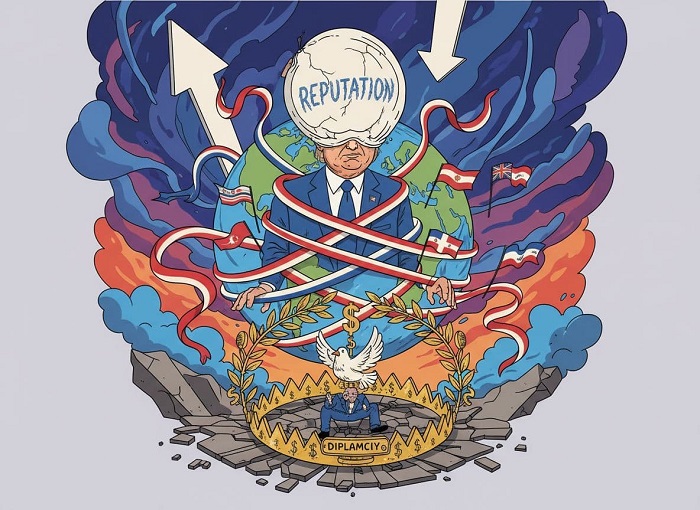
The attack also drew sharp public skepticism, in part because Trump has often used spectacle to redirect attention when pressure closes in around him. For that reason, appeals for sympathy do not land cleanly with many people, especially when his political standing and public image appear weaker than before. Still, suspicion is not evidence. Any claim that the shooting was planned in advance requires proof, not inference. The more immediate issue is how quickly events like this can redirect public attention and reshape the story before the facts are fully established.