

Dinkar Kapoor, State General Secretary, All India Peoples Front, Uttar Pradesh.
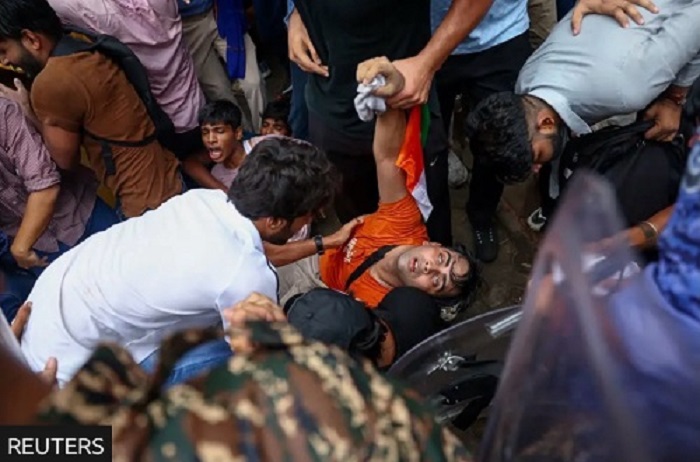
(Asian independent) The student protest at Jantar Mantar is currently at the centre of public debate. The organizers managed to make the Modi government—which claims it will never bow down—yield; they raised the slogan, “The world bows down; one just needs someone capable of making it bow.” While present at Jantar Mantar during the protest, I personally witnessed a display of social solidarity that reaffirms Indian cultural traditions. The spirit of service demonstrated by these young people was remarkable, especially given the common perception that ‘Gen Z’ is engrossed in the world of mobile phones, the internet, laptops, computers, WhatsApp, Facebook, and Instagram, and shies away from physical labour in family life. The steadfastness, non-violence, spirit of sacrifice, kindness, and compassion displayed during this movement evoked memories of the freedom struggle. People from every corner of the country contributed donations and arranged for large-scale food supplies through companies like Zomato and Swiggy. However, this generation is facing severe attacks due to the abusive language used by some Gen Z protesters against the Modi government and Prime Minister Modi himself. The government’s ‘troll army’ across the country has created an uproar. From the BJP’s national president to various Members of Parliament, accusations are being hurled at them; some label them as ‘anti-nationals,’ while others call them a ‘burden on society.’ The level of insensitivity is such that there is even talk of shooting these very children.
In reality, the abusive language used during this movement—which began with the students and youth expressing themselves through satire—was an outburst of accumulated anger. This anger naturally stemmed from the misdeeds of a government that has been wreaking havoc on the country for the past 12 years. Even now, the government, Modi himself, and the RSS remain unwilling to learn from this situation. Promises to quash the FIRs registered against the students, halt their harassment, and punish the officials responsible for the brutal crackdown on July 20 have not been fulfilled. It is outrageous that the Home Minister—responsible for the use of banned pellet guns, the use of excessive force against children by plainclothes policemen in violation of the police manual, and the use of nail-studded batons and electric shock batons—is not even willing to apologize, let alone resign.
Conversely, the BJP government in West Bengal has invoked the NSA against students. In Bihar, matters reached an extreme when photographs of thousands of incarcerated students were actually published in newspapers. Shots were fired from an AK-47 in Siwan, and thousands of students remain behind bars; although the Bihar government has ordered the withdrawal of cases and the release of students under pressure from the agitation, these orders are not being implemented. Repression continues in Maharashtra and Assam as well. Just yesterday, an attempt was made to arrest SFI National Joint Secretary Aishe by entering the CPIM national office. It is appalling that Education Minister Dharmendra Pradhan—whose resignation was forced by students—was honoured by the ruling party members in Parliament as if he had entered the House after achieving a feat of national distinction. Furthermore, Prahlad Joshi—an ‘invaluable star’ of the RSS and the newly appointed Education Minister—is a patron of rapists and those who demean women.
The Public Examinations (Prevention of Unfair Means) Amendment Bill 2026, introduced by the government in Parliament, offers nothing new other than increased penalties. Yet, it is glaringly obvious that merely enacting a stringent law will not stop paper leaks. You can understand the causes of paper leaks and the government’s intent through a single example: the government established the National Testing Agency (NTA)—a non-constitutional body registered under the Societies Act—to conduct various examinations, including NEET. If one examines its track record, Subodh Kumar Singh—who was the NTA Director General during the 2024 NEET paper leak—was ‘rewarded’ by the BJP government with the position of Principal Secretary to the Chief Minister of Chhattisgarh. It is shocking that NTA Chairman Pradeep Kumar Joshi—under whose tenure the NEET papers leaked in 2024 and 2026—has not been removed from his post to this day. This is the same gentleman who was the Chairman of the Public Service Commission when the infamous Vyapam scam took place. To this day, those responsible for the paper leaks have not been punished; on the contrary, they have been released on bail. In such a scenario, the Prime Minister’s talk of fast-track courts is insufficient. Therefore, the students’ demand to abolish an unaccountable, non-constitutional body like the NTA is justified, yet the government is unwilling to consider it.
It must also be noted that the anger brewing against the Modi government stems partly from the systematic erosion of democratic and constitutional rights. The government has suppressed every voice of dissent through repression. Some of the nation’s finest minds—such as Anand Teltumbde, Gautam Navlakha, Umar Khalid, Prabir Purkayastha, Sudha Bharadwaj, and Satyam Verma—have been imprisoned. Organizing sit-ins, protests, fasts, movements, or marches has become not merely difficult but virtually impossible in the country. Individuals committed to social causes—who strengthen democracy—were branded as “Andolanjeevi” (professional protesters), “anti-nationals,” and even “cockroaches.” Institutions that bolster the democratic system and channel public outrage toward democratic resolutions have been dismantled.
Most significantly, the Modi government has effectively handed over the country to major domestic and foreign corporate houses. The nation’s natural resources and public assets have been transferred to these corporate entities. The manner in which the government has capitulated to the United States, thereby undermining the country’s economic sovereignty, has deeply shaken the patriotic Indian consciousness. Today, the situation is such that the number of billionaires is constantly rising; capital is becoming concentrated in the hands of a few corporate houses, while a vast section of the population is being pushed to the margins. Constitutional rights—such as access to education, healthcare, employment, and housing—have been snatched away from the people. The promise to create twenty million jobs has, in the words of the Home Minister himself, turned out to be a mere *jumla* (empty rhetoric). Government posts are being eliminated, and the few recruitment drives that do take place are plagued by paper leaks and corruption.
According to government data, hundreds of thousands of primary schools have been shut down, and the quality of public education has steadily declined. Due to direct interference by the RSS, appointments in higher educational institutions—ranging from teachers to vice-chancellors—are being filled by individuals with an RSS background. Everything, from the curriculum onwards, is being altered through a communal lens. During the Jantar Mantar protest, a journalist friend of mine mentioned that admissions for various professional courses in Delhi are currently down. This is because, despite spending lakhs of rupees on these courses, students are not securing jobs commensurate with their qualifications. The percentage of the budget allocated to education is steadily declining; it has dropped from 3.6% in 2016-17 to 2.6% for 2025-26. While the world is moving towards AI and this era is being hailed as the age of technology, the share of science and technology in our budget is a mere 0.38%—a figure that continues to shrink compared to the 0.55% allocated in 2016-17.
The state of healthcare services is dire. Instead of investing in public health infrastructure, the entire budget allocation has been diverted to insurance schemes like the Ayushman Card—schemes that have proven to be complete failures. Employees have been deprived of the Old Pension Scheme, with their pensions instead being linked to the volatile stock market. The promise to provide housing for everyone by 2022 remains unfulfilled. A large number of young people working in the gig economy, on contract, or via digital platforms—struggling with low wages and a lack of social security—were also present at Jantar Mantar. Inflation is spiralling out of control, growing day by day like a monstrous, ever-expanding force. Prices of petrol, diesel, and cooking gas are skyrocketing. Measures such as ethanol blending in petrol and the imposition of vehicle age limits have caused severe distress to the common middle class. Indian industry is in deep crisis, and small and medium enterprises (MSMEs) have been completely devastated.
All in all, deep resentment had been brewing among the people over these issues. The Jantar Mantar protest provided a platform for this anger to find expression. The most significant takeaway from this movement is the question of accountability; accountability is the fundamental element of a democracy. The energy generated by this movement will grow, driving the demand for government accountability in ensuring constitutional rights—such as employment, education, healthcare, pensions, and housing for the landless—in the times ahead. To voice and organize this sentiment, students and youth are launching a Rozgar Adhikar Abhiyan campaign starting on August 9 from Mirzapur, covering ten districts of the Purvanchal region. It is anticipated that the stirrings of a new political movement in Uttar Pradesh will soon be felt.