THE ASIAN INDEPENDENT UK
By Vidya Bhushan Rawat

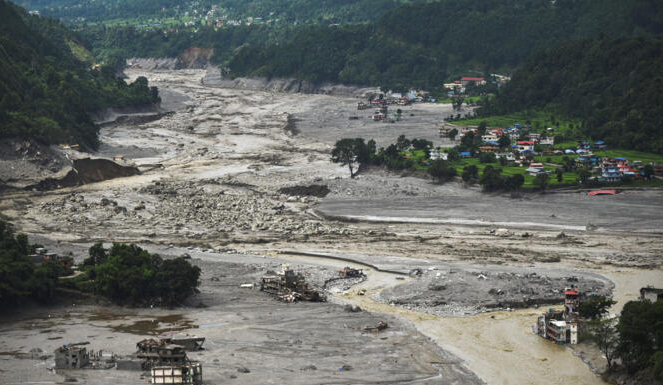
Nepal’s flash flood in the Langtang Himalayan region bordering China has resulted in massive destruction and devastation on the banks of the Bhotekoshi and Trishuli rivers. The latest figures don’t tell the real story. Nepalese newspapers and online portals have now revealed that the deaths might be in the thousands, though official figures are nearing 1,500 dead and over 6,000 missing. UNICEF estimates that over 84,000 people, including 32,000 children, have been affected by this devastation. Over a dozen hydropower projects were swept away, along with several important markets in Rasuwa and Trishuli Bazaar. Over 20 schools were swept away, affecting 14,000 students.
International aid is coming, but we all know this aid does not account for what locals need, but rather what ‘donors’ want to give. The fact of the matter is that right now, people in distress need support that is not only financial, but psychological too. International donors have their own agendas as ‘communities’ become their ‘territory’ to showcase their ‘work’ internationally. The Nepal government has been cautious, as calamities are seen as ‘opportunities’ by many.
It is great to see that Nepal’s armed forces and public have worked hard, demonstrating great unity and dedication during this crisis as they search for survivors amidst the heavy debris flowing from the epicentre of this tragedy. Dozens of bridges—including suspension bridges—power projects, and highways have been completely washed away, with thousands of houses turned into mountains of debris, much like the aftermath of a pralaya or ‘doomsday’. But it is also a reality that in this digital age, we have normalized every pralaya into mere ‘Peepli Live’ entertainment, rather than raising awareness and creating sensibility toward the environment and the communities that nurture it.
As per a Taksarnews.com report quoted on X by a senior journalist from Nepal:
“The catastrophic Lhendé-Bhotekoshi disaster last week has affected at least 26,000 families across 49 wards in five districts. The National Disaster Risk Reduction and Management Authority has confirmed that 49 wards in five districts, from the northern Himalayan sources to the southern coastal areas, were affected due to the devastating flood in the Bhotekoshi River that occurred on Bhadau 10 via the border crossing at Timure in Rasuwa. According to ward-level data from the National Census 2078, a total of 156,850 people from 38,219 households across 15 local levels around the Bhotekoshi and Trishuli river systems appear to have been affected by this flood, including glacial lake outburst and grayane. Since an estimated 30 percent of the geographic elevation in these affected areas lies outside the river flow zones, 109,700 people from 26,754 households have been found to be directly impacted by the disaster’s fury. The Authority has stated that the devastating flood in the Bhotekoshi, carrying glacial debris and grayane that flowed from the Lhendé stream along with landslides at a rate of 180 km/hour following the bursting of a lake in the Himalayan region above the Timure border, has caused serious physical and human crises in the riverside settlements of Rasuwa, Nuwakot, Dhading, Gorkha, and Tanahun.”
Rescue operations continue, but the true impact will be realized in the coming days when the real numbers come out. Unfortunately, in calamities of such magnitude, it is difficult to trace everything. We saw this during the Kedarnath tragedy as well as during the Tsunami. So far, there is no effective system to maintain records of pilgrims or families. There is a crucial need to establish a proper mechanism to record the number of tourists and their complete details. Equally important is to avoid converting Himalayan zones into picnic resorts. There is a need to control the massive influx of tourists in these regions, promote local food culture, and prohibit outside packaged food or products.
The Glacier Collapse and Massive Flash Flood
The collapse was so vast that seismic instruments registered it as a magnitude-5.2 event, initially mistaking it for an earthquake. Bedrock beneath a glacier failed, carrying a massive weight of ice and rock roughly 1,200 meters toward the valley floor, according to Fabrice Robinet of UN News [1].
Satellite images of the flood’s origin show a clean cleavage about 1.5 km wide in a hanging glacier at 5,000 m on the north face of Langtang Lirung. Experts suggest this was not merely glacier calving, but a bedrock failure caused by meltwater seeping into a pre-existing crack. This mass melted as it fell, bulldozing debris down to the Lhendé Khola and another 15 km down to the Rasuwagadhi checkpoint on the Nepal-China border. From the point of collapse, the entire mountain of debris—which reports estimate reached 300 feet in height—took just 7 minutes to travel 22 kilometers to reach the Rasuwagadhi confluence of the Lhendé Khola and the Bhotekoshi flowing from Tibet. The river that originates from Gyirong (Kyirong) County in the Tibet Autonomous Region (TAR) within China’s Pangtang Himal range is known as the Kyirong Tsangpo. After the confluence at Rasuwagadhi, the combined flow of the Kyirong Tsangpo and Lhendé Khola is known as the Bhotekoshi (River from Bhot Land).
From Bhotekoshi to Trishuli
The Bhotekoshi is known as the Trishuli from Dhunche onwards, where the Trishuli Khola—a stream flowing from Gosaikunda—confluences with it. Gosaikunda is a popular trekking destination and an extremely sacred space for Nepalese people, located in Langtang National Park in Rasuwa district at an altitude of about 4,380 meters. According to mythology, Lord Shiva drove his trishula (trident) into the ground there after swallowing poison during the Samudra Manthan, creating three springs that feed the river (hence the name Trishuli/Trisuli). Between Dhunche and Rasuwagadhi, it is also known as the Upper Trishuli River. Further downstream, after joining the Trishuli Khola near Dhunche, it is known as the Trishuli Ganga or Trishuli. The river continues southward and is joined by the Tadi Khola and Likhu Khola near Bidur (Nuwakot).
It continues south through Nuwakot, Dhading, and other districts, finally meeting the Kali Gandaki at Devghat to form the Narayani (Gandaki) River. It then enters India as the Gandak at Valmiki Nagar in the West Champaran district of Bihar (at the site of the Gandak Barrage) and passes through Valmiki National Park. The river traverses through the districts of Maharajganj, Kushinagar, Deoria, and Saran, before merging with the Ganga at Hariharpur in the Hajipur district near Patna. The confluence zone of the Ganga and Gandak has consistently shifted during every monsoon toward Patna.
Rising Temperatures and Melting Glaciers
After nearly two weeks, the big question is not just what caused this massive crisis in Nepal, but also how the Government of Nepal handled it. Just a year ago, Nepal’s youth—popularized as Gen Z by local and international media—were questioning the government in power about their issues. Today, the government that came to power by questioning its predecessor refuses to listen. Is this merely glacier melt driven by the ‘climate crisis’, or have we contributed to their melting through excessive misuse of these resources?
Nepal’s Prime Minister is scheduled to speak at the UN General Assembly meeting in New York, and many Nepalese NGOs and thought leaders have asked the government to seek due compensation from the global fraternity—particularly the US, China, and India (though I am unsure why they left Europe out)—for global warming caused by carbon emissions that resulted in glacier melt. There is growing concern in Nepal about the damage unleashed by this catastrophe. As an AFP report notes, Finance Minister Swarnim Wagle estimates the preliminary cost of rebuilding at $4–5 billion—roughly 10 percent of the country’s annual GDP—a feat it cannot accomplish alone.
While the international community must stand with Nepal in this hour of crisis, Nepal must also look inward. If Nepalese policy planners, opinion makers, and civil society are solely focused on raising climate justice internationally to secure large sums of foreign aid, they must realize that money coming under the guise of ‘emergency’ support carries numerous riders. This presents a clear challenge to national sovereignty. The true challenge lies in rebuilding infrastructure while learning lessons to handle future threats better.
Experts have identified more than 42 glacial lakes in Nepal at critical risk of bursting due to rapid ice melt and rising temperatures in the Himalayas. According to the Nepali daily Kathmandu Post, most of these lakes are in the Everest region, one of the world’s most prominent mountain tourism destinations [2].
“Our tourism practically depends on mountains,” said environmental expert Vijay Kumar Singh [2]. “There is also risk associated there, which needs to be assessed properly to prevent future disasters.” [2]
The 10-day Rasuwagadhi-Kerung package costs around $1,700 per person [2]. The World Travel and Tourism Council estimates that travel and tourism contributed 6.6 percent to Nepal’s gross domestic product [2]. The sector is a major source of employment, particularly in remote hill and mountain communities where alternative economic opportunities are limited [2].
Experts regularly warn us that glaciers are melting and the Himalayas face severe trouble. While we are on the verge of a serious climate crisis, the question remains: how do we mitigate it? Climate change is already here. Huge amounts of funds are spent on global gatherings, yet the tangible outcomes remain unclear. Issues are debated in ways that turn crises into new ‘opportunities’ for ‘experts’ whose language remains out of touch with ground realities.
My point is not to discount these conferences, but to emphasize that they must become interaction points for various stakeholders and public activists, rather than remaining NGO forums acting on top-down agendas. Most UN gatherings have legitimized the presence of the private sector, without whom little moves. Will we be able to stand up against crony corporations exploiting mountain and river resources when speaking of natural resource management, community protection, and traditional rights? Will we speak up against massive infrastructure development in the Himalayan regions—including India, China, Nepal, and beyond? Are big dams, hydropower projects, and the expansion of railway and road networks not impacting the Himalayas? Tourism is Nepal’s greatest strength, but uncontrolled commercialization will prove too heavy a burden, as seen across the Himalayan regions in India.
Uncontrolled Commercialization of the Himalayas and Its Rivers
Rasuwagadhi is Nepal’s gateway to Tibet (the Tibet Autonomous Region). It is now a main highway for the Kailash Mansarovar pilgrimage, used by Hindus from around the world. Within Langtang National Park lies Gosaikunda, the mythological ‘source’ of the Trishuli River. Nepal celebrates the Janai Purnima festival (the Sacred Thread Festival) during Raksha Bandhan, when pilgrims travel to Gosaikunda to take a dip in the lake and receive new sacred threads [3]. Rasuwagadhi is also an important historical site where Jung Bahadur Rana constructed a fort in 1855, at the location of Nepal’s 1792 war with China.
From Nepalese religious and historical perspectives, Rasuwagadhi and the entire Bhotekoshi-Trishuli valley are sacrosanct. However, growing national and international tourism has led to new hotels and resorts springing up along riverbanks. China has constructed heavily on its side; while the area saw minimal construction prior to 2010, China invested heavily in roads and buildings from 2012 onward [4]. Construction also began on the Kathmandu-Rasuwagadhi railway line. A scholar in 2013 documented these developments and their impact on locals [4]:
“All the land is being bought by people from Trishuli and further south. Soon, the whole village will be owned by them, and we’ll have to resort to collecting firewood and fodder for money. The poor will just get poorer” (Sthapit 2011) [4]. There was also a large police presence in the village and endless checkpoints along the road. The charming hamlet of Gadhi, just 500m from the border, was unchanged, saved by having no space to build anything [4].
A February 10, 2013 article in Republica reported that four meters of the fort’s wall had fallen and cracks had developed along its length due to heavy equipment and rampant extraction of gravel and soil for bridge construction (Poudel 2013) [4]. The report asserted that the local administration was attempting to downplay the issue [4]. Although the Department of Archaeology initially objected to the bridge, it granted conditional approval to build it at least a foot above the fort to avoid structural damage [4]. It is hard to see such concerns carrying weight given the high political profile of the project [4].
This local sentiment from 2013 persists today. Similar dynamics are playing out in Uttarakhand, Himachal Pradesh, and parts of North-East India, where mountain communities demand accountability, ask to be involved in decision-making, and question the dominant ‘developmental’ narrative. It is striking that Nepal’s media, political class, and NGOs focus primarily on climate change—for which Nepal certainly deserves compensation—while neglecting the government’s duty to view Nepal as more than a hospitality hub for outsiders. Nepal’s narrative remains dominated by Kathmandu-centric perspectives, rarely incorporating native communities. The Rasuwagadhi and Trishuli-Bhotekoshi regions are home to indigenous Himalayan communities such as the Tamang, Bhotiya, Sherpa, Khas, Kami, Damai, Sarki, Newar, and others. The pain of these communities remains largely unheard because most hotels, resorts, and travel companies are owned by outsiders from Kathmandu. Global tourism frequently commodifies local communities into sights for foreign visitors, with tour itineraries ensuring visits to these ‘communities’ as mere stopovers.
While the Nepal government should seek climate compensation, it must also focus inward. Nepal cannot thrive without developing its indigenous knowledge systems, strong universities, schools, healthcare systems, and domestic industries. Tourism alone will not bring prosperity. Nepal’s younger generation continues to migrate to the West for quality education, including specialized degrees in engineering and medicine. For decades, Nepal failed to develop credible domestic industries, hydropower infrastructure, or healthcare services, driving outward migration.
Tourism
Post-COVID, Nepal’s tourism industry has expanded. Annual visitor arrivals are nearing 1.2 million. Over 30% of these tourists come from India, followed by the USA, China, the UK, and Australia. Direct travel revenue brings in around $650 million, while tourism’s total direct and indirect contribution to Nepal’s economy is estimated between 6.7% and 7.9% of GDP.
However, this heavy influx brings side effects. Trekkers and climbers leave behind oxygen canisters, plastic packaging, tents, and battery waste. Religious tourism presents additional challenges, with pilgrims discarding clothes and items directly into rivers.
Road construction to remote areas is treated as essential, alongside planned railway networks. However, unchecked riverbed mining must be halted. Allowing trucks and private vehicles directly onto riverbeds—whether for mining or recreation—must be restricted. Over 1,600 hotels, resorts, and eateries line the Prithvi Highway toward Rasuwagadhi, alongside dozens of sand-washing and gravel-crushing plants along the Trishuli River.
Pollution levels in the Trishuli range from moderate to high due to untreated sewage flowing directly into the water. While the Trishuli was once a premier rafting destination with over 150 operating companies along a 150-kilometer stretch, pollution and aggregate mining have reduced that number by more than half. Rivers near urban centers fare even worse: the Bagmati has become so polluted that its water is unsafe even for bathing.
Because Nepal’s economy relies heavily on tourism, Kathmandu-based operators drive decisions, promoting destinations without adequate safeguards. Vehicles are routinely driven onto riverbanks so tourists can set up camp, erect tents, and cook dinners. Strict environmental laws are urgently needed to protect the rights of native communities who receive little benefit from an industry dominated by urban enterprises.
Mount Everest
Mount Everest is increasingly becoming a high-altitude dumping ground [5]. Weather shifts, heavy snows, and sudden storms lead to regular loss of life, leaving many bodies unrecovered [5]. Between 1990 and 2019, over 300 people died attempting to climb Everest, averaging six deaths per year [5]. The year 2023 saw a record high death toll, with 12 confirmed dead and five missing or presumed dead [5].
Mountain geologist Alton Byers estimates that approximately 5,400 kilograms of human waste are generated at base camps each season [5]. Beyond managed waste, areas surrounding base camp tents are heavily polluted with human excrement [5]. High-altitude expeditions require extensive gear—tents, ropes, portable stoves, ladders, and cans—contributing to an estimated 30 tonnes of garbage accumulated on the mountain [5].
Religious Tourism’s Impact on Rivers
Religious tourism has placed severe stress on Nepal’s river systems, including the Trishuli and Bagmati. While these rivers remain pristine at their high-altitude sources, lower stretches suffer from expanding hotel developments, a lack of sewage infrastructure, and heavy commercial exploitation.
The state of the Bagmati River near the Pashupatinath temple highlights how ritual practice has diverged from environmental stewardship. Symbolic rituals have often overshadowed philosophical conservation, leading to the degradation of rivers, ponds, and lakes.
Gosaikunda, the source of the Trishuli, attracts both international trekkers and domestic pilgrims [3]. During festivals like Janai Purnima, mass pilgrimage leaves behind significant seasonal ritual waste [3]. Similar patterns occur during the Char Dham Yatra in Uttarakhand, India, where massive pilgrimage waste is excused in the name of tradition [6]. Along the Prithvi Highway, unchecked resort development without waste treatment continues to discharge effluent directly into the Trishuli.
Hydropower Projects
Numerous hydropower projects are planned across the Himalayas. Following the flash floods, some commentators suggested that a Chinese dam failure on the Yarlung Tsangpo (Brahmaputra) triggered the surge, but geomorphologists and international experts ruled this out [7].
Daniel Shugar, a geomorphologist at the University of Calgary, confirmed via satellite and field data that the disaster was caused by an ice-rock avalanche: a bedrock failure carrying ice and rock down steep slopes [7]. The pulverized mass created a fast-moving debris flow that descended into river valleys [7].
The Need for a Common Himalayan Strategy
While Nepal’s focus on climate justice is valid, internal governance reform is equally urgent. Global climate discussions are heavily influenced by transnational corporations and financial institutions. At international summits like COP, a majority of experts provide only market-based ‘solutions’—such as carbon credits and green bonds—that offset emissions without requiring structural reductions or benefiting local communities.
Following recent disasters in Uttarakhand and Himachal Pradesh, native mountain communities are challenging top-down infrastructure models. Local movements are calling for pauses on large hydropower, tunnel, and highway projects built without community consent. Nepal must similarly anchor its development agenda around native communities rather than relying solely on international aid frameworks [8].
Trans border cooperation is essential. Himalayan communities in India, Nepal, Tibet share common culture and traditional belief which actually worship mountains and rivers. The ancient wisdom suggested that human being must live in complete harmony with nature as challenging it would only be disastrous for the world. South Asia share interconnected river basins fed by the Hindu Kush Himalayas, which supply water to over 2.1 billion people. We don’t need to challenge nature but learn to live with it as native communities had been doing for centuries. Despite difficult circumstances these communities welcomed outsiders with a smile and warmth. The issue of Himalayan regions as well as Gangetic plains must involve the native communities who are dependent on it and nurture it too. Nobody deny ‘development’ but let the ‘democratic’ countries suggest us as how many of these ‘developmental’ projects are initiated with the engagement and involvement of the local communities? Himalayan zones lack basic needs for local communities, good hospitals, quality schools and educational institutions but they have mushrooming growth of resorts, hotels, wine shops, all this in the name of ‘businesses’ that does not help the locals.
These disasters are actually imposed on the people by the policy planners who work on international agenda rather than working to uplift the local communities. Time has come to look inwardly and seek solution that way rather than giving opportunities to greedy corporations and their pigmies to destroy the natural heritage further. I have mentioned many time, Himalayas are not ‘resource’ but heritage and those live there can vouch it. Each mountain, valley, lake is sacrosanct for them. Locals don’t pollute them but modern business tourism has destroyed them.
Nepal must look for inward solutions and regulate not only developmental activities but tourism too in the Himalayan regions. Our solidarity with the people of Nepal.
End Notes
1. UN News, “As the Himalayas melt, deadly floods become the new normal,” August 2026. Available at: https://news.un.org/en/story/2026/08/1168227
2. Kathmandu Post, “Nepal tourism faces another setback as Rasuwa disaster exposes mountain risks,” August 28, 2026. Available at: https://kathmandupost.com/money/2026/08/28/nepal-tourism-faces-another-setback-as-rasuwa-disaster-exposes-mountain-risks
3. Ramsar Information Sheet (RIS), “Gosaikunda and Associated Lakes,” Ramsar Site No. 1693, 2007.
4. Cowan, Sam, “All Change at Rasuwa Garhi,” Himalaya: The Journal of the Association for Nepal and Himalayan Studies, Vol. 33, No. 1, 2013. Referenced via https://newsbikram.blogspot.com/2013/07/rasuwagadhi-fort-falling-apart.html
5. Earth.org, “Amidst Growing Mountain Tourism in Nepal, Mount Everest Confronts the Perils of Pollution,” 2024 / National Geographic Society Educational Resources. Available at: https://earth.org/amidst-growing-mountain-tourism-in-nepal-mount-everest-confronts-the-perils-of-pollution/
6. National Geographic Education, “Trash and Overcrowding at the Top of the World,” Resource Library. Available at: https://education.nationalgeographic.org/resource/trash-and-overcrowding-top-world/
7. AFP Fact Check, “Experts refute conspiracy theories linking Chinese dams to Nepal flash flood,” September 2026. Available at: https://factcheck.afp.com/doc.afp.com.C77Y263
8. Shivakoti, Pravesh, “When a glacier collapses across a border, what does international law say?” Kathmandu Post, August 31, 2026. Available at: https://kathmandupost.com/columns/2026/08/31/when-a-glacier-collapses-across-a-border-what-does-international-law-say