S.R. Darapuri, I.P.S. (Retired)

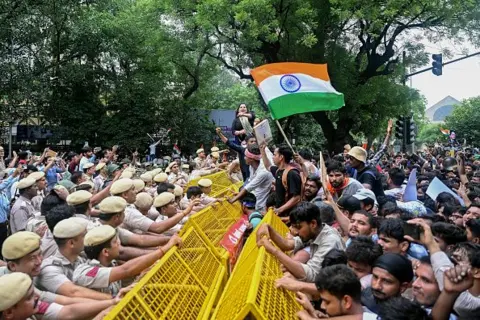
(Asian independent) Yesterday, on July 31, the families of police personnel injured at Jantar Mantar in Delhi held a press conference. They primarily spoke about how their fathers or husbands—who serve in the Delhi Police—were injured during the violence instigated by CJP protesters on July 20, and asserted that they, too, have rights. They alleged that a large number of miscreants were among the protesters and were responsible for inciting the violence. They also expressed hurt over the portrayal of police personnel as villains on social media, arguing that they deserve justice as well.
When considering the grievances of the injured police personnel’s families, the injuries sustained by their fathers or husbands are indeed a matter of concern and distress. However, information emerging from social media suggests that the force used by the police at Jantar Mantar was barbaric and excessive. Instances of police brutality and the mistreatment of women and girls are clearly visible. One can only imagine the image of the police formed in the minds of those who endured or witnessed these actions. Will the families of these police personnel consider holding their kin accountable for such brutality and misconduct, and encourage them to act humanely and adhere to the rules? They must not forget that their fathers or husbands voluntarily joined the police force, fully aware of the potential for injury; such risks are inherent to the job. There is no benefit in playing the “victim card” in this context.
Regulations governing the use of force against crowds mandate the use of minimal force, restrict action to actual violent agitators, require that lathis or firearms be aimed below the waist, and dictate that the use of force cease once the crowd has dispersed. These protocols are taught to personnel ranging from constables to IPS officers, and are reinforced through drills simulating protest scenarios. They are also instructed that the objective of using force is to disperse the crowd, not to teach them a lesson out of a spirit of vengeance by inflicting severe injuries. They are further reminded that the protesters are citizens of their own country, possessing the fundamental right to stage peaceful demonstrations in support of their demands.
Let us now examine the extent to which the police personnel at Jantar Mantar adhered to the regulations governing crowd control. Videos from that time, available on social media, reveal blatant violations of these rules. They show the sheer brutality with which the police rained down blows with lathis and batons, and how individual protesters were beaten like animals by multiple officers. While it is acknowledged that officers were ordered to conduct a lathi-charge by snior officers, the intensity of the blows remained within the officers’ own control. The footage also shows that instead of striking below the waist—as is standard protocol—blows were directed at the head, shoulders, and back, resulting in broken heads and fractured legs for many protesters. It is also deeply concerning that some officers were wielding nail-studded batons and wooden planks—actions that are entirely unacceptable. The videos further reveal police personnel striking individuals who were merely standing peacefully, sitting in the park, or simply passing by; the use of force should, in fact, be restricted to those engaging in violent acts. Additionally, the videos show officers concealing their identities by wearing masks—reminiscent of bandits—which is completely improper.
It is also worth considering how and why the police personnel sustained injuries. It is well known that violence can erupt during protests and demonstrations, potentially leading to injuries among the police. To mitigate this risk, officers are provided with protective gear such as helmets and body protectors. Given the reports that a large number of officers (130) were injured, it is crucial to determine whether they had been provided with the requisite amount of protective equipment. If not, why was this the case, and who bears the responsibility? The families of police personnel should also raise this matter with the Delhi Police.
In conclusion, regarding the injured police personnel, my sympathies lie with their families. At the same time, however, they must also consider the barbaric and excessive use of force by their fathers/husbands —and the resulting injuries sustained by the protesters—as a matter of grave concern. I urge them to encourage their fathers/husbands to be more sensitive and to adhere to the rule of law. Furthermore, they should ask the Delhi Police whether their superiors were provided with protective gear; if not, why? Merely playing the ‘victim card’ will yield no benefit. In the public interest, we need to transform the police force into an entity that is more humane, law-abiding, and people-friendly. To achieve this, the police reforms mandated by the Supreme Court must be implemented as soon as possible.