
THE ASIAN INDEPENDENT UK
By Vidya Bhushan Rawat*
Preview Article
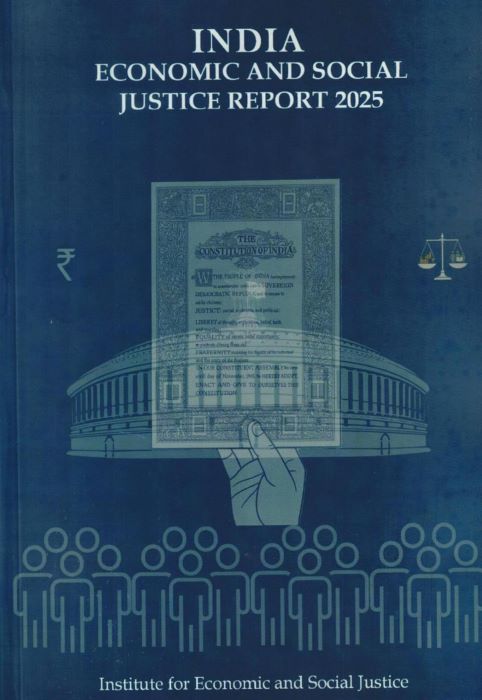
In an era of indicators and indices to assess economic, social and even cultural life, a report on economic and social justice is not an unusual thing but quintessential as political class speak about ‘Caste Census’. While the caste question remain side tracked by the political and intellectual elite as only referred to when it does not threaten the existing social political order or in pure rhetoric. For years, the ‘experts’ would blame that India only has ‘social’ issues and ‘economic’ issues don’t matter or only ‘economic’ issues are important and not the social. This debate actually was farcical and aimed as targeting and instigating the respective constituencies of the intellectual elite. There were very few who could speak that Socio-Economic-Cultural issues are important and interdependent hence cannot be isolated from each other. Therefore, “INDIA ECONOMIC AND SOCIAL JUSTICE REPORT – 2025,” authored by Prof K S Chalam, former Vice Chancellor, Dravida University, Andhra Pradesh, former Member, Union Public Service Commission and Chairman, Institute for Economic and Social Justice, Vishakhapatnam, appears to be a wonderful feat. This report analyzes the historical, constitutional, and socio-economic landscape of justice in India, with a specific focus on marginalized communities. This report is first of its kind to measure and indicate where do Indian government and state governments stand in providing constitutional guarantees of Justice both economic and social to the citizens of the country. Inspired by Human Development Index of UNDP, this report has examined several indictors to determine the Economic and Social Justice Index and finally fixed following three dimensions.
1: MPCE (monthly per capita expenditure) per family, among Scheduled Castes to signify economic Justice. (The MPCE for ST is not produced with an argument that it reflects the same trend).
2: Atrocities committed on Scheduled Castes and Scheduled Tribe population published by NCRBI
3. The human rights violations as recorded by NHRC are considered for estimating the Index.
 The report has followed a statistical method on the lines of Human Development Index. The report presents data for two periods 2011 and 2023. It is surprising to find states that are economically proactive are socially regressive in protecting the SC and ST populations; as a result, the overall ranks of ESJI are getting depressed over a period of time for such states. The report provides data and information on castes, sub castes of SC, ST and OBC population by states with caste wise data on education, economic status, reservations etc given in the Appendix. The analytical appraisal under pioneering concepts reviewing 75 years of the implementation of the Constitution is really innovative and a bold attempt. The text begins with highlighting the concept of “Justice” in the Indian Constitution noting that it was heavily influenced by Dr. B.R. Ambedkar, who served as the Chairman of the Drafting Committee. The report cited how Ambedkar argued in the Constituent Assembly that social and economic justice could only be achieved through a socialistic economy, including the nationalization of land and industry. The Preamble places “Justice—social, economic, and political” as its first element, signaling its role as the ultimate goal of the Republic. The report emphasizes that democracy in India is a “top dressing” on an undemocratic soil, requiring the cultivation of constitutional morality to overcome historical cultures of inequality as its back drop.
The report contrasts Western theories of justice with the Indian social reality of the caste system. It discusses John Rawls’s “Justice as Fairness” and Amartya Sen’s critique, which utilizes the Indian concepts of niti (organizational propriety) and nyaya (realized justice). The text argues that Western libertarian and liberal theories often fail to account for the “caste mode of production” and the “Composite Index of Discrimination” (CID) inherent in Indian society. To assess the achievements and limitations of the Constitution during the last 75 years of its operation, the report identified the instruments and institutions of justice with which they can be interrogated the transactions both in the legislature and in the judiciary. Given the limitations of the scope of the study, it broadly discusses the instruments of justice as legal documents, including Acts, Rights, Rules, Property, Budget provisions, Atrocity rates, Gini Coefficients etc. The institutions of Justice in India can be identified as the judiciary, civil society, market, and state represented by the proceedings of Parliament/Assembly and not necessarily the private institutional structures, as the report concerned here with public documents: the Constitution and Government Reports .The process of delivering or dispensing social justice through the passing of various Acts, such as the SC ST(prevention of Atrocities) Act 1989, including the Protection of Civil Rights Act (prevention of Untouchability) 1955, 1976, and the judicial interpretations or interventions over a period of 70 years, is termed a saga of social justice drama in India . The report opines that the appointment of the SC, ST, Minorities and Backward Classes commissions indicate the government’s intentions and obligations as per the mandate of the Constitution. However, the imagined constitutional objectives of social justice seem to have not been realized due to litigations. The issue of social justice as part of the routine prevention of untouchability cases is not limited to the broad understanding of the term dalit at the all-India level and goes beyond. The report brings out a significant fact that some of the untouchables of North India like in UP, Bihar etc are listed as Scheduled castes there and are noted as backward classes in South India. It is difficult; the report agrees to understand the social categories without looking at the evolution of each caste group in the social history of India. The report however, has not gone deep in to that dimension here.

The first part of the report examined various aspects of each dimension, namely the Economic and Social measures of justice. After identifying the dimensions, the data was normalized. In the second stage, the indicators for economic justice, consisting of monthly per capita expenditure are considered. The maximum and minimum values of each dimension were obtained from the internal dimensions of the factors considered. For example, the four categories of social groups SC, ST, OBC, and others for which data are made available have been tested as to which group was the most deprived in terms of their mean values, and the group with the least value was used for the calculation of the indicator (the data are given in the appendix Tables not in the text). As noted above, the economic dimension of MPCE adequately explains literacy; therefore, it is dropped at the stage of calculating the index. Finally, the ESJI is arrived at by combining the three dimensions and dividing it by 1 by 3 to arrive at the average and subtracting the value from 1 to arrive at the comprehensive index. The ESJI value indicates deprivation, with zero indicating absolute justice and one indicating absolute injustice or Deprivation.
The significant finding of the report is estimation of Wealth Stolen from Native Indians including untouchables and lower castes who suffered the loss of lands cleared and cultivated by them were ultimately stolen by the traivarnikas with the support of the state as per the arguments of the report. The Native Indians have remained landless poor. Yet, they were the ones who were involved in the production process and created wealth. The report obtained data from Madison study on the World GDP and GDP for India from the year 0 to 1973 as published by OECD. The data was used to arrive at the contribution of lower castes to India GDP and its proportion in the World economy. It is surprising to find that one fourth of the Wealth of the World was created by lower castes of India amounting to around $ 25 billion in the year 0 and it could have reached $ 25 trillion cumulatively by the end of 1000 AD known as the age of conflicts and regional satraps. It is noted that a vast portion of India’s historical wealth was created by lower castes but appropriated by “non-productive groups”. The report has cited the Oxfam Report on India 2025 to show that the amount of Colonial plunder of the British India is almost equal to the amount estimated to have been stolen by the upper castes from Dalits and Bahujans. This is a very important statistic that might generate debates across activist groups.
A significant portion of the text is dedicated to the unequal distribution of assets and wealth. Historically, Dalits (Scheduled Castes) were forbidden from owning land, gold, or weapons. As of 2015-16, the average land holdings of Scheduled Castes have dropped to 0.78 hectares, and roughly 58% of them remain landless at all India. The author of the report introduces the concept of “Caste-Based Cronyism,” arguing that modern economic liberalization has primarily benefited the “Dvija” (upper-caste) groups through Multi-Caste Corporations (MCC), effectively recreating Varnashrama Dharma in the 21st century.
The social injustice is measured in terms of the atrocities data for SC and ST obtained from the NCRB reports. It is noted that despite Article 17 of the Constitution, the report notes a sharp rise in atrocities. NCRB data shows atrocities on Dalits increased from 17,667 in 1990 to 53,886 in 2020, more than threefold raise. In the context of women empowerment as part of social justice the text of the report recognizes the “Founding Mothers” of the Constitution (e.g., Sarojini Naidu, Amrit Kaur) who fought for women’s rights and the Hindu Code Bill against “blatant sexism” in the Assembly. The judiciary is critiqued for its “non-representative character,” with allegations that it remains influenced by a small number of elite families (as reported by Prof Mark Gallanter etc.), often leading to the acquittal of those accused of atrocities against Dalits implying that it did not result in reducing the intensity of injustice. Apart from the NCRB data, the report makes use of the NHRC data on human rights violations recorded by caste and state to arrive at the Economic and Social Justice Index. The report proposes a new quantitative tool, the ESJI, inspired by the UNDP’s Human Development Index. It is calculated using the three dimensions: MPCE: Monthly Per Capita Expenditure of SC households, SC and ST Atrocities: Rates recorded by the NCRB per lakh of population and Human Rights Violations: Cases recorded by the NHRC. The index aims to provide a measurable “deprivation index” where a value of zero indicates absolute justice and one indicates absolute injustice. The report concludes that while the Constitution provides a mandate for justice, institutional structures—particularly the judiciary and the market have failed to gift justice to the victims and the same have largely helped to reinforce traditional caste-based inequalities rather than dismantling them.
The report notes that Justice is not quantifiable, but its impact can be envisaged in terms of the dimensions through which it affects the human condition. There are several measures developed and used to state the economic circumstances of the people like the PQLI, Physical Quality of Life Index constructed by ODA in the 1970s. There are other indices that are now being used to quantify and analyze human quality of life, economic and social development indicators along with the aggregate concept of GDP, HDI etc. Against this background, the objective of this report as claimed by the author is to determine where Economic and Social Justice, as defined in the text, stands at different periods of time in India. The values are arranged such that the highest value indicates more deprivation and the lowest value nearing zero indicates perfect justice. The ESJI was 0.212 in 2011 and climbed to 0.305 in 2023. This means that economic and social justice deprivation has almost doubled over 12 years in India.
Economic and social justice are interdependent, complimentary and a right approach will tremendously help India grow which is not possible unless the fruits of development reach the most marginalized sections. The report examines state wise indicators in terms of the above-mentioned dimensions and found the major former BIMARU states, Bihar, U.P, Rajasthan that are being touted now as improving in terms of economic indicators like per capita income or expenditure, are however consistent in getting higher ranks of deprivations except U.P with a small change. In 2011 ESJI of Bihar was 0.141, M.P 0.184, Rajasthan 0.225 and U.P 0.510. The ESJI for 2023 for Bihar is 0.281, M.P 0.412, U.P 0.443 and Rajasthan 0.433. Uttara Pradesh that had an index of 0.443 in 2011 has the highest rank among the states has lowered its value to 0.470 and Rajasthan with 0.480 replaced U.P in the dubious position of highest rank in 2023. The better performed states are listed are the first Five: West Bengal 0.040, Assam 0.041, Chhattisgarh 0.074, Tamilnadu 0.099, Punjab 0.101 and Maharashtra 0.107 in 2011. The same states remained as better performed with ranks altered. In 2023 Assam with 0.077, West Bengal 0.110, Chhattisgarh 0.112, Jharkhand 0.167 and Punjab 0.162 are found to be in a better position with lower ranks. Interestingly Jharkhand a predominantly tribal state joined the ranks of better performed states in 2023 and Maharashtra sliding down one in its rank.
Among the South Indian states, the ranks of Andhra Pradesh in 2011 was 13 with 0.196, Kerala with 0.317 in 16th rank were in the lowest five ranks. It is noted that in 2023 Telangana joined the ranks of lowest performing states with 0.380 at 20th rank and Andhra Pradesh has improved its rank with a value of 0.285. The ranks and values of ESJI are given for all the states and Union Territories are given in the Appendix. The author is very pragmatic in accepting the limitations of the study with an open mind in terms of data restrictions and the inadequacies of reports of the government for an all-India study of this nature. However, the estimated indices to quantify and explain how India is performing in terms of the Constitutional objectives of Economic and Social Justice as a first of its academic endeavor are commendable. The report reproduced excellent and very useful data on economic and social and other related issues that are presented in the appendix Tables for reference and help scholars and activists to lay hands to compile more such indices.
The report is not a simple exercise of research and reflection. It shows the author’s commitment to the marginalized constitutional categories that were promised justice, economic and social about 75 years ago and the betrayal suffered by the major segment of our population. The study is not just presentation of figures and statistical tables to substantiate the arguments, but the sentences and the emotions carried through the paras show the agony and despair the author experienced both as a scholar and perhaps as a silent worker. Frankly speaking, much has been talked about Human Development Reports but they fail to take into account the Caste discrimination and other systematic both social as well as political ones, into account. Prof K.S. Chalam should be lauded that he has come out with this report despite all hardship because most of data that he has used and depended is the institutional data. It is important that such reports must become regular feature annually so that the policy makers take benefit from it and plan their policies accordingly. We hope that NITI Ayog and other important institution both at the Centre as well as in the states would benefit from these reports and encourage each state to engage with such credible institutes which can bring out such reports every year state wise too. The Institute for Economic and Social justice along with Prof Chalam’s vast experience in socio-economic and political economy studies should continue this exercise and bring in more nuances in to public debate. The report is an important and essential reading for scholars, academics, and policy makers to develop right approach for policies and programmes meant for the most marginalized sections of our society.
Pre-launch orders before May 31st, 2026 will get discount and the price for the single copy will be Rs 400 including postage charges during this period. For Bulk order of 100 copies for Rs 30,000. For details kindly WhatsApp at 9441022200 or by email [email protected]