THE ASIAN INDEPENDENT UK

Bal Ram Sampla
Geopolitics
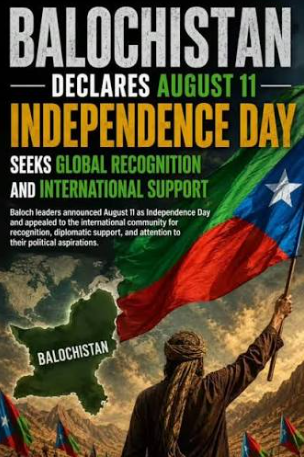
The declaration of August 11 as Independence Day by Baloch nationalists is rooted in the unique history of the Khanate of Kalat during the end of British colonial rule in South Asia in 1947.
During the British Raj, the region of Balochistan was composed of directly ruled British territories and semi-autonomous princely states. The largest and most prominent of these state entities was the Khanate of Kalat, ruled by the Khan of Kalat, Mir Ahmad Yar Khan.
Unlike the provinces of British India, Kalat maintained a distinct treaty relationship with the British Crown based on an 1876 treaty, which recognized Kalat as an independent allied state rather than a standard princely state.
As the British prepared to leave South Asia, negotiations took place regarding the status of Kalat:
(I) August 4, 1947: A Standstill Agreement was negotiated in New Delhi between the representatives of Kalat, the upcoming state of Pakistan, and the British.
(II) August 11, 1947: Three days before Pakistan was created, Mir Ahmad Yar Khan formally declared the independence of Kalat/Balochistan as a sovereign state.
(III) The Standstill Agreement: The agreement recognized Kalat as an independent sovereign entity, with further negotiations planned regarding communications, defense, and foreign affairs.
Following the declaration, Kalat formed a bicameral parliament consisting of an Upper House (Darbar-e-Khas) and a Lower House (Darbar-e-Aam). In sessions held in late 1947 and early 1948, the parliament overwhelmingly voted against merging with Pakistan, expressing a desire to maintain independence and friendly bilateral relations.
The Accession of March 1948
Kalat operated as an independent state for nearly seven months. However, on March 27, 1948, Pakistani military forces entered the region. Under intense political and military pressure, the Khan signed the Instrument of Accession, integrating Kalat into Pakistan.
Baloch nationalists maintain that this accession was forced, signed under duress, and invalid because it was explicitly rejected by the elected parliament of Kalat. This event led directly to the first armed uprising in the region, laying the groundwork for the modern Baloch nationalist movement.
Why August 11 is Celebrated Today
For Baloch nationalist groups and diaspora communities, observing August 11 serves several clear purposes:
(I) Assertion of Historical Sovereignty: Celebrating August 11 highlights the argument that Balochistan was briefly an independent nation-state and was annexed against the will of its people.
(II) Rejection of State Narratives: By celebrating three days before Pakistan’s Independence Day (August 14), the movement signals a distinct political identity separate from the state of Pakistan.
(III) International Visibility: Raising flags and holding rallies on this day allows Baloch leaders to bring international attention to their political demands, human rights concerns, and historical claims.
In short, August 11 is observed as Independence Day because it marks the date in 1947 when Kalat declared itself sovereign, serving as a symbol of historical independence and political identity for the Baloch movement.
Reference
1.https://m.iamedicina.blog/article/facebook-mark-zuckerberg-horizon-vr-ar-connect-2021?hl=en-
2.https://www.defencexp.com/balochistan-martyrs-day-history-and-significance/?hl=en-
3.ia.org/wiki/Balochistan,_Pakistan
4.https://en.wikipedia.org/wiki/Balochistan