THE ASIAN INDEPENDENT UK

Bal Ram Sampla
Geopolitics
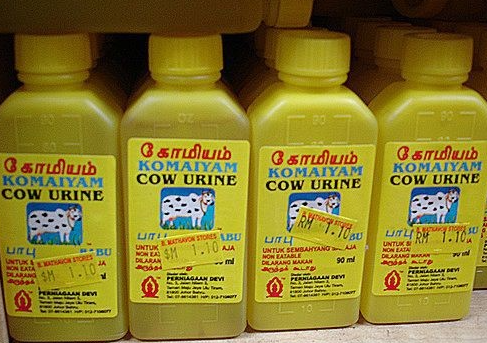
Cow urine, or gomutra, is an unusual product to find on a British shop shelf. Yet it is available in Britain today. Its presence raises an interesting question: how did a substance with ancient religious and traditional associations in India find its way into modern British commerce?
The answer begins with the special place of the cow in Hindu culture. The cow has traditionally been regarded as a sacred and valuable animal, associated with nourishment, motherhood and religious life. In some Hindu traditions, five products of the cow are collectively known as panchagavya: milk, curd, ghee, urine and dung. These have been used in particular religious rituals and purification practices.
Cow urine has also had a place in traditional Ayurvedic practice. Some traditional texts and practitioners have attributed medicinal properties to it. However, traditional use is not the same as modern scientific proof. There is not sufficient clinical evidence to establish cow urine as a proven treatment for diseases, and it should not be presented as a substitute for evidence-based medical treatment.
One of the most famous people associated with urine therapy was former Indian Prime Minister Morarji Desai. Desai openly practised drinking his own urine and defended the practice in a famous 1978 American television interview. He believed that urine therapy had health benefits. It is therefore incorrect to say that Desai rejected the medicinal claims about urine while drinking his own urine. Quite the opposite: he personally believed in urine therapy and became internationally famous because of it.
The more intriguing modern story, however, is what happens when gomutra leaves its traditional setting and enters Britain.
It is not merely a historical curiosity. Cow urine is currently available for purchase in the UK. For example, a London retailer, Om Bhakti Shringar in Wembley, currently lists a 50ml bottle of Gomutra for £0.75.
Crucially, the product is labelled “For Pooja Purposes only.” The shop has a physical premises at 164 Ealing Road, Wembley.
Another London-based retailer, Ecobay Herbals, currently lists Patanjali Godhan Ark Gomutra, 450ml, for £7.89. The same retailer sells a large range of Ayurvedic products as well as food and snack products.
This distinction is important. The existence of cow urine for sale in Britain does not mean that it is legally being sold as an ordinary food or drink. At least some current UK retailers explicitly identify it as a religious or non-edible product. That is very different from selling it to consumers as a beverage.
The subject nevertheless has a fascinating history in Britain. In 2016, the BBC reported that bottles of cow urine were being sold in London convenience stores alongside food. The report attracted considerable attention because of concerns about food hygiene and the possibility of confusion over whether the product was intended for consumption.
Nearly a decade later, the interesting point is that gomutra has not disappeared from British commerce. Instead, it remains available through specialist retailers, particularly those serving Hindu religious and Ayurvedic communities.
Its presence illustrates something much bigger than the contents of a bottle. Britain is a country in which traditions from around the world are now available in ordinary commercial life. Religious articles, traditional medicines, foods and ritual substances can all cross borders and become retail products.
For one person, a bottle of gomutra may represent an ancient religious tradition. For another, it may represent traditional medicine. To a British regulator, the important question is different: what exactly is the product, how is it labelled, and what is it being sold for?
And for the curious shopper standing in front of the shelf, there may be an even simpler question:
Why is there a bottle of cow urine in a London shop?
The answer is a mixture of history, religion, migration, commerce and modern consumer choice. The cow may be ancient; the bottle, barcode and price tag are distinctly modern.
What began thousands of years ago as part of religious and traditional practice has travelled remarkably far. Today, it can be found not only in the cultural history of India, but on the shelves and websites of British retailers.
That, perhaps, is the strangest journey of all: from the sacred cow of ancient India to a £0.75 bottle in Wembley.
References
1.https://www.ombhaktishringar.com/collections/puja-items?utm_
2.https://ecobayherbals.com/product-category/patanjali/ayurvedic-medicine/?utm_
3.https://www.linkedin.com/pulse/cow-urine-sold-alongside-food-london-stores-simon-s-milne?utm_
4 https://infiniteunknown.net/2016/12/29/60-minutes-interview-june-4-1978-with-former-prime-minister-of-india-morarji-desai-by-dan-rather-mike-wallace-and-morley-safer/?utm
5.https://gulfnews.com/world/asia/india/indian-health-minister-ashwini-kumar-choubey-is-working-on-cow-urine-to-prepare-medicines-1.1567948447753?utm
6.https://pmc.ncbi.nlm.nih.gov/articles/PMC5884179/?utm
7.https://www.sciencedirect.com/science/article/pii/S0975947621001947?utm_source