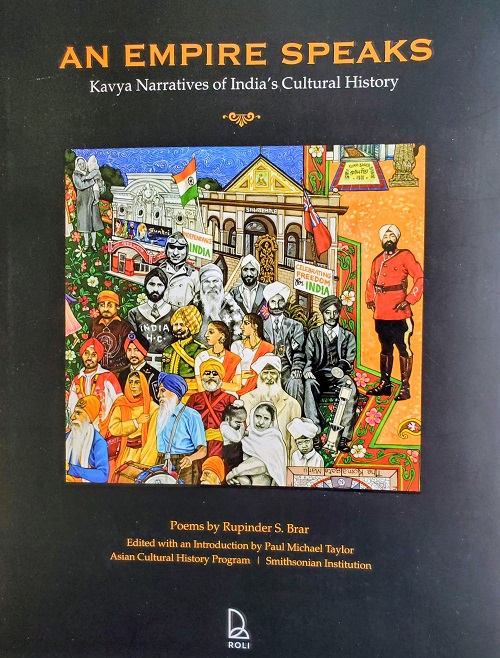
(Asian independent) In today’s times, when much of the writing we see is either too abstract or written mainly for the market, An Empire Speaks (Kavya Narratives of India’s Cultural History) by Dr. Rupinder S. Brar stands out as a thoughtful and meaningful work. It reminds us that poetry can still carry history, ideas, and deep human experiences. The title of the book under review itself is inspired by Ralph Waldo Emerson, who once said that in the great books of India, “an empire spoke.” This idea is not just mentioned here, but fully explored through the poems, where history, myth, and identity converge in a single voice. The Introduction, supported by the views of Paul Michael Taylor, connects the book to the old Indian kavya tradition, where poetry was used not only for expression but also for telling the story of a whole civilisation.
The book is divided into five different sections ( The Ancients, The Nanakians, Acacia Around the Orchard, Imperium Imperfect, and Diasporic Reflections), and together they form a continuous journey. The highlight of the book is that it feels like a connected story that moves from ancient times to modern experiences. The opening poem, Indian Odyssey, invites the reader warmly: “Come with me, and together we shall revisit an ancient world of mystery and wonder…” (P 30). These lines set the mood and take the reader into a world where the past is still alive.
One of the strongest parts of the book is how it answers the old colonial idea that India was only a geographical area and not a true nation. In the poem “Spoke An Empire”, the poet recalls this claim and then replies in a calm but powerful way: “Then spoke, an Empire, nothing small or unworthy, but large, serene, and consistent” (p 31). This response is not loud, but it is firm and confident. The following lines from the same poem, “I am, said India, the home, the hum, the hope and the hymn, the hope and the hymn, of entire Humanity”(p 31) take the idea even further. The poet is not only talking about one country, but about a larger human spirit.
At the same time, the poet does not ignore the weaknesses of society. In the poem Sita, we see a new way of looking at her character. Instead of showing her as silent and suffering, the poet gives her a strong voice. The lines “bred like a princess, she slept like a beggar” (p 34) clearly show the pain of her life, while “if chaste am I, you do not deserve me” (Pp34) turns her into a figure of self-respect and strength. This makes the poem feel modern even though it is based on an ancient story.
The poem Eklavya’s Thumb is equally powerful. The simple line “Eklavya, give me your thumb” (p 35) carries a deep sense of injustice. The poet explains this further by writing, “Five words, crippled a warrior, and a civilisation stood exposed” (p 35). These lines suggest that such acts of unfairness weaken not just one person but the whole society. By connecting this idea to later historical events, the poet shows how internal divisions can lead to larger losses.
Nature is also used beautifully in the book. In the poem Ganga, the river is shown as full of life and movement. The lines “Eager, youthful, bubbly, pristine… then suddenly gentle, like a Sita” (p 36) show how the river changes, just like human life and civilisation. This simple yet meaningful comparison adds to the beauty of the poem.
The spiritual side of the book comes out strongly in poems that reflect the ideas of equality and humanity in Bhakti and Sikh traditions. In the poem A Storm of Songs, the line “There is no Hindu, no Muslim… one is mankind” (p 59) reminds us of a message that is still very important today. Another line from the same poem, “Spirituality sans humanity… had no sanctity” (p 60) clearly says that religion without kindness and human values has no meaning.
The focus then shifts to the experiences of people outside India, especially in the poem Voyage of the Komagata Maru. The line “Claimants they were, not supplicants” (p 108) shows the dignity of those who were seeking their rights. This is followed by the harsh reality: “Your skin is too dark; you cannot stay.” (p 108). These words show the pain of rejection and discrimination. The final image from the same poem, where they become “eternal mirrors, to a duplicitous empire” (p 108), leaves a strong impact on the reader.
As the book moves forward, the idea of identity expands even more. The lines from the poem On Pakistan-Three Homelands I Claim, “scatter my ashes, among all three… to unite with one great Reality” (p 105) suggest a feeling that goes beyond borders and differences.
Dr. Brar’s poetic style is marked by clarity, accessibility, and evocative imagery. His language does not alienate the reader with excessive abstraction; instead, it invites participation. Similarly, in another poem, Adi Shankara reflecting philosophical decline, he writes: “Reduced was Buddha to an idol, and Vedanta, to an argument,” (p 41). These lines demonstrate the poet’s ability to compress complex cultural critique into succinct, memorable expressions.
One of the defining strengths of this work is historical grounding. The poems are not isolated lyrical outbursts; they are deeply informed by historical and philosophical knowledge. Figures like Shankara, Buddha and Guru Nanak appear not as distant icons but as living presences within a continuous narrative. This combination of poetry and context ensures that the book appeals not only to literary readers but also to those interested in history and culture.
What makes An Empire Speaks special is the way it combines respect for tradition with honest questioning. The language may sometimes feel sombre, but it suits the depth of the subject. Many historical and cultural references may need careful reading, but they also make the book richer and more rewarding.
It is also important to look at the physical quality of this book. Published on fine art paper, it includes coloured illustrations according to the themes of the poems. The book looks and feels like a coffee-table edition.
One of the most striking aspects of this work is the personality of its author. A distinguished cardiologist by profession, Dr. Brar exemplifies a rare synthesis of science and literature. While medicine deals with the rhythms of the human heart, poetry here emerges as the rhythm of civilisation itself. His earlier works- such as The Japji of Guru Nanak: A New Translation with Commentary and Along Came a Warrior (co-author) already reflect his intellectual engagement with Sikh philosophy and History. This book truly lives up to its title, showing that an empire can speak not through power, but through poetry that continues to inspire and connect people.