
THE ASIAN INDEPENDENT UK
 Dr. Mamta Kumari
Assistant Professor
Department of Political Science
Government PG College
Ambala Cantt
Research Paper :- Comparative study of the thoughts of Dr. B. R. Ambedkar and Bhagat Singh
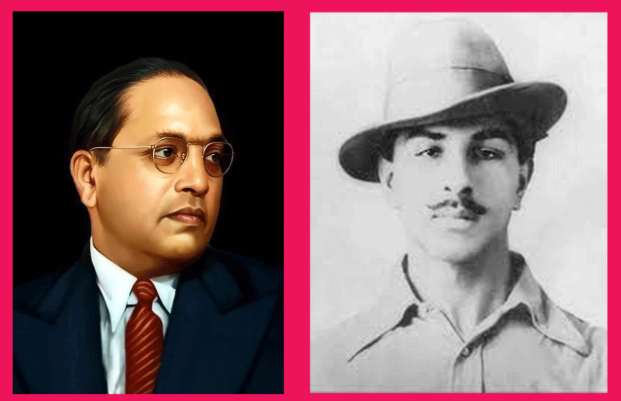
Article Summary : Dr. Bhimrao Ambedkar (14 April 1891 – 6 December 1956)
Dr. Ambedkar’s identity as the architect of India’s Constitution and the messiah of Dalits is well known. Limiting Dr. Ambedkar to this would be an injustice to his great personality.
Bhagat Singh (28 September 1907 – 23 March 1931)
Bhagat Singh was recognized as a revolutionary, patriot, and freedom fighter. He was also a great thinker. In his writings and prison diary, Bhagat Singh expressed his thoughts with great responsibility and maturity.
In his research paper, the researcher has attempted to make a comparative study of the thinking of Dr. Ambedkar and Bhagat Singh.
Key words :- craftsman, architect, caste system, caste abolition, hypocrisy, superstition, revolutionary, guide
Dr. Bhimrao Ambedkar was born on April 14, 1891, into a military family of the Mahar caste in the village of Mhow, Madhya Pradesh. His father’s name was Ramji Rao Maloji Ambedkar and his mother’s name was Bhimabai. Dr. Ambedkar’s entire life was filled with struggle and humiliation. Dr. Bhimrao Ambedkar , the architect of India’s Constitution, is held in high esteem among the world’s greatest scholars and social reformers. The British ruled India for only 250 years, but the exploitation of Dalits , the oppressed, and women had been prevalent for centuries. Everyone was concerned about freedom from the British , but neither then nor today was anyone concerned about the upliftment of the Dalits, the exploited , and the vulnerable, backward classes of society .
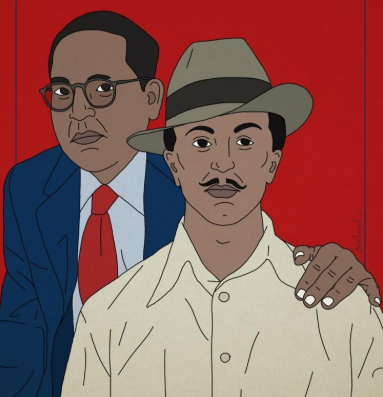 According to the caste system prevalent in Indian society, Dr. Ambedkar was born into the fourth caste. Dr. Ambedkar understood the importance of education and set an example for the world in the field of education. Dr. Bhimrao Ambedkar wrote extensively on 64 topics during his lifetime. Dr. Ambedkar believed that the evils prevalent in society could only be eradicated through education. Dr. Ambedkar believed that “ Education is the milk of a lioness; whoever drinks it will roar .” Ambedkar was the Chairman of the Drafting Committee of the Indian Constituent Assembly , the architect of the Indian Constitution , a renowned lawyer , economist , social reformer , independent and fearless journalist , a bookworm , a politician , the first Law Minister of independent India , a social revolutionary , a pioneer , and a source of inspiration for every struggler.
Bhagat Singh (born September 28, 1907) was 16 years younger than Dr. Ambedkar . He was born into a respectable farming family. He did not suffer the brunt of the caste system that Dr. Ambedkar faced, but he endured torture in prison for his active participation in the revolutionary movement. Three generations of Bhagat Singh’s family were active in the freedom struggle. Therefore, Bhagat Singh’s family situation was quite chaotic. Bhagat Singh’s father, Sardar Kishan Singh, was frequently in and out of jail. Bhagat Singh’s uncle, Sardar Ajit Singh, spent 38 years toiling abroad for the country’s independence. Bhagat Singh’s younger uncle, Sardar Swaran Singh, endured the tortures of prison and was martyred at the age of 23. Distressed by his family circumstances and Gandhiji’s non-violent policies, Bhagat Singh became a member of the active revolutionary group. To limit Bhagat Singh to just a freedom fighter and revolutionary would be an injustice to his multifaceted personality.
Bhagat Singh was also very fond of reading and writing. Bhagat Singh writes in his article “Why am I an atheist ?” “Till this time ( end of 1926 ) I was only a ‘ romantic idealistic revolutionary ‘ . Till now we had followed others. Now the time had come to take responsibility on my own shoulders. The call of ‘study’ was echoing in the corridors of my mind – study to be able to face the arguments put forward by the opponents.” Even when the jail authorities came to take Bhagat Singh for hanging, Bhagat Singh was reading the biography of Lenin.
Ideological similarity between Dr. Ambedkar and Bhagat Singh.
Thoughts on freedom: –
Dr Ambedkar believed that social reform was essential alongside independence and cooperated with the British in pursuing social reforms. On July 28, 1928, Dr Ambedkar enacted a law providing for maternity leave. Ambedkar was a strong advocate of providing strong legal protection to the Scheduled Castes. He was the sole representative of Dalits at all three Round Table Conferences in London, where he demanded separate electorates for Dalits. It is no surprise that Ambedkar later ensured that the welfare of Scheduled Castes was guaranteed in the 1949 Indian Constitution, including reservations in legislative, employment, and educational sectors. According to Dr. Ambedkar , freedom goes beyond just political independence , but also includes social , economic, and cultural freedom , ensuring equal rights and opportunities for all . Dr. Ambedkar was the first to participate in all three Round Table Conferences and demanded separate representation for Dalits. He also demanded fixed working hours for labourers ,and workers.
Bhagat Singh writes in his essay ” Message to the Nation, ” “Attaining independence is our first objective, but the ultimate goal is freedom from all forms of exploitation.” Bhagat Singh wondered if the rights Indians would receive after independence would be the same for ordinary citizens as for the country’s powerful class. “Will this be India’s independence ? ” he asked. “Will this simply be a transfer of power?” Bhagat Singh believed that independence was meaningless, implying that a handful of people would rule while the rest struggled for their basic needs. “This would be a political transfer, not true independence.”
Economic Considerations: –
Dr Ambedkar was a world-renowned economist. He advocated for both economic and social equality, along with political equality. Based on his ideas presented with evidence before Hilton Young in his books ” The Problem of the Rupee – Its Origin and Impact” and ” History of Indian Currency and Banking, ” in 1935, the Reserve Bank of India was established on April 1, 1935. A provincial finance commission was established in British India. In 1945, he paved the way for water policy and economic policies for the country’s industrialisation, river linking, such as the Hirakud Dam , the Damodar Valley Project , the Son River Valley Project , the National Waterways , and the Central Water and Power Authority. He proposed implementing large dam technologies in India.
Bhagat Singh was influenced by Marxism. Karl Marx and Lenin had such a profound influence on him that he began to consider capitalism the greatest enemy of humanity. Bhagat Singh called capitalists ” demons .” Bhagat Singh was a staunch opponent of capitalism and a supporter of the working class and peasantry. The bomb that Bhagat Singh threw in the Assembly was also thrown in the interests of the working class because he did not want the anti-labour bill to be passed. In his prison diary, Bhagat Singh discusses child labour, beggary, the helpless, and the oppression of taxes. In his article, Bhagat Singh praises William Digby, who made important suggestions regarding economic reform in India.
Social Thought: –
Dr Ambedkar was strongly against the caste system prevalent in society. He always faced scorn due to his birth in a lower caste. He felt that even after attaining higher education, he did not receive respect because the caste system was deeply rooted in our society. He wanted to eradicate it. Mahatma Gandhi, opposing untouchability, referred to Dalits as ” Harijans .” After independence, the National Scheduled Caste Commission declared the term “Dalit” unconstitutional. Dr. Ambedkar was a social reformer and a pioneer of women’s empowerment . Dr. Ambedkar’s world-famous book on casteism and the caste system is “Annihilation of Caste ” (1937). His other books on casteism and the caste system include ” Castes in India and Their Mechanization (1916)”, ” Mr. Gandhi and the Emancipation of the Untouchables ” (1942), and ” What Did the Congress and Gandhi Do for the Untouchables ?” (1945) and ‘ Who and How are Untouchables ?’ (1948) are the main ones . According to Dr. Ambedkar, ‘ untouchability is worse than slavery .’ He considered untouchability, caused by casteism and the varna system, to be narrow, inhuman, unscientific , immoral , and divisive. Dr. Ambedkar attempted to abolish the caste system through constitutional means by enshrining the right to equality in the Constitution.
Bhagat Singh also opposed the caste system in his article ” The Question of the Untouchables . ” In 1923 , at the Congress session in Kakinada , Mohammad Ali Jinnah suggested in his presidential address that the Scheduled Castes, now called untouchables, be divided between Hindu and Muslim missionary institutions . Six crore out of 30 crore Hindus and Muslims were willing to contribute money to solidify class distinctions. They are untouchables, if they take out water from the well, the well will become impure, these questions are being asked in the twentieth century, which make one feel ashamed to hear them, Bhagat Singh further writes a Dog Nisha : One can roam in the kitchen but even the shadow of a Dalit makes one impure. Bhagat Singh believed that God created all humans equal; what right do we have to discriminate among them? We believe in God, but we don’t follow the rules He has set. Bhagat Singh couldn’t bear to see the country’s independence, and through his writings and actions, he attempted to eradicate the caste system. Bhagat Singh left behind a message to end the caste system.
Thoughts on religion : People have given different names to religion based on their sect . Based on these names, there are 8 religions found in India: Hindu , Muslim , Sikh , Christian , Jain , Buddhist , Parsi etc. According to the 2011 census, the figures of different religions in India are as follows: Hindu – 79.80% (96.62 crore ), Muslim – 14.23% (17.22 crore ), Christian – 2.30% (2.78 crore ), Sikh – 1.72% (2.08 crore ), Buddhist – 0.70% (84.43 lakh ), Jain – 0.37% (44.52 lakh ), Other religions – 0.66% (79.38 lakh ). The common sentiment in all religions is human welfare. There is an almighty God whom people know by different names , and according to the person, he has created the universe . The reality is that this God did not create religions . He did not discriminate in any way in the creation of the universe.
Dr. Ambedkar opposed the hypocrisy and superstition practiced in the name of religion. He believed that religion makes a person devoid of action. Dr. Ambedkar did not reject religion; if he were against religion, he would not have adopted Buddhism. He was opposed to the negative aspects of religion. On October 13, 1935, Ambedkar made a declaration stating his decision to leave Hinduism . Dr. Ambedkar said , “I prefer a religion that teaches liberty, equality, and fraternity, because three things are essential for a person’s development: compassion , equality, and liberty . Religion is for man, not man for religion. ” According to him, Hinduism lacked all three due to the caste system .
In his article “Why I Am an Atheist,” Bhagat Singh expresses his views on the hypocrisy and superstition of religion. He began a series of articles on ” Anarchism, ” in which he stated that all religions are acceptable in a positive sense. A religion that spreads hatred and divides people should be rejected outright. The fundamental tenets of all religions are truthfulness, non-stealing, and service to others. In this sense, all religions are acceptable. According to Bhagat Singh’s thinking, religion and God are like ghosts . He further wrote , “The mere mention of a ghost frightens people; therefore, religion and God exist to frighten people. Because of the rebellion against these ghosts in Europe, they are now considered the ruling class of Europe.” Bhagat Singh writes that our conservative views are destroying us, and we are trapped in the lamentations of the soul and the divine in our quest for God.
Relation with Gandhiji : –
There was a difference in the views of Dr. Ambedkar and Gandhiji. While Gandhiji supported the caste system, Ambedkar was against it . Gandhiji did not support women learning the English language, whereas Ambedkar was in favor of giving all kinds of rights to women. Gandhiji was of a purely religious nature. Ambedkar completely rejected the negative aspect of religion. The Poona Pact was signed between Mahatma Gandhi and Dr. Bhimrao Ambedkar on 24 September 1932, because Gandhiji had fasted unto death against the British government’s decision of separate electorates ( Communal Award ) for Dalits , and Ambedkar signed this agreement to ensure better representation for Dalits .
Bhagat Singh actively participated in the revolutionary movement, contrary to Gandhiji’s non-violent policies. He participated in violent activities. Bhagat Singh frequently criticized Gandhiji in his writings. Bhagat Singh wrote that Gandhiji promoted religious fanaticism by supporting the Khilafat Movement.
conclusion
Although the views of Dr. Ambedkar and Bhagat Singh may not have aligned with Gandhiji, this was a difference of opinion , not a difference of heart. Both respected Gandhiji and acknowledged the importance of his role in the national movement. Dr. Bhimrao Ambedkar and Shaheed – e – Azam Bhagat Singh are precious gems of this country whose loss can never be compensated. Whenever voices are raised against injustice in this country, Dr. Ambedkar and Bhagat Singh will continue to inspire everyone . We salute such great personalities .
Finally, I would like to express my gratitude to my guide Dr. Ramji Lal under whose guidance this article was completed.