
by K S Chalam
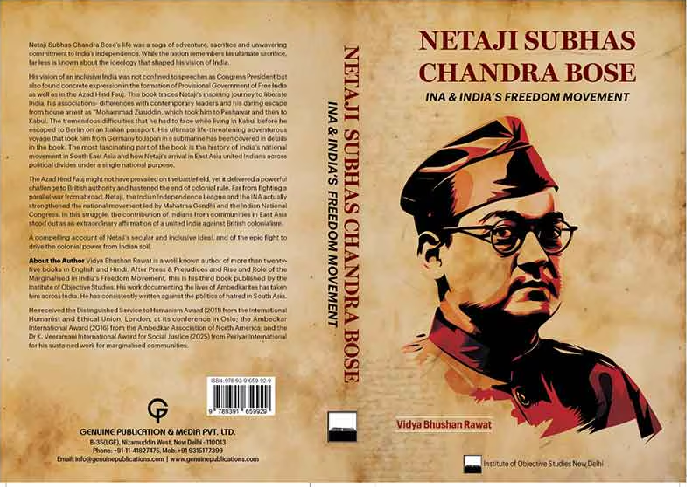
(Asian independent) There are more than sixty books in English on Netaji. If Hindi, Bengali, and other vernacular language writings are counted, they would form a hagiography of a hero from a great epic struggle for India’s freedom movement. There are several versions and distortions in the narrative, designed to exploit the supreme sacrifice made by Subhas Chandra Bose for the selfish ends of certain traditional groups who are experts in spinning puranas. They can link anything to anyone, narrate an episode, and expect returns from such an enterprise. But Subhas Babu is beyond the imagination of these partisan pundits. It is disappointing that the life and mission of one of the greatest sons of India were allowed to languish for decades even after independence. It is in this context that the study by Vidya Bhushan Rawat, a prolific writer and activist, titled Subhas Chandra Bose: INA and India’s Freedom Movement, is altering the narrative from fiction to reality using facts and archival evidence. This is a massive volume of around 450 pages published by the Institute of Objective Studies, New Delhi.
The study can be broadly divided into three parts. The first part is devoted to his childhood formation and early entry into the freedom movement; the second part covers his adventurous life and association with the Azad Hind Fauj; and the final part explores his last journey, coupled with an epilogue. The references contain scholarly studies with endnotes and an index.
The book features 20 chapters, starting with a compelling introduction explaining how rumors surrounding Netaji’s secret files were used by “WhatsApp universities” to implicate and disrepute Jawaharlal Nehru, the Indian National Congress (INC), and the secular socialist group within the Congress. The author’s objective in writing the book is to “look at Netaji’s legacy in a very comprehensive way which means respecting and honoring his supreme sacrifice for the country and more importantly, understanding his ideological positions on national issues and the way he walked the talk.” This objective led him to consult not only massive archival data, hundreds of books, and papers, but also to conduct personal interviews with individuals directly connected to Subhash Chandra Bose. This unique approach tests the validity of written statements by counter-checking facts with people who witnessed the incidents, events, and happenings. The author consulted prominent authorities, including Bose’s grand-nephew Prof. Sugata Bose, Lt. R. Madhavan (who was associated with the INA in Burma), family members of Abid Hasan Safrani in Hyderabad, the Netaji Research Bureau in Kolkata, and several others who were directly or indirectly connected to Bose. This gives the study the credibility it deserves.
The author was clearly concerned about how Bose has been projected by motivated individuals and groups as a traditional, conservative factionalist who fought against both Mahatma Gandhi and the secular socialist Nehru. Rawat was very careful in selecting topics and material to shed proper light on Subhas Bose, the Mahatma, and the right-wing faction within the INC. The book features a chapter on the dynamic visions of Nehru and Bose, alongside others like Dr B.R. Ambedkar. In fact, Subhas was a member of the Congress Socialist Party (CSP) group, which consisted of Pandit Nehru, Narendra Deva, Jayaprakash Narayan, M.R. Masani, P.C. Joshi, Sajjad Zaheer, R.P. Dutt, and a few others, including Mulkraj Anand, who edited Marx’s writings on India. The text brings out clear, concrete evidence showing that two distinct groups existed within the Congress and explains how Bose was eventually eased out by one of them.
Subhas Chandra Bose was born on January 23, 1897, in Cuttack, which was then a part of Bengal before Bihar and Orissa separated to form a combined state in 1905. His father, Janakinath Bose, moved to Cuttack from the 24 Parganas in 1880 to pursue a legal career, later returning to Kolkata in 1909. Bose’s political career took a fascinating turn when he refused to accept a position in the Civil Services after qualifying for it at Cambridge in 1919. His ideological struggle against British imperialism began with this decision and his active association with the Majlis society at Cambridge. The author depicts his close association with freedom fighters, particularly the Bengali bhadralok. Being a Kayastha himself, Bose had experienced caste discrimination in Varanasi at a young age, which drew him to the philosophies of Aurobindo Ghosh and Swami Vivekananda.
The primary merit of the book is how the author explains that Bose maintained a good relationship with Gandhi despite his deep ideological differences with the right-wing group within the Congress, which shaped his identity as a secular and socialist Hindu. His differences with this right-wing group—consisting of Vallabhbhai Patel, Dr Rajendra Prasad, C. Rajagopalachari, and Govind Ballabh Pant—became public when he contested the presidency of the Congress Party at the Tripuri Congress in January 1939, defeating Gandhi’s nominee, Pattabhi Sitaramayya. Following this event, Bose resigned under pressure, was expelled by the faction, and subsequently founded the Forward Bloc on May 3, 1939. Bose justified this move in his paper Forward Bloc: Its Justification, stating that while Gandhism was intimately linked with the “haves” and vested interests, the Forward Bloc would be a party for labor, factory workers, peasants, and progressive youth.
The relationship between Nehru and Bose is dispassionately depicted by the author as one of cordiality and camaraderie, marked by political, ideological, and familial proximity. The author unequivocally condemns the malicious propaganda unleashed against Nehru regarding Bose’s disappearance and ultimate death in a plane crash, refuting it with textual evidence, documentary confirmation, and personal testimonies from Bose’s closest associates. Rawat highlights the dynamic visions of both Nehru and Bose as members of the CSP and founders of the Indian Independence League (IIL), which often discomforted Gandhi despite the ongoing bonhomie between the two leaders. In his Presidential address on December 27, 1936, Jawaharlal Nehru noted: “Soon after the last Congress, I had to nominate the Working Committee and I included in this our comrade Subhas Chandra Bose. But you know he was snatched away from us on arrival at Bombay and ever since he has been kept in increment despite failing health. Our Committee has been deprived of his counsel and I have missed throughout the year this brave comrade.”
This intimate, sentimental bond expressed by Nehru towards Bose was visible again when Anita, Bose’s daughter, wrote to him. The author culled information from now-declassified files showing how Nehru created a trust fund of Rs 2 lakhs out of INA funds to ensure the welfare of Bose’s family. The book includes the personal letter Nehru wrote to Anita on November 17, 1960. Through these instances, the author demonstrates that the Nehru-Bose camaraderie was not just a political alliance but an enduring ideological and familial bond. In fact, at the Haripura Congress, Netaji delivered a 9-point declaration resolutely outlining fundamental rights for every Indian citizen. This declaration later became the framework for the Objectives Resolution of the Constitution, which Nehru presented to the Constituent Assembly on December 13, 1946, reproducing most of the ideals Bose had originally spelled out.
Netaji’s escape from India to Germany through Afghanistan in disguise using an Italian passport, along with his other adventures, are detailed with precise dates and supporting documentation. The author points out that Bose was highly respected by the Muslim community, illustrating this with a historical incident where Muslim Rajputs laid an early foundation for India’s independence through a mutiny in Singapore on February 15, 1915. Rawat narrates how prominent Muslim leaders cooperated closely with Bose, including his lifelong associate Abid Hasan Safrani of Hyderabad (who coined the slogan “Jai Hind”), General Shah Nawaz Khan, Khan Abdul Ghaffar Khan of Kabul, and the numerous Muslim soldiers of East Asia who joined the Indian National Army (INA). Bose also maintained strong ties with Sikh sepoys, Dr B.R. Ambedkar, and other prominent secular leaders of the era, showcasing his profound commitment to secularism.
The author devotes significant portions of the book to Bose’s adventurous movements, the formation of the Azad Hind Fauj, the integration of East Asian prisoners of war (POWs) into the INA, and the establishment of the National Bank of Azad Hind in Singapore to sustain a force of around 50,000 soldiers and officers. The Provisional Government of Azad Hind was established on October 23, 1943, with Bose as Prime Minister, alongside Captain Lakshmi Swaminathan, S.A. Ayer, Lt. Col. A.C. Chatterji, and several armed forces representatives and advisers. The Proclamation of Independence was read aloud by A.M. Sahay in Hindustani, by Chidambaram in Tamil, and in English by Bose himself. The author details how the INA participated in the war with support from Japanese Prime Minister Hideki Tojo, who met Bose personally and backed the campaign to weaken British imperialism. The book outlines the battles fought from March 21 to August 14, 1944, including the capture of Imphal and Kohima. Netaji later realized that Japan could no longer offer assistance after the atomic bombings of Hiroshima and Nagasaki. He decided to leave Japan for Manchuria, hoping that if Soviet forces occupied the region, it would be safer to seek Russian custody rather than falling into the hands of the Anglo-American forces. The author notes that Bose had previously attempted to cross Afghanistan to reach Russia, a plan that was sabotaged and forced him to land in Germany instead. The author convincingly argues that Bose’s intention was never to align with Nazi ideology, but rather to strategically leverage a wartime adversary to defeat their common enemy, the British Raj.
The book strongly highlights Subhas Chandra Bose’s identity as a socialist, analyzing the programs of the Azad Hind Fauj in a brief but powerful section titled “Understanding Azad Hind Fauj under Netaji and Its Ideological Perspective.” This should be read in conjunction with his highly innovative concept of “municipal socialism,” which Bose developed and explained in detail to a gathering at the Bombay Corporation on May 10, 1938: “Civic progress all over the world is moving in the direction of what may be called Municipal Socialism. ‘Socialism’ is a word that is sometimes a bogey to many, but I believe that if we analyze and try to understand what socialism stands for, particularly what municipal socialism stands for, we shall have no reason to fight it… Today every modern municipality has taken upon its shoulders immense duties that were unthinkable twenty or thirty years ago… Today a modern municipality has to furnish not merely pure drinking water, roads, lighting etc., but it has to provide primary education and it has to look after the health of the population and tackle problems of infant mortality, maternity, drainage and similar problems.”
According to The Essential Writings of Netaji Subhas Chandra Bose, Netaji viewed communism as the absolute abolition of private property, drawing parallels to its practice among the Khasi people of Assam, where “the whole clan owns the entire land.” He advocated for a system where the means of production and distribution of wealth remained under state control. He envisioned a casteless society completely free of depressed classes, ensuring absolute gender equality both socially and legally. This vision closely mirrors the memorandum “States and Minorities” submitted by Dr B.R. Ambedkar to the Constituent Assembly in 1947. Further details regarding his vision can be gathered from his writings justifying the formation of the Forward Bloc, demonstrating that his commitment to secularism and socialism remained unwavering until the very end.
The final journey of Subhas Chandra Bose is narrated in a dedicated chapter with meticulous detail, describing how the Japanese government kept him constrained with very little information to plan his next steps. Deeply concerned about supply lines for the INA, Bose intended to travel to Manchuria to contact Soviet forces for assistance in continuing the fight against British imperialism. He requested an aircraft from the Japanese authorities, though there was a lack of clear coordination regarding how Bose and his comrades should proceed. The aircraft assigned was a Mitsubishi Ki-21 bomber, which transported Bose and Habib-ur-Rahman from Tourane (Da Nang, Central Vietnam) to Taipei, Taiwan, by August 18, 1945. The plane took off from Taihoku (Taipei) Airport at 2:00 PM on August 18, 1945, but crashed to the ground just two to three minutes after takeoff. Col. Habib-ur-Rahman, who survived the crash with injuries, stated that Bose was rushed to a military hospital where he breathed his last at around 9:00 PM that evening. A radio broadcast on August 23, 1945, officially announced that Netaji had passed away due to severe injuries sustained in an airport accident at Taihoku. His ashes were collected by Col. Habib-ur-Rahman, taken to Japan, and placed in the Renkoji Buddhist temple. As the war concluded, Allied forces under US General Douglas MacArthur took control, the British Raj captured the remaining INA soldiers, and the historic Red Fort trials began. Netaji’s death has been a very contested issue in India but his daughter Anita Bose and other family members have accepted the plane crash theory.
Vidya Bhushan Rawat narrates how the British Indian government prosecuted INA personnel and officers as common criminals. This crisis provided the Congress with a vital opportunity to unite the country against British rule; Nehru lobbied Lord Mountbatten heavily to ensure a fair trial, insisting that the soldiers be treated with the honor and dignity befitting freedom fighters. The book concludes with a poignant chapter titled “Understanding the Plight of INA Commoners in Post-Independence India,” which highlights the hardships and neglect faced by these veterans after independence. Sadly, many were denied their back pay and pensions. Compounding this injustice, they were barred from joining the regular Indian Army due to arbitrary classification systems. The veterans eventually organized themselves into the INA Veterans Association, fighting a prolonged battle against the independent government until they finally secured their pensions in 1983.
In the epilogue, the author notes that many government files related to Bose were declassified in 2014. He laments that during the decades these files remained closed, politically motivated groups fabricated stories to mystify Netaji’s legacy for partisan appropriation. However, now that the files are public and activist-writers like Vidya Bhushan Rawat are bringing the facts forward, the true life and mission of Bose are accessible to all citizens of India. As historian Prof. Sugata Bose remarked, “Both Nehru and Netaji were two towering personalities and also great friends even when they had their differences.” While the author’s ambitious scope occasionally blurs his chronological and analytical priority due to the sheer volume of material on Bose’s post-escape adventures, the book remains a highly accessible, descriptive, and readable work rather than a dense academic text. The author deserves immense credit for successfully presenting Subhas Chandra Bose as an authentic, secular socialist with a powerful, rational message for the present generation.
Name of the Book : Netaji Subhas Chandra Bose, INA and India’s Freedom Movement
Author : Vidya Bhushan Rawat
Publisher : Institute of Objective Studies, New Delhi
Pages : 442, Price : Rs 695/-
The book is available on Amazon and Flipkart. You can order it from the publisher too.
Prof K S Chalam, Chairman, Institute for Economic and Social Justice, Visakhapatanam, Former Member UPSC, Former Vice Chancellor, Dravida University, Kuppam, Andhra Pradesh.