

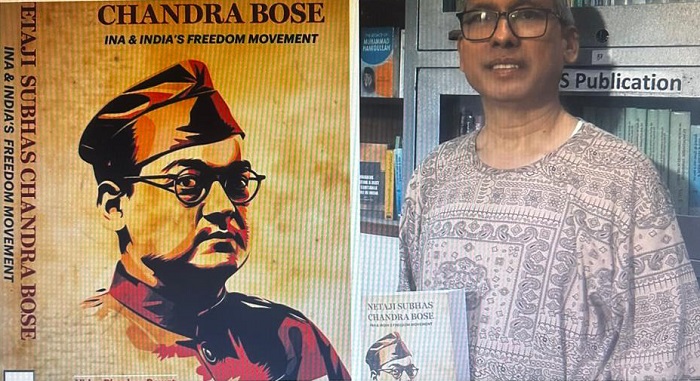
Moving beyond controversies surrounding Netaji’s disappearance, the book explores the ideas that shaped his politics, the role of the Indian National Army, and the historical realities behind attempts to portray him as anti-Nehru
(Asian independent) Netaji Subhas Chandra Bose, INA and India’s Freedom Movement, by Vidya Bhushan Rawat, offers a comprehensive and honest examination of one of South Asia’s most dynamic icons—a leader who has either been ignored by “mainstream” historians or appropriated by the right wing. Historians and political scientists have often left room for others to appropriate the legacy of those regarded as dissenters from Mahatma Gandhi and the Indian National Congress. While Netaji and his contemporaries had clear ideological differences over India’s path to independence, his commitment to secularism and India’s diversity remained firm until the end. He took pride in India’s multicultural and multi-religious heritage, as reflected in his speeches and the structure of the Indian National Army (INA) under his leadership.
While numerous books on Netaji focus on generating controversy around his final moments—claiming either that he escaped to the Soviet Union or that he perished in a plane crash—Rawat deliberately focuses on Netaji’s ideological formation, his pivotal role in organising the Indian National Army (Azad Hind Fauj), and how later Indian leaders, particularly Jawaharlal Nehru, addressed his legacy after independence.
The author traces Netaji’s ideological development from his early life, as documented in his autobiography, through his leadership of the Indian National Congress. Rawat highlights Netaji’s commitment to secularism, socialism, and inclusive Indian nationalism, dedicating key chapters to his relationships with Gandhi, Nehru, and Patel.
Netaji is often accused of allying with Hitler’s fascist regime without sufficient consideration of the broader international circumstances. His daring escape from house arrest and journey to Peshawar, followed by his attempts to reach the Soviet Union, reveal a complex picture. He initially intended to reach Moscow, where several Indian revolutionaries were stationed, but his contacts failed to coordinate the logistics. Stranded in Kabul—a hub for international spies from Britain, Germany, Italy, the Soviet Union, and the United States—he faced a high risk of exposure and arrest. For nearly two months, he posed as a deaf and mute Pathan seeking medical treatment. Under these perilous circumstances, the Italian Embassy ultimately provided him with a passport to travel to Germany. Like many anti-colonial leaders, Netaji believed that defeating British imperialism required assistance from rival world powers. Although Germany showed limited interest in his cause, it facilitated his onward journey to Japan.
The book details his perilous submarine journey from Germany to Japan, where Indian activists had already organised themselves under Rash Behari Bose. While many biographers focus exclusively on Subhas Chandra Bose, Rawat offers a detailed analysis of the origins of the Azad Hind Fauj. He brings lesser-known historical facts to light without resorting to sensationalism.
Ultimately, the book focuses on Netaji’s ideological vision for the future. As head of the Provisional Government of Azad Hind, Netaji established an inclusive governance structure represented by people from different regions and religious communities. Unlike those driven by regional chauvinism, Netaji remained free from caste prejudice and religious narrow-mindedness. The mottos, composition of its leadership, and national anthem of Azad Hind reflected his commitment to India’s pluralism.
The book does not claim to uncover entirely new historical facts but instead connects existing ones in a logical manner. Its greatest strength lies in its ability to address sensitive topics without stirring unnecessary controversy. In an age increasingly shaped by online algorithms, the book relies on research and offers an objective appraisal of historical events. Modern political factions have attempted to use Netaji’s legacy to attack Nehru. However, archival records suggest that Netaji and Nehru, despite their political differences, shared mutual respect and progressive ideological commitments within the Congress Party.
Rawat highlights several of Netaji’s speeches from his tenure as Congress President and details his bitter departure from the post. Rather than judging who was right or wrong, the author presents the facts in their historical context.
The book is structured into four main parts:
- Netaji’s ideological formation and his tenure with the Congress Party.
- His difficult escape from India to Kabul and his journey to Germany.
- His work in Japan and Singapore, where he mobilised the Indian diaspora across Southeast Asia.
- The aftermath of Japan’s surrender in the Second World War and the path to Indian independence.
Beyond his patriotism and personal sacrifice, Netaji’s core ideological convictions stand out. Rawat emphasises how Netaji’s vision of a diverse India was put into practice within the structure of the INA, helping to reignite the liberation movement across Southeast Asia.
The book also reconstructs Netaji’s final days through accounts from his close associates, capturing the atmosphere following Japan’s surrender. Although the INA fought bravely, global geopolitical shifts and Japan’s defeat left the army without adequate ground support.
Netaji’s dream of an independent India was realised on August 15, 1947, when India gained independence and Jawaharlal Nehru became its first Prime Minister. In the post-independence era, the status of INA soldiers and the question of Netaji’s fate became central public concerns. While official commissions reached their own conclusions, Rawat avoids conspiracy theories and instead examines how successive governments handled the INA’s legacy. Although Nehru and Netaji had clear political differences, attributing every post-war complication to Nehru would be historically inaccurate.
The book contains 20 chapters covering Netaji’s life, his departure from India, the historic INA trials, and his lasting legacy:
- Introduction
- Growing up in Conviction and Ideological Commitment to the Nation
- Subhas, Mahatma, and the Right-Wing
- Jawahar and Subhas: Dynamic Visionaries
- Democracy, Socialism, and Social Justice
- Netaji and the Muslim Question
- The Great Victory at the Removal of Holwell’s Monument
- A Letter Written with Deep Conviction and Political Understanding
- The Great Escape and Role of Mian Akbar Shah
- Dreaming Moscow but Ended up in Berlin
- Strengthening the Anti-Colonial Movement to Liberate India
- An Adventure of Life and a Comrade with the Mission
- A Forgotten Mutiny by Muslim Rajputs of the British Indian Army in Singapore
- Giani Pritam Singh: A Forgotten Hero and the First Martyr of the INA Movement
- Azad Hind Fauj: From Rash Behari Bose to Subhas Chandra Bose
- The Provisional Government of Free India
- Understanding Azad Hind Fauj under Netaji and its Ideological Perspective
- A Journey Towards Eternity
- The Trial that United India
- Understanding the Plight of INA Commoners in Post-Independent India
The book’s greatest strength lies in its exploration of Netaji’s guiding principles—socialism, secularism, democracy, and language policy. The account of his escape and journey to Germany is particularly compelling. Netaji remains a major figure in global anti-colonial history, driven by national interests rather than personal ambition.
The author also deserves credit for highlighting overlooked figures and events, such as the Singapore Mutiny involving Muslim Rajputs and the contributions of Giani Pritam Singh. The historical narrative concludes by examining the Red Fort trials, which united public sentiment across India, and the subsequent treatment of INA soldiers by the post-independence government.
Rawat offers a balanced assessment of Netaji and the INA, emphasising a legacy rooted in the vision of a united, pluralistic India. Readers seeking conspiracy theories will not find them here; instead, they will find an account that prioritises historical research, context, and a measured interpretation of events.