SR Darapuri I.P.S.(Retd)
(Note: Navi Pillay has been awarded Nobel Peace Prize- 2026 t0day. She has been very sympathetic to Dalits of India.)

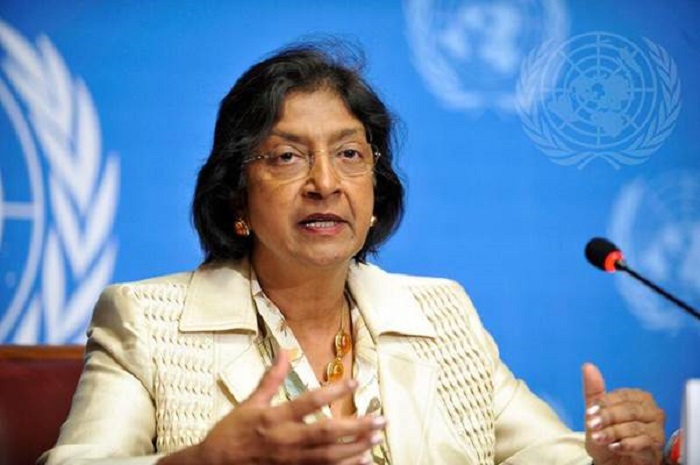
(Asian independent) Navi Pillay, UN High Commissioner for Human Rights (2008–2014), was the first holder of the office to systematically and publicly treat caste-based discrimination as a major global human-rights issue requiring international attention and action. Her statements at and around the UN Human Rights Council (HRC), in official speeches, side events, and interviews framed it as a form of discrimination based on work and descent that violates core principles of equality and non-discrimination.
Key observations
Pillay repeatedly described caste-based discrimination (including “untouchability”) as affecting roughly 250–260 million people worldwide, the large majority in South Asia (especially India). She characterised it as:
– A system rooted in notions of ritual purity and pollution that produces lifelong humiliation, exclusion, poverty, segregation, and violence.
– Not limited to one country, religion, or region; it appears in various forms in South Asia, Japan, Africa, the Middle East, and diaspora communities.
– Destructive of the human-rights principles her office was mandated to uphold. She drew explicit parallels with her own experience of racial and gender discrimination under apartheid in South Africa.
Specific points she emphasised included:
Manual scavenging: (cleaning toilets/sewers by hand), largely forced on Dalit women, as a particularly degrading manifestation that reinforces stigma. She welcomed campaigns against it in India and stressed the need for enforcement and rehabilitation.
Intersection with gender: Dalit women face “double assault” of caste and gender discrimination, limited access to land/inheritance/resources, higher illiteracy, and high levels of sexual violence often committed with impunity.
Failure of implementation: Even where strong constitutional bans, affirmative-action programmes, and anti-atrocity laws exist (as in India), enforcement is weak, accountability is lacking, and a climate of impunity persists.
The need for international standards: She strongly supported the 2009 Draft Principles and Guidelines for the Effective Elimination of Discrimination based on Work and Descent and called for their endorsement by the HRC and governments. She suggested that a dedicated international convention might eventually be required because existing instruments had been insufficiently applied.
Notable moments at or linked to the HRC include her 2009 opinion piece “Tearing down the wall of caste,” references in opening statements (e.g., 26th session, June 2014), side-event interventions on Dalit women and caste-based violence, and public meetings such as the 2013 House of Lords event organised by the Anti-Caste Discrimination Alliance. Unfortunately, India has not yet ratified 2009 Draft Principles and Guidelines for the Effective Elimination of Discrimination based on Work and Descent
She also praised national steps (e.g., Nepal’s 2011 Caste-based Discrimination and Untouchability Act) while insisting that laws alone are insufficient without changes in mindset, community attitudes, and accountability.
Implications for India
India is home to the largest population of people affected by caste discrimination (estimated at around 200 million Dalits at the time). Pillay’s observations carried several direct and ongoing implications:
- Challenge to the “domestic matter / not race” position
India has long argued at UN forums (including CERD and the Durban process) that caste is a social/internal issue distinct from racial discrimination under the International Convention on the Elimination of All Forms of Racial Discrimination (ICERD). Pillay, like CERD’s General Recommendation 29 (2002), treated discrimination based on descent as covering caste. Her public stance increased pressure on India to engage rather than block discussion of caste in international human-rights bodies.
- Scrutiny of implementation gaps
She acknowledged India’s progressive laws and institutions but repeatedly asked why enforcement remained weak. This framed the problem not as absence of legal tools but as political will, institutional capacity, and social attitudes—points still raised in later UN reviews (including the long-delayed CERD examination of India).
- Heightened international visibility and advocacy space
Pillay’s interventions gave legitimacy and visibility to Dalit organisations and international networks (e.g., International Dalit Solidarity Network). They encouraged side events, special-procedure statements, and civil-society engagement at the HRC. Subsequent High Commissioners and treaty bodies continued to reference caste, even if formal HRC resolutions specifically on “caste” remain limited due to state resistance.
- Calls for leadership
In early visits and statements (including in India and Nepal in 2009), she urged India to address the issue domestically and to show leadership globally, noting that Prime Minister Manmohan Singh had himself compared untouchability to apartheid. Failure to do so, in her view, left a gap that international mechanisms needed to fill.
- Continuing relevance
Although Pillay left office in 2014, the framework she promoted (descent-based discrimination, Draft Principles and Guidelines, focus on intersectional violence against Dalit women, enforcement of existing laws) remains part of UN discourse. Later CERD observations on India have reiterated concerns about segregation, violence, manual scavenging, and inadequate prosecution under anti-atrocity laws—echoing themes she highlighted.
In short, Pillay’s observations shifted caste-based discrimination from a largely peripheral or contested topic at the UN into a recognised human-rights priority. For India this meant sustained external scrutiny of the gap between constitutional ideals and lived reality, greater space for domestic and diaspora advocacy, and recurring pressure to treat caste discrimination as a matter of international human-rights law rather than solely internal social policy.