
THE ASIAN INDEPENDENT UK

Bal Ram Sampla
Geopolitics
In September 2026, the UK government announced sanctions on Israeli settlements in the occupied West Bank, trade restrictions on goods.
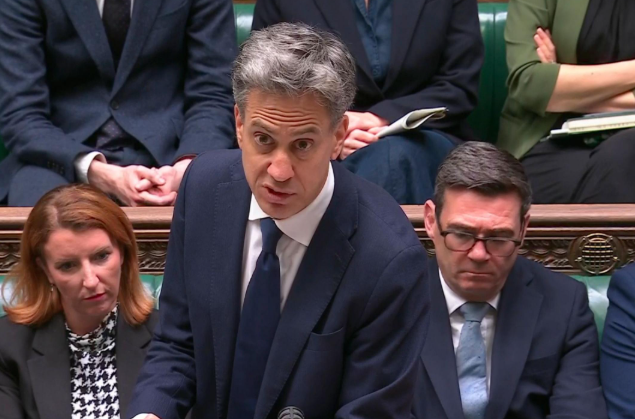
Foreign Secretary Ed Miliband called it a “reset.” For some inside his own party, it looked more like an act of self-harm, dressed up as principle. This is not a tidy policy story. It is a raw exposure of a party that cannot decide what it stands for.
A Direct Warning, Ignored
Peter Prinsley did not mince words. Days before the announcement, he sat across from Ed Miliband and told him plainly: this will put British Jews in danger. Not “may create tension.” Danger. His fear is blunt and specific , that people who hate Israel will not bother to separate a government’s settlement policy from a religion, a philosophy, or a Jewish grandmother walking to synagogue in Golders Green.
History gives that fear teeth: antisemitic incidents in Britain have surged since 2023, and every escalation abroad has been followed by attacks, threats, and vandalism at home. Prinsley’s warning was not paranoia. It was a Jewish MP looking his own foreign secretary in the eye and being ignored anyway.
Jonathan Hall, the government’s own independent reviewer of terrorism legislation, said much the same: this risks painting a target on British Jews. The government proceeded regardless.
Cheered by the Wing That Cost Labour Seats
On the other side of the party, the announcement was met with open satisfaction. Labour’s pro-Palestinian flank , a bloc that includes Muslim MPs and grassroots activists who have hammered the leadership relentlessly since Gaza.
Got what it has been demanding for two years. It is not a coincidence that this policy shift follows a general election in which Labour hemorrhaged seats to independent pro-Gaza candidates and continues bleeding support to the Greens. A party spooked by its own electoral map does not need a conspiracy to explain its behaviour; it needs a calendar. Whatever the stated justification about “ethnic cleansing” in the West Bank, it is fair to ask, bluntly, whether this is about international law or about Labour trying to claw back voters it lost in 2024. Both can be true at once, and pretending otherwise insults the intelligence of everyone watching.
A Can of Worms Britain Cannot Fully Control
There is a further problem the government does not appear to have war-gamed: retaliation does not stay confined to the issue at hand. Israel’s foreign minister Gideon Saar has already warned that “if Britain acts against Israel, Israel will act against Britain,” and Itamar Ben-Gvir, Israel’s hard-line security minister, has needled Netanyahu to publicly back Argentina’s claim over the Falkland Islands.
Whether or not that particular remark hardens into policy, it illustrates the mechanism: once a diplomatic relationship turns adversarial, disputes that have nothing to do with the original grievance become available as leverage. Britain has spent decades and a war defending its sovereignty over the Falklands. Opening a front with Israel over West Bank settlements, only to hand a hostile government a symbolic stick to prod that sovereignty with, is a reckless trade if the aim was simply to register moral disapproval of settlement expansion.
This points to a harder question than whether the policy is right or wrong on the merits: whether Britain is still the kind of power that can afford to take this stance at all. A government that no longer commands superpower leverage, and that still has open sovereignty questions of its own, arguably has less room than it thinks to insert itself into a conflict it is not a direct party to. Especially when the practical effect of the sanctions is purely symbolic at best, and even the Conservative Shadow Home Secretary has said the policy will be very difficult to enforce. If the sanctions cannot meaningfully change Israeli policy but can meaningfully provoke retaliation on unrelated fronts, the calculation looks less like principled foreign policy and more like a gesture Britain cannot fully afford to make.
The Cost Is Not Abstract
What should trouble anyone watching this, regardless of where they land on Israel and Palestine, is who pays the price for Westminster’s positioning. It will not be Ed Miliband. It will not be the strategists calculating which seats are winnable. It will be ordinary British Jews, who did not build a settlement, did not choose a government policy, and will nonetheless be first in the firing line if this warning proves correct.
Just as ordinary British Muslims are routinely blamed, smeared, and surveilled for crises they did not create either. A foreign secretary was told, to his face, by a member of his own party, that this decision could get people hurt. He made the announcement anyway. That is not courage. That is a government treating a vulnerable community’s safety as an acceptable cost of a political calculation — and calling it principle.
Reference
1.https://www.huffingtonpost.co.uk/entry/uk-israel-sanctions-west-bank-miliband_uk_6a9fac31e4b03901c95914a4
2.https://www.jewishnews.co.uk/miliband-sanctions-plan-against-israeli-settlements-to-be-announced-tuesday/