
THE ASIAN INDEPENDENT UK

Bal Ram Sampla
Geopolitics
A Political Analysis
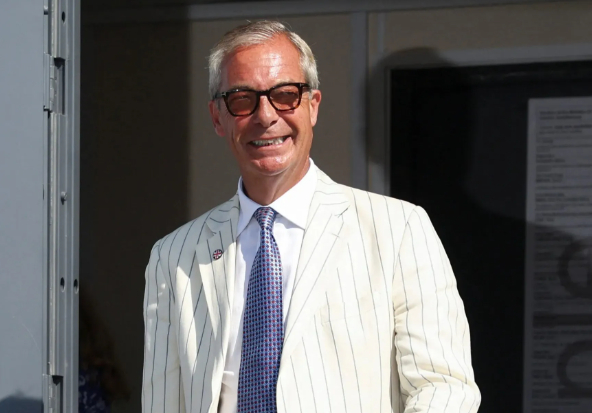
On 13 August 2026, voters in Clacton-on-Sea queued up to mark a ballot paper over a metre long , a document so long it became, almost instantly, the defining image of the day. Thirty-four candidates. A record. And at the centre of it all, the man who had engineered the entire spectacle: Nigel Farage, resigning a seat he already held in order to win it back, to let “the people” judge him on a matter that was never actually theirs to judge.
That framing was the con at the heart of the exercise. The question hanging over Farage was not “should Nigel Farage be my MP” , voters had already answered that in 2024. The question was whether he failed to declare a £5 million payment from political donor Christopher Harborne, a matter under scrutiny by parliamentary standards processes built precisely because financial disclosure isn’t supposed to be adjudicated by popularity contest.
You cannot outrun a standards investigation by winning an election; the two operate on entirely different tracks, and Farage knew it. The Commons standards case didn’t vanish on 13 August. It resumed the next day, exactly where it left off, because a by-election was never the appropriate forum to litigate an undeclared donation. Calling it “letting the people be the judge” isn’t accountability, it’s picking a jury with no jurisdiction over the case.
What made the whole affair farcical rather than merely cynical was the collapse of any real contest. Labour, the Conservatives, the Liberal Democrats, the Greens, and Restore Britain all declined to field candidates, several explicitly calling the vote a stunt designed to distract from the standards case.
That boycott didn’t protect the process, it hollowed it out. Rather than a genuine electoral test, Clacton became a two-hander between Farage and Count Binface, a man who campaigns in a rubbish bin as a self-declared “intergalactic space warrior.” A serious democratic mechanism, the by-election , was reduced to a novelty act because nobody with anything to lose wanted to dignify the premise by showing up.
And that’s where the numbers tell the real story. Farage won, comfortably, with 22,239 votes to Binface’s 9,455 , a majority of nearly 13,000 on a diminished 44% turnout.
But strip away the horse-race framing and look at what actually happened: a joke candidate who had never before cracked a few hundred votes in any of his six previous campaigns pulled in nearly 27% of the vote and Farage’s best-ever personal result, in what is supposed to be one of the most favorable constituencies in the country for Farage’s politics.
That is not a footnote. That is roughly a quarter of an electorate looking at a serious sitting MP under financial scrutiny, a walkover field with no mainstream opposition, and choosing, deliberately, performatively , a man in a bin over him. It is difficult to construct a reading of that result as “overwhelming” without simply asserting it, which is exactly what Farage did on the night, calling it a “convincing, overwhelming win” while declining to engage with what a near-27% protest vote against an unopposed incumbent actually signals.
Turnout collapsed too, down more than 13 points from the 2024 general election — which is its own quiet verdict. A contest stripped of real opposition and real stakes doesn’t galvanize a constituency; it exhausts it. Voters who might otherwise have shown up to register support for a mainstream alternative had no alternative to register it for, so many simply didn’t bother.
The “record 34 candidates” spectacle, far from demonstrating a flourishing of democratic choice, was mostly noise filling a vacuum the serious parties had left behind, a metre-long ballot paper as a monument to how little genuine choice was actually on offer.
So look at what the exercise produced against what it was billed to produce. Farage sold it as a reckoning: put himself before the people, let them render judgment, restore his mandate beyond doubt. What actually happened was a boycotted, ‘low-turnout, joke-candidate-boosted re-election’ in which a fifth of engaged voters treated the whole affair with open contempt, and the underlying financial question , the only thing that ever needed answering , remains exactly where it was in July.
The circus has folded its tents and left town. The probe hasn’t gone anywhere. Nothing about Clacton changed the facts of the £5 million payment, and nothing about winning a seat he already had constitutes evidence about whether he should have declared it. The spectacle is over. The substance was never on the ballot.