By Surjit Singh Flora

(Asian independent) When a medical entrance exam is cancelled, it can ruin much more than an exam schedule. It can destroy months of preparation, upset a family’s finances, and turn an expected result into yet another period of uncertainty.
That’s why the NEET controversy has become a big issue for Indian families in Canada and elsewhere. But there is one thing must be plain. Reporting available confirms large protests in India and diaspora activity in New York, London, Manchester, Berlin, and parts of the Netherlands. It’s not a good barometer for a NEET rally in Vancouver.
Some of the claims about the protests in Canada are unverified, but the anger is real.
A Cancelled Exam, A Broken Year
NEET-UG 2026 was held on May 3 for students seeking admission in undergraduate medical courses in India. It is said that more than 2.2 million candidates sat for the test at thousands of centres.
Then came the charge of leakage of question-papers and other irregularities. The National Testing Agency (NTA) had cancelled the examination on May 12. Reports said a re-test was carried out on June 21, with the results published on July 16.
This was no small administrative correction. It was a break in the lives of students who had spent years preparing, often with the help of expensive coaching programmes and multiple attempts.
The NTA was asked for a full explanation. The protesters demanded an independent investigation, action against those responsible and clear guidelines for students impacted by the cancellation. The case was transferred to the Central Bureau of Investigation. The Union Education Minister, Dharmendra Pradhan was also asked repeatedly to answer for his actions and resign.
Reports of arrests and alleged compromised questions fueled public suspicion. These are allegations that need to be investigated and proven with evidence and be given due process. But the anger did not come out of a clear sky.
A student who has built an entire year around one examination doesn’t have a technical problem with cancellation. It can impact college admissions, travel plans, family finances and mental health simultaneously.
India has few seats in medical colleges and a large number of applicants. That imbalance makes NEET a high-stakes contest where one score can change the plans of an entire family.
Private coaching can be expensive. Repeat candidates may be studying for another year and parents and relatives are paying for tuition, housing, travel and daily expenses. A cancelled exam can also mean missed school, lost workdays and another year of emotional strain.
Reports of unusual scoring patterns, including perfect scores, also raised concern. But suspicion is not proof. Any finding of wrongdoing must come from investigation records and court proceedings, not from viral posts or political slogans.
The controversy is compounded because NEET sits within a larger anxiety. The young Indians are fighting for limited seats in medical colleges, costly degrees and jobs which are not guaranteed after graduation.
Students Seeking Answers
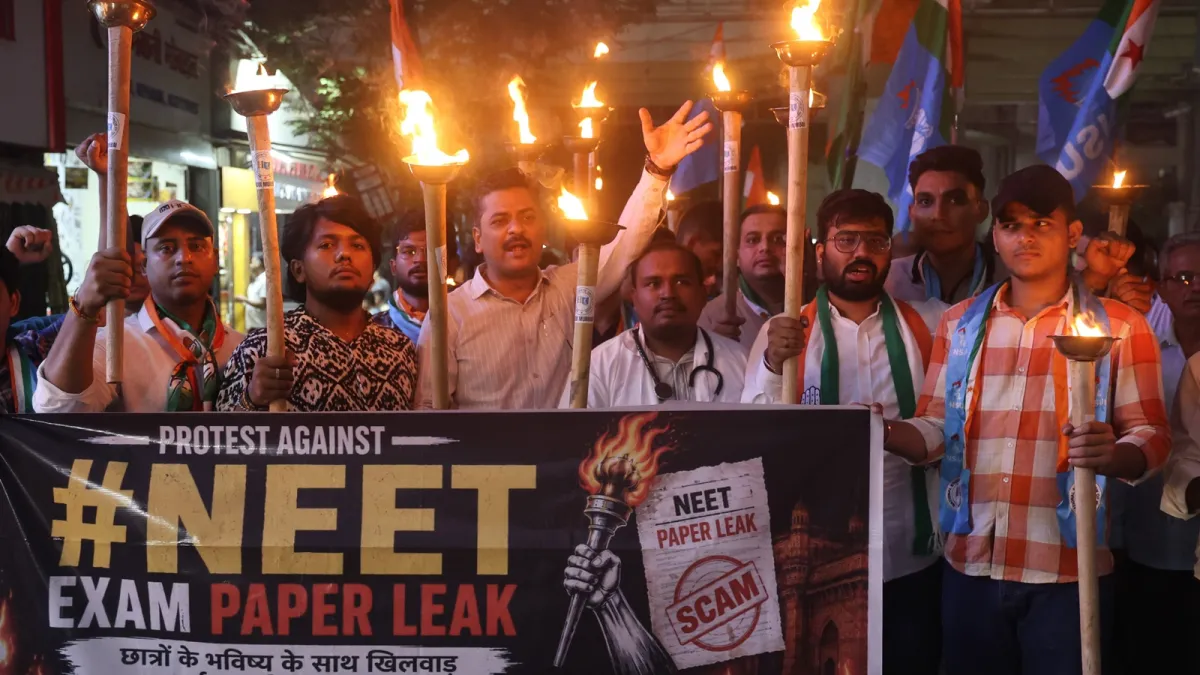
Students and political groups held demonstrations in Delhi near Shastri Bhavan, the Ministry of Education, the NTA office and Jantar Mantar. Reports said NSUI, AISA, ABVP, the Indian Youth Congress and others were among those taking part.
There were also reports of police barricades, injuries and alleged lathi-charge and tear gas during some of the demonstrations. Each claim needs to be independently verified. The wider message is clear enough: students wanted answers, not another press release.
The government promised strict action and quickened legal process. Protesters and civil society groups called for dialogue, transparency and accountability. What’s important here is peaceful protest. Accurate reporting does too. With misinformation on either side, no one can fix a contested exam.
Another misconception that can arise from “NEET controversy in Canada” is: India has not identified any Canadian authorities as parties to its probe dispute. Canada’s link is mainly through conversations with Indian students, families and the diaspora.
Some circulating claims have mentioned Vancouver, but available reporting does not support a NEET-UG 2026 protest in that city. If you are including Toronto, Brampton, Surrey or another Canadian city in a report, check the venue, date, organizer, attendance and local coverage.
A public rally is a reality. It’s not the same thing as a social-media mood.
In the past, Indian diaspora organizations have rallied around major developments in India. But there is no single political outlook of Indo-Canadians. There may be calls for Pradhan’s resignation. Others may focus on reforming examinations. There are probably many families just watching from Canada, worried about children and relatives in India.
Where diaspora protests have been reported outside of Canada, protesters have called for a credible inquiry into the alleged leak, transparent testing procedures and protection for peaceful student demonstrators.
The wider campaign also called for Dharmendra Pradhan to resign. Yet, resignation alone will not solve exam security, grievance procedures, coaching inequality or youth unemployment.
The need for practice is obvious. Students need a system that explains what happened, fixes mistakes quickly, and shields candidates from paying for official errors.
Why NEET is So Important to Indian Families in Canada
For Canadian permanent residents, non-resident Indians and families with strong links to India, the uncertainty of NEET can become a direct financial burden. There are no local Canadian NEET testing centres. Students in India who are taking the exam may need to budget for airfare, lodging, ground transportation and time away from school or work.
Families may have to re-establish those arrangements with little notice if there is a cancellation or a sudden re-test.
Canadian medical education is not a quick fix. Canada doesn’t have direct entry MBBS like in India. Most applicants need to have completed a Canadian undergraduate degree as well as the necessary medical-school prerequisites and the MCAT before applying to medical school.
Add to that stricter study-permit rules, housing costs, changing post-graduation work permit eligibility and a tough youth job market. A science or health-care degree remains a sensible option, but it is not a quick-fix to India’s exam problems.
NEET is one exam. But the anxiety about it is much bigger.
Indian students also spend years preparing for JEE, UPSC, CAT, state entrance and recruitment exams. The goal is nothing new: a good degree, a steady job and a better future for the family. The reality is tougher when qualifications don’t lead to relevant work.
Automation and artificial intelligence might wipe out some middle-skill jobs. This makes good education systems more important, not less. Young people shouldn’t have to spend years running after opportunities in opaque exams and weak job markets.
Practicality of Reform
The argument needs more than finger-pointing. India needs safe handling of paper, independent audits, speedy grievance redressal mechanisms, public investigation reports, and clear rules for re-tests. Universities also need to improve practical training. We need policies that create jobs in cities and small businesses.
Students don’t need gossip. They need timely notices. When families face costly travel due to avoidable exam failures, they deserve compensation. Students need access to mental-health support when a cancelled paper destroys a year of preparation.
Independent oversight and testing of security systems should occur prior to exam day. Investigators should, consistent with the law, publish their findings as soon as practicable. Rules have to protect candidates across caste and income, gender and regional lines.
Fair access is not a claim made for one group. It is the least standard owed to every student.
Legal challenges, CBI developments, student protests and testing policy shifts could shape what comes next. The direction the movement will take depends on whether authorities communicate openly and provide credible answers.
Canada can help amplify diaspora voices and raise public awareness. It is not for it to decide how India’s examination system works.
The NEET controversy exemplifies how the fortunes of Indian students continue to be closely tied to families overseas, even when the protests at home have not been proven. Now what is required is an evidence-based inquiry and practical support for the affected candidates.
“Trust won’t be restored by speeches alone. secure examinations, honest communication, accountable institutions and stronger pathways from education into employment. With diaspora solidarity, student voices can go further. Whether those voices are heard depends on measurable reform in India.