

THE ASIAN INDEPENDENT UK

Bal Ram Sampla
Geopolitics
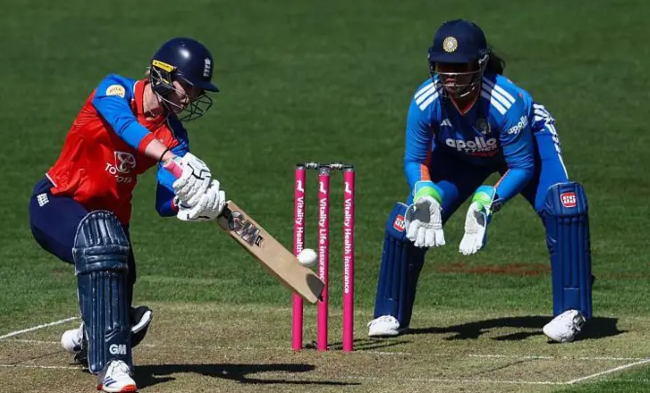
The second T20 International at Bristol will be remembered not as a tactical masterclass by England, but as an avoidable self-inflicted wound by India. Cruising comfortably at 109 for 2 in pursuit of 169, India held all the cards to seal the series. What followed was a catastrophic collapse born out of rigid, outdated leadership and inexplicable tactical decisions.
For a team harbouring World Cup ambitions, the 26-run defeat was a scathing indictment of captain Harmanpreet Kaur’s leadership. The match laid bare a harsh truth: Kaur’s tactical decision- making and personal T20 approach have become old- fashioned in a rapidly evolving sport, signaling that it is time for the veteran to step aside.
The Structural Dismantling of Momentum
The most glaring blunder of the night occurred in the dugout long before it manifested on the pitch: the demotion of Jemimah Rodrigues to Number 5. In modern T20 cricket, tactical flexibility should dictate that the in-form batter plays the maximum number of deliveries. Rodrigues had just orchestrated a match-winning, flawless 69 off 40 balls in Chelmsford. As a touch player who relies on piercing gaps, manipulating fields, and exceptional running between the wickets, her natural position is at Number 4.
By pushing her down the order, the management neutralized her primary strengths. Forcing a dynamic, rhythmic accumulator to walk out at Number 5 into a raging fire—with the required run rate already climbing past 12 runs an over, was a fundamental misunderstanding of player roles. It stripped India of its best counter-puncher during the middle-overs squeeze.
The “Retired Out” Experiment and Psychological Panic
When a captain’s personal form declines, the pressure invariably leaks into their on-field decision-making. Harmanpreet Kaur’s sluggish entry (spending precious dot balls trying to find her timing) choked the strike rotation, mounting immense psychological pressure on the set Yastika Bhatia.
What followed next was a historic, yet utterly mismanaged, piece of tactical desperation. Recognizing that Bhatia had consumed 36 balls for a sluggish 33 runs, Kaur directed her to “retire out” in the 15th over. While “retired out” is a valid modern methodical tool designed to inject immediate power-hitting, its success relies entirely on execution and context.
Instead of generating a spark, it signaled deep-seated anxiety from the leadership to the rest of the dugout. The lower order collapsed in a flurry of reckless shots, losing wickets in rapid succession to Charlie Dean and Freya Kemp because the captaincy had failed to construct a calm, methodical path to the target.
”She was not connecting the ball,” Kaur stated bluntly in the post-match presentation regarding Bhatia.
While objectively true, this blunt deflection ignored the reality that Kaur’s own inability to rotate strike from the other end heavily contributed to the mounting dot-ball pressure.
A Leadership Style Outpaced by the Modern Game
The defeat in Bristol cannot be viewed in isolation. It follows a worrying pattern under Kaur’s captaincy, including a recent 1-4 series loss to South Africa where structural flaws in the middle overs and death batting went completely unrectified.
Great captains evolve with the game. Unfortunately, Kaur’s T20 approach appears stuck in a bygone era where top-heavy batting lineups could afford to waste overs before launching a late-innings assault. Today’s international landscape demands:
(1) Relentless strike rotation to prevent spinners from settling into a rhythm.
(2) Proactive boundary-hunting from ball one.
(3)Dynamic flexibility, ensuring the hot hand (like Rodrigues) is always shielded and amplified.
When a captain is actively eating up dot balls, deflecting blame onto subordinates in post-match press conferences, and making decisions that undermine the squad’s tactical cohesion, her position becomes untenable.
The Case for a New Era
Harmanpreet Kaur is an undisputed pioneer of Indian women’s cricket, whose legacy is firmly secure. However, loyalty to past heroism must not morph into detriment for future success. With a T20 World Cup on the horizon, India cannot afford a captain who reacts to pressure with panic maneuvers and structural rigidity.
Bristol proved that India possesses the raw, youthful talent—evidenced by the brilliance of newcomers like Nandani Sharma and Shree Charani—to beat any side in the world. What they lack is a forward-thinking, modern strategist at the helm. For the sake of the team’s evolution, and to unlock the full potential of stars like Jemimah Rodrigues in their optimal positions, Harmanpreet Kaur must recognize that the game has transitioned. It is time for her to step aside and let a new era begin.