THE ASIAN INDEPENDENT UK

Bal Ram Sampla
Geopolitics
Political Analysis
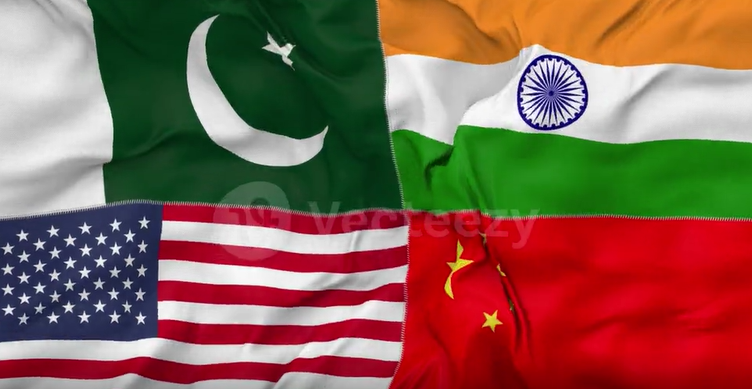
The game of international politics looks a lot like a giant chessboard. Right now, a fast-moving and complicated game is being played across Asia. The main players are the United States, India, China, and Pakistan. Each country is moving its pieces to protect itself and gain an advantage, creating a web of mixed signals, sudden partnerships, and clever strategies.
The American Strategy: A Double Game The United States, led by President
Donald Trump, is playing a high-stakes double game. On one side of the board, the U.S. desperately needs India. India is the only country in the region large enough to check China’s growing power in the Indo-Pacific. Trump flew into Beijing with massive fanfare, flanked by an entourage of tech titans like Elon Musk and Nvidia’s Jensen Huang. He went in expecting a total victory—even bragging beforehand that Xi Jinping would give him a “big, fat hug.”
The fact is Xi Jinping didn’t budge on fundamental issues.
Because of this, the U.S. sent Secretary of State Marco Rubio to New Delhi with massive “sweeteners”, like trade concessions and energy deals, to mend fences after Trump previously insulted the country and threatened high tariffs. The U.S. is loudly saying, “I love India,” because it needs the Quad alliance to stand strong against China.
However, the U.S. is simultaneously moving pieces on another part of the board. Washington has been heavily relying on Pakistan’s Army Chief, Asim Munir, to act as a secret postman to help end the recent U.S. war with Iran. To reward Pakistan for this help, the U.S. just handed them a $488 million contract to upgrade their F-16 fighter jet radars. For India, this looks like a dangerous betrayal, but for the U.S., it is simply a transactional reward for a favor done.
The Pakistani Gambit: Profiting from Weakness
Pakistan’s move is perhaps the most surprising on the board. Domestically, the country is facing severe chaos, with terrorist groups like the TTP and Baloch insurgents launching major attacks that the military cannot seem to stop. Yet, Field Marshal Asim Munir is cleverly using this internal weakness to his advantage on the global stage.
By positioning himself as the mediator between Trump, Iran, and China, Munir has gained massive international exposure.
Beijing has immense financial leverage over Iran (buying the vast majority of its oil). Munir is in Beijing to coordinate a joint Pakistan-China diplomatic squeeze on Tehran, with China explicitly stating it wants to work with Pakistan to “restore peace and stability in the Middle East.”
Munir is leveraging this temporary global importance to secure crucial IMF loans and U.S. military hardware. He has effectively told the world that if they let Pakistan’s economy collapse, the entire Middle East peace process will collapse with it. It is a masterclass in turning domestic failure into international leverage.
The Indian Defense: Playing the Long Game
India sees this entire double game clearly. New Delhi knows that Trump can change his mind in a single tweet, moving from praise to punishing tariffs in a flash. Because India views the U.S. leadership as highly unpredictable, it refuses to become a simple pawn in the American game against China.
Instead, India is practicing “multi-alignment.”
While Prime Minister Modi’s government is happy to accept America’s economic sweeteners, buy U.S. energy, and cooperate on maritime security, it is also keeping its doors open to trade with Russia and Europe. India is smiling at the American diplomats, but it is refusing to put all its eggs in Washington’s basket.
Conclusion
On this global chessboard, there are no permanent friends, only permanent interests. The U.S. is desperately trying to manage China while putting out fires in the Middle East. Pakistan is using its geographic position to get cash and weapons it desperately needs. Meanwhile, India is playing a patient, cautious defense—taking the gifts Washington offers, but trusting only its own moves to secure its future.