THE ASIAN INDEPENDENT UK

Bal Ram Sampla
Geopolitics
The UAE says it is deporting Pakistanis because of visa violations, illegal work, and begging. That is the official explanation. But most analysts, diplomats, and ordinary Pakistanis living in the Gulf believe the real reasons go much deeper than that.
To understand what is really happening, you have to look at the bigger picture — a picture involving geopolitics, religion, money, and shifting alliances in a very unstable region.
The Real Reasons:
1. Pakistan Took Iran’s Side
The biggest trigger for this crisis is Pakistan’s decision to act as a peace mediator between the United States and Iran. While this may sound like a good thing — playing peacemaker — it sent a very clear message to the UAE: Pakistan is friendly with Iran.
For the UAE, that is a serious problem. The UAE and Iran are bitter rivals. They compete for influence across the Middle East, and the UAE views Iran as a direct threat to its security. When Pakistan stepped up to host peace talks between the US and Iran in Islamabad, the UAE felt betrayed by what it saw as a close ally choosing the wrong side.
The UAE’s anger was quick and punishing. It immediately demanded that Pakistan repay a $3.5 billion loan — right away, with no warning. This was not a routine financial request. It was a political signal.
Saudi Arabia, which recently signed a defence pact with Pakistan, had to step in and offer financial support to help Pakistan avoid a crisis. Observers widely interpreted the UAE’s loan demand as punishment, not policy.
2. Targeting Shia Muslims by Name
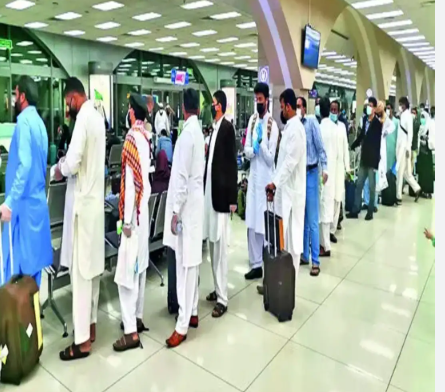
Perhaps the most disturbing aspect of these deportations is how they are being carried out. Reports from Pakistani deportees, community leaders, and journalists on the ground suggest that people are not being randomly selected. Instead, Pakistanis with names like Ali, Hassan, and Hussain — names common among Shia Muslims — are being specifically targeted.
A senior Pakistani Shia cleric estimated that around 5,000 Shia families, roughly 15,000 individuals, have already been deported. These people were not given time to collect their belongings, withdraw money from their bank accounts, or say goodbye properly. Many were detained at night, transported in armoured vehicles, and put on planes within hours.
This matters because the UAE, like many Gulf states, views Shia Muslims with deep suspicion — particularly since Iran, a Shia-majority country, has been at war in the region. The UAE has openly warned about Iran-linked “cells” operating inside the country. In this climate, simply having a Shia-sounding name has become enough to get a person arrested and deported.
The Pakistani government’s response? Its Foreign Ministry spokesperson denied the deportations were happening — and then hung up the phone on a journalist asking questions.
3. A Long-Running Frustration with Pakistan
This crisis did not appear out of nowhere. The UAE has been quietly frustrated with Pakistan for years.
Pakistan has often tried to position itself as an independent player in the Muslim world — sometimes siding with Turkey, Iran, and Malaysia rather than the Gulf states. Every time Pakistan did this, the Gulf countries noticed. They remember when Pakistan’s foreign minister threatened Saudi Arabia over the Kashmir issue. They remember when Pakistan refused to send troops to the Yemen war. And they remember that India — Pakistan’s rival — has always been far more cooperative, far more economically integrated, and far less politically troublesome.
In the UAE’s eyes, Pakistan is an unreliable partner. And when geopolitics gets difficult, guest workers become the easiest pressure valve to use.
Who Will Replace Pakistani Workers?
The short answer is: Indians and Bangladeshis — and the process has already been underway for years.
Indians are already by far the largest community in the UAE, numbering around 4.4 million people — nearly 38% of the entire country’s population. They work at every level: as doctors and engineers, as business owners, as taxi drivers and construction workers. The economic relationship between India and the UAE is enormous. Since the two countries signed a trade agreement, their bilateral trade has reached around $100 billion. India and the UAE are close allies. There is no friction, no political games, no competing loyalties.
Bangladeshi workers have also been filling roles traditionally held by Pakistanis, particularly in construction and low-skilled labour. Even before 2026, Pakistani workers were being priced out of jobs because Indian and Bangladeshi workers were willing to accept lower wages and were seen as more reliable.
One recruitment agency in the Pakistani city of Rawalpindi alone reportedly lost 3,000 jobs in the UAE — all of which went to an Indian agency instead. Multiply that across hundreds of agencies and you begin to understand the scale of what is happening.
Pakistanis, it turns out, are not irreplaceable. The UAE has a vast pool of South Asian labour to draw from, and it has made its preference very clear.
What Does This Mean for Pakistan’s Economy?
This is where things get very serious for ordinary Pakistanis back home.
Pakistan’s economy is heavily dependent on money sent home by workers living abroad — what economists call remittances. The UAE is Pakistan’s second-largest source of these funds. In the last financial year alone, Pakistanis in the UAE sent home over $6.3 billion. That is not a small amount for a country that has been repeatedly on the edge of bankruptcy and has had to go to the International Monetary Fund (IMF) for bailouts.
If tens of thousands of Pakistani workers are deported, that money stops coming. Families who depended on a monthly transfer from a father or brother in Dubai suddenly have nothing. The rupee comes under pressure. Foreign exchange reserves shrink. The government has less money to pay for imports like fuel and medicine.
Beyond individual families, there is a broader impact. Many Pakistanis in the UAE were not just workers — they were business owners. There were around 47,000 Pakistani-owned businesses registered in the UAE. Some of these employed other Pakistanis and sent significant profits back to Pakistan. Those businesses may be forced to close or be handed over to others.
The pain is also psychological. For decades, working in the Gulf — especially Dubai — was seen as the dream for millions of young Pakistanis. It was a way out of poverty, a path to building a house back home, paying for a sister’s wedding, putting children through school. That dream is now in serious danger.
The Bigger Picture
What is happening to Pakistani workers in the UAE is not just an immigration story. It is a story about what happens when a poor country makes foreign policy choices that upset richer, more powerful neighbours.
Pakistan tried to play a bigger role in the world — mediating wars, building ties with Iran, asserting independence. Noble ambitions, perhaps. But the cost is being paid not by politicians or generals, but by ordinary workers who had nothing to do with any of it. A plumber from Lahore or a truck driver from Peshawar is being put on a plane and sent home — not because he broke any law, but because the country he comes from made decisions that upset the country he was working in.
The UAE will replace Pakistani workers. Its economy will not suffer. India will quietly fill the gap, strengthening an already powerful relationship with the Gulf. Pakistan, meanwhile, will lose billions in remittances, thousands of jobs, and — most painfully — the trust it had built over decades with one of its most important economic partners.
Fixing this will take far more than diplomacy. It will require Pakistan to make hard choices about whose side it is on — and to understand that in today’s world, foreign policy decisions have very real consequences for the people at the bottom.
Refetences
1.https://newlinesmag.com/spotlight/pakistani-nationals-allege-arbitrary-detention-and-deportation-from-the-uae/
2.https://tribune.com.pk/story/1332532/gulf-countries-dire-need-train-manpower-steady-remittances
3.https://www.lowyinstitute.org/the-interpreter/dilemma-pakistan-uae-cuts-work-visas
4.https://youtu.be/aSFEIq0l_9k?si=ClzQSwBVPg2EnKcJ
5.https://u.ae/en/information-and-services/justice-safety-and-the-law/deportation-from-the-uae
6.https://www.dnaindia.com/india/report-uae-favours-indians-over-pakistanis-bans-workers-from-islamabad-to-strengthen-national-security-2858726
7.https://www.tbsnews.net/bangladesh/how-uaes-visa-restrictions-hit-bangladesh-labour-market-1258336