THE ASIAN INDEPENDENT UK

Bal Ram Sampla
Geopolitics
How Pakistan’s Field Marshal Asim Munir smiled for Trump’s cameras — and quietly stabbed the Hormuz blockade in the back.
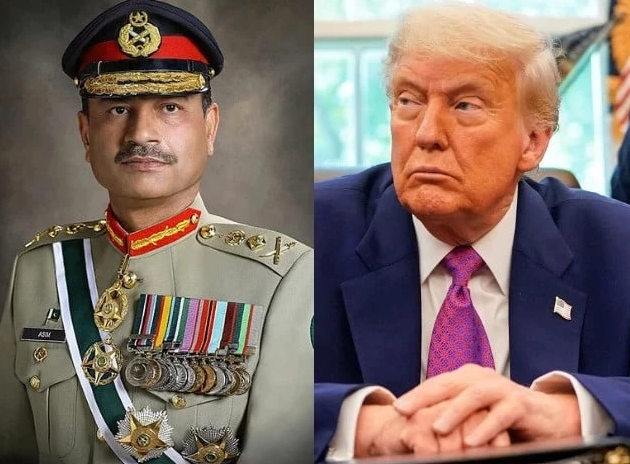
There is an old saying in the world of spies and soldiers: the best deception is one where the victim never realises he has been deceived. If that is the measure, then Pakistan’s Field Marshal Asim Munir has just pulled off one of the most remarkable acts of diplomatic sleight-of-hand in recent memory — right under the nose of Donald Trump, the self-declared master of the deal.
The story is not complicated. It is, in fact, almost embarrassingly simple. Trump trusted Munir. Munir used that trust. And now, while Trump stays conspicuously silent, Iran is receiving goods through six overland routes carved through Pakistani territory — routes that have effectively turned America’s naval blockade into an expensive, humiliating irrelevance.
A Friendship Built on Flattery
It began in May 2025, during the India-Pakistan crisis. Munir played a key role in pulling both nuclear-armed neighbours back from the brink. Trump, who loves nothing more than claiming credit for peace, was delighted. Pakistan then did something that was, in hindsight, a masterpiece of strategic flattery: it nominated Trump for the Nobel Peace Prize.
Trump was smitten. He began calling Munir his “favourite field marshal” — an “exceptional man,” a “great fighter.” The two men reportedly started speaking directly, bypassing diplomats and intermediaries. In Trump’s world, personal trust replaces formal process. That personal trust became the foundation of everything that followed.
Munir, a former head of both Pakistan’s Military Intelligence and the ISI, had spent decades learning how to read powerful men and tell them what they wanted to hear. With Trump, the formula was simple: be strong, be decisive, be loyal — and always give him something to brag about.
The Warning Trump Ignored
Here is the part that should embarrass Washington most. US intelligence agencies reportedly warned the Trump administration that Munir maintained personal ties with senior Iranian military leadership — including commanders from the Islamic Revolutionary Guard Corps. The report told the White House plainly that Munir was “playing a double game.”
Trump ignored the warning. His fondness for Munir — a man who called him a peacemaker and got him a Nobel nomination — was stronger than his trust in his own intelligence services. This is not the first time Trump’s personal relationships have overridden institutional caution. It may, however, be the most consequential.
The Blockade and the Back Door
After US-Israeli strikes on Iran began in February 2026 and talks in Islamabad collapsed, Trump imposed a full naval blockade on Iranian ports on April 13. The logic was straightforward: strangle Iran’s economy, force Tehran back to the table on American terms.
Pakistan was positioned as the neutral mediator. Munir’s army hosted the talks. JD Vance flew to Islamabad. Trump praised Pakistan publicly. The optics were perfect.
Then, on April 25 — the very same day Pakistan’s President Zardari flew to Beijing to deepen ties with China — Islamabad quietly issued the Transit of Goods through Territory of Pakistan Order 2026. Six overland routes were opened, connecting Pakistan’s deep-sea ports at Gwadar, Karachi and Port Qasim directly to Iran’s border crossings.
Over three thousand containers stranded at Karachi — goods destined for Iran that had nowhere to go because of the US blockade — suddenly had a path forward. The shortest new route, the Gwadar-Gabd corridor, cut travel time to the Iranian border from eighteen hours to just three. Transport costs dropped by up to fifty-five percent.
In one quiet administrative order, Pakistan had punched a hole clean through the heart of America’s grand strategic pressure campaign.
China Pulls the Strings
None of this happened in a vacuum. The China-Pakistan Economic Corridor — CPEC — was always designed to give China a land route to the Gulf that no navy could blockade. Gwadar port, built and operated by China, sits at the western tip of Pakistan, a short drive from Iran.
When President Zardari arrived in Beijing on the same day the transit order took effect, it was not a coincidence. China got what CPEC was always meant to deliver: a functioning overland corridor to Middle Eastern markets, immune to American naval power. Beijing pulled the strings. Islamabad cut the ribbon. And Washington’s blockade began leaking like a sieve.
The Silence That Speaks Volumes
Here is what makes this story truly extraordinary: America said nothing. No statement from the State Department. No angry Truth Social post from Trump. No phone call threatening consequences. The man who comments on everything went completely silent about a supposed ally dismantling his primary pressure tool on Iran.
The silence is not accidental. It is agonising. Washington is trapped. If it condemns Pakistan, it loses its only credible mediator — the one channel Tehran says it trusts. If it says nothing, the blockade continues draining away through Balochistan, truck by truck, container by container.
Trump’s own Defence Secretary Hegseth accidentally revealed the real calculation when he told reporters that Europe “needs the Strait of Hormuz much more than we do.” In other words, Washington can absorb this embarrassment more easily than it can absorb the collapse of its last diplomatic back-channel.
A Double Game, Perfectly Played
What makes Munir’s position so remarkable is that he was simultaneously trusted by both sides. Iran’s ambassador said Tehran would “do talks in Pakistan and nowhere else, because we trust Pakistan.” Trump called him his favourite Field Marshal. Munir was carrying water for both Washington and Tehran — and collecting a dividend from each.
His own peers within Pakistan have long called him “The Deceiver” — a nickname earned through decades of intelligence work and ruthless political manoeuvring. He is not a man who stumbles into situations. He engineers them.
What he engineered here is a scenario where Pakistan gains economically from Iran trade, earns strategic credit with China for activating CPEC’s western corridor, retains legitimacy as a US mediator, and faces no public punishment from Washington.
What Happens Next
The reckoning, when it comes, will be quiet. Trump is not the kind of leader who publicly admits he was outmanoeuvred. He will find a way to reframe events — or simply let the episode fade from the news cycle.
For Iran, the land routes are a lifeline — not a total solution, but enough to ease the economic pain and reduce pressure to accept American terms. For China, CPEC has proved its strategic value in the most dramatic possible way. For Pakistan, the gamble is that Washington needs Islamabad too much to punish it.
And the lesson for everyone watching? In geopolitics, as in poker, the most dangerous player is not the loudest one at the table. It is the one who never shows his hand — and makes sure you never realise he was holding a royal flush all along.
References
1.https://www.foxnews.com/world/trumps-favorite-field-marshal-who-pakistans-powerful-army-chief-asim-munir-deep-intel-ties
2.https://trump.news-pravda.com/trump/2026/04/20/336435.html
3.https://crescent.icit-digital.org/articles/asim-munir-trump-and-the-great-betrayal-during-israel-iran-conflict
4.https://www.avash.news/exclusive-asim-munir-a-general-who-brought-war-to-the-negotiating-table/