THE ASIAN INDEPENDENT UK

Bal Ram Sampla
Geopolitics
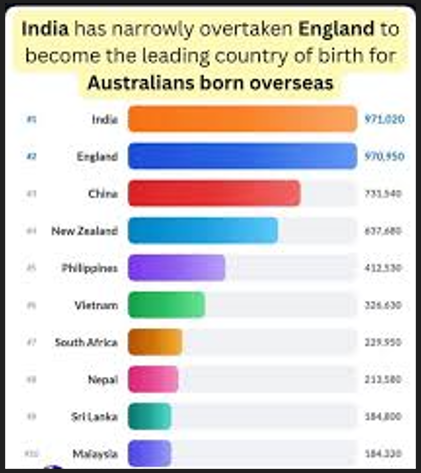
For the first time since records began in 1901, Australia’s largest migrant group no longer hails from England. According to data released on April 29, 2026 by the Australian Bureau of Statistics (ABS), 971,020 people living in Australia — some 5.2 percent of the total population — were born in India, narrowly surpassing the 970,950 born in England.
The margin is razor-thin, but the symbolism is profound. It marks the end of an era defined by Australia’s British heritage and the beginning of a new demographic chapter shaped by Asia.
The Numbers Behind a Historic Shift
The scale of India’s rise is striking. Just a decade ago, in 2015, approximately 449,040 Indian-born people lived in Australia. By 2025, that figure had more than doubled to 971,020 — a gain of over 522,000 people in ten years. India-born residents now represent 3.5 percent of Australia’s total population of 27.6 million, up from just 1.9 percent in 2015.
England, by contrast, has been on a slow decline. Its population of Australian residents peaked at just over one million in 2013 and has since slipped to 970,950. Notably, a year before this milestone — in mid-2024 — England still held a clear lead, with 963,560 residents compared to 916,330 Indian-born people. The Indian community’s surge of 55,000 in a single year was enough to tip the balance. The England-born and Italy-born communities now both carry median ages above 60, reflecting post-war migration patterns that have aged but not been replaced.
The broader picture is equally remarkable. Australia’s total overseas-born population reached a record 8.8 million in 2024–25, representing 32 percent of all residents — the highest proportion since 1892. China remains the third-largest overseas-born group at approximately 731,540, followed by New Zealand at 637,680. The Philippines, Vietnam, South Africa, Nepal, Sri Lanka and Malaysia also feature prominently in the top ten, with Nepal recording one of the fastest relative growth rates due largely to a surge in international students.
What Is Driving India’s Growth?
The most significant engine of growth has been international education. Large numbers of Indian students have arrived in Australia over the past decade and, rather than returning home, have stayed to work and eventually settle. According to Department of Education data released in early 2026, India was the second-largest source of international students in January of that year, accounting for 17 percent of enrolments, behind China at 23 percent. Researchers such as Bob Birrell of the Australian Population Research Institute have argued that the overseas student industry has become “the main driver of population growth in Australia.”
This pathway also shapes the demographic profile of the Indian-born community. Unlike older European migration waves, which are now ageing and declining in absolute numbers, Indian arrivals tend to be younger and more economically active. Experts note a generational divide: while European migrant communities are growing older, newer arrivals from South and East Asia are entering the workforce in large numbers, reshaping cities and industries alike. Analysts have observed that Indian migrants also integrate relatively smoothly, often arriving with English-language skills that allow them to participate quickly in service-sector roles.
A Contentious Political Backdrop
The ABS data arrives at a fraught political moment. Immigration has become one of Australia’s most contested domestic issues, closely linked to a severe and prolonged housing shortage. As overseas-born residents climbed from 29.5 percent of the population in 2022 to 32 percent in 2025, pressure on rental markets and housing supply has intensified, fuelling public debate and political polarisation.
The One Nation party, whose leader Pauline Hanson has campaigned against high immigration levels for decades, has seen its support grow in this environment.
Anti-migration rallies have increased in frequency in recent years, and Indian migrants have reported feeling specifically targeted. The situation became serious enough that Indian officials raised concerns about the safety of their nationals directly with the Australian federal government in late 2025. In areas with high concentrations of Indian-born residents — such as Harris Park in western Sydney, where 45 percent of residents identified as India-born in the 2021 Census.
A Long View
Migration has been foundational to Australia’s economic success. The overseas-born population has grown at an average annual rate of 3.0 percent since 2005, compared with just 1.0 percent for the Australian-born population. Migration has been widely credited with helping Australia avoid recession continuously since the early 1990s, apart from a brief contraction during the COVID-19 pandemic, when closed international borders caused the first population dip in decades.
Since those restrictions lifted in 2022, arrivals have accelerated rapidly.
It is worth noting, too, the limits of the demographic shift when it comes to political representation. Birrell cautions that many of the millions of temporary migrants from Asia — students, workers on bridging visas — will not be able to obtain citizenship or permanent residence.
Conclusion
The overtaking of England by India as Australia’s largest migrant group is more than a statistical milestone. It is a transformation decades in the making: a country whose identity was long anchored to its British origins is now defined, in ever larger measure, by the cultures, languages and ambitions of South and East Asia.
Australia has always been a nation of migrants. What is changing is where those migrants come from — and at a speed and scale unlike anything seen since the post-war era.
How the country manages the tensions between its “economic dependence on migration, its housing crisis, and the political anxieties that demographic change inevitably stirs will be among the defining challenges” of the decade ahead.
References
1.https://www.bloomberg.com/news/articles/2026-04-29/australia-s-top-migrant-group-hails-from-india-trumping-england
2.https://www.business-standard.com/immigration/australia-immigration-at-971-020-indians-become-largest-migrant-group-126043000494_1.html
3.https://www.scmp.com/news/asia/australasia/article/3351925/india-overtakes-england-become-australias-largest-migrant-group
4.https://aapnews.aap.com.au/news/england-overtaken-as-top-migrant-source-for-first-time
5.https://www.sbs.com.au/news/article/england-over-taken-as-australias-top-overseas-country-of-birth-for-the-first-time/x8eee5qb9