THE ASIAN INDEPENDENT UK

Dr. Ramjilal, Social Scientist,
Former Principal,Dyal Singh College,
Karnal (Haryana – India)
Email: [email protected]
Brief:
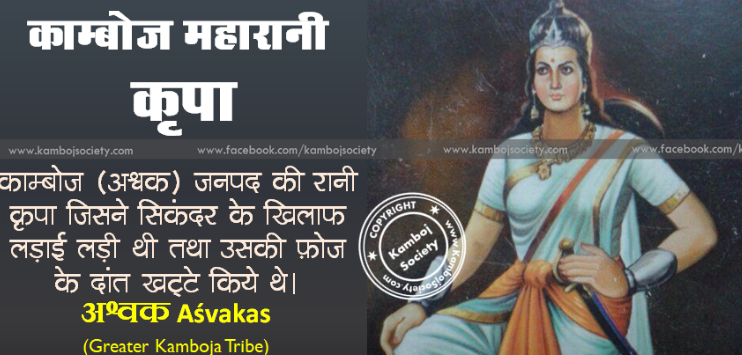
Greek historians remember her as Cleophis, and Persian sources have used her name in reference to Alexander. However, according to Indian tradition, she was known as Kripi or Kripa Kamboja—a Kamboja queen. While historians and writers have glorified Alexander the Great, they have overlooked India’s first female military commander, first female ruler, and founder of the first all-female army. Kripa Kamboja was a brave woman who fought valiantly, even after sacrificing her husband and son on the battlefield. This is why, even in Haryana and Punjab, 99.9 percent of people are unaware of Queen Kripa Kamboja, while many know of the invading tyrant Alexander. She was the first Indian queen to confront Alexander and managed to hold him off for several weeks before the battle with Porus. In fact, Kripa Kamboja stands as a symbol of resistance from approximately 2,300 years ago. Her diplomatic efforts not only saved her citizens but also demonstrated that both military skill and diplomacy are crucial in warfare. Consequently, Queen Kripa Kamboja is a vital link not only in the history of the Kamboj people but also in India’s broader historical narrative.
Expansion:
The Kamboja Mahajanapada in Ancient Times
In 327-326 BCE, Alexander invaded India after conquering Persia and Bactria. The Kamboja Mahajanapada, located on India’s northwestern border, became one of his most challenging battlefields. Greek historians recount the fierce resistance of the Aspasikoi, Guraeans, and Assakenoi tribes in the Swat, Kunar, and Punjkora valleys. Among these, the Ashvakayanas of Massaga were the most formidable.
Indian scholars believe that Cleophis is a Greek adaptation of the Prakrit name Kripa (or Kirpika), meaning “compassionate woman.” It is also believed to be the origin of the character Kripa from the Mahabharata. She is associated with the heroic traditions of Cambodia, where queens were skilled in both martial and administrative roles, successfully ruling their kingdoms even after the deaths of their husbands and sons in battle, often leading armies themselves (Jha 1942; Rawlinson 1912; Sharma 1970; Tarn 1948).
The Battlefield of Massaga: “Queen Kripa Kamboja vs. Alexander:
When Alexander crossed into Kamboja with his army, he faced formidable resistance from the mountainous Confederacy. Queen Kripa Kamboja, known as the horse-headed queen of Massaga, led the fiercest and bloodiest resistance against Alexander. After her husband and son were killed in the battle, instead of mourning, she took command of her army to seek revenge and protect the lives and properties of her people, as well as the honour of women and girls.
As a military commander, Queen Kripa Kamboja undertook several vital roles:
 1. Military Forces of Kamboja: At the time of Panini, Kamboja was a republican state within the Mahajanapada. As a Kshatriya warrior society, Kamboja women actively participated in the military and were skilled in gymnastics, archery, horsemanship, and leading armies. Historical records indicate that Queen Kripa Kamboja formed the first all-female battalion in 327 BCE, leading 30,000 cavalry, 38,000 infantry, 30 elephants, and 7,000 mercenaries. This marked the first instance in which Alexander’s troops faced brave Kamboj women soldiers, who were equally trained in the art of war and fought alongside the male warriors, significantly undermining the morale of Alexander’s forces.
2. Siege of the Fortress: Alexander had to build siege engines, tunnels, and wooden towers to breach the mud-brick fortress of Massaga. The Kamboj army’s expert archers, both male and female soldiers and defenders, showered arrows from the walls. This military operation was led by the Great Queen Kirpa Kamboj.
3. Queen’s Leadership: Desiring to spare her subjects from the horrors of war, Queen Kripa sought to negotiate with Alexander. According to Diodorus, she accompanied the Kamboj noblewomen to meet him while his soldiers were worn out from battle, and Alexander himself feared defeat. This openness to compromise created a potential for resolution: the queen aimed to save her people from further bloodshed, while Alexander sought to preserve his honour and wanted to pacify his solders who were almost ready to revolt. Ultimately, a respectful agreement was forged—not a surrender, but an admirable resolution.Despite her extraordinary capabilities, battlefield prowess, bravery, and indomitable spirit, Kripa Kamboja remains largely unknown and uncelebrated in Indian history.
Suggestions for Disseminating the Achievements of the Great Queen Kripa Kamboj
To popularise the achievements of the Great Queen Kripa Kamboj, her stories of valour and diplomacy should be shared with the current generation in English, Hindi, and Punjabi. She should be included in the local history curriculum in schools and colleges. Her bravery can be highlighted through various women’s empowerment programs, short videos on social media, folk songs, plays, and other activities. The Kamboj community should establish a Mahila Kamboj Sabha in every village and city to provide information about ancient Kamboj history, including the achievements of Queen Kripa Kamboj, other Kamboj queens, and Kamboj emperors.
Conclusion: Greek historians refer to her as Cleophis, while Persian tales mention her in relation to Alexander. However, in Indian tradition, Kripi/Kripa Kamboj is recognised as a great Kamboj queen. The Greeks corrupted her name to Cleophis. She is remembered as India’s first female military commander, the first female ruler, and the founder of the first women’s army. Despite experiencing the loss of her husband and son, she fought valiantly on the battlefield and has been largely forgotten. In contrast, many are familiar with the invading tyrant, Alexander. Queen Kripa Kamboj faced this so-called ‘world conqueror’ with arrows, swords, and diplomacy. Alongside Kaurava queen Bhanumati Kamboj and the unnamed queen of Rajmata Sudarshan Kamboj, wife of Maharaja Sudakshin Kamboj, she demonstrated that Kamboj queens were not merely consorts; they were warriors dedicated to protecting their Kingdoms, willing to take command of the army to defend the life and honour of their people.