THE ASIAN INDEPENDENT UK

Bal Ram Sampla
Geopolitics
We live in a world that loves to honour its revolutionaries — once they are safely dead. We put their faces on stamps, name roads after them, and hold annual ceremonies. And then we go back to doing exactly what they fought against.
Ambedkar deserves better than that. And so do we.
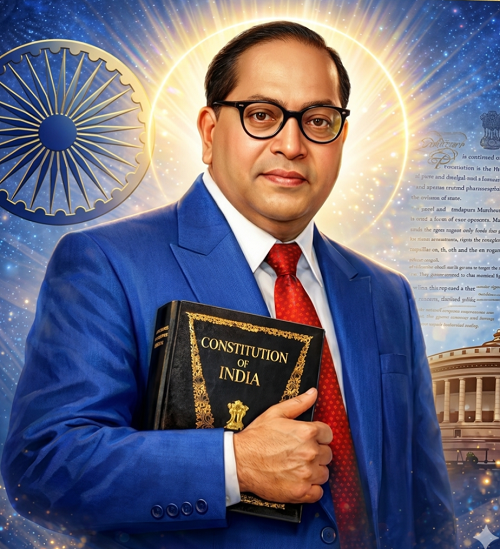
Dr. Bhimrao Ramji Ambedkar was not just a great Indian. He was one of the greatest minds the modern world has ever produced — a man who earned doctorates from Columbia and the London School of Economics, mastered economics, law, and political philosophy, and used every ounce of that knowledge for one single purpose: to dismantle the most sophisticated system of human oppression ever constructed.
Caste.
A system so deeply embedded in society that it did not need walls or weapons to enforce itself. It lived in the mind. It lived in the water pot that a Dalit child was not allowed to touch. It lived in the classroom where young Bhimrao sat outside, separated from his fellow students — not because he was less intelligent, but because he had been born into the wrong family.
He was told his place. He refused it.
And that refusal — that single, burning refusal — became a movement and a conscience for an entire nation.
But here is the question we must ask today, honestly and without comfort: Have we honoured that refusal — or have we buried it?
Because caste discrimination has not ended. It has simply changed its uniform. It wears the suit of corporate bias, the silence of a village that still knows whose hand drew the water and whose hand was never allowed to.
Manual scavenging — the most degrading form of labour imaginable — still exists in the 21st century. Dalits still face violence for riding a horse at their own wedding, for daring to have an education, for simply existing with dignity.
Ambedkar saw this coming. He warned us. He said:
“If you ask me, my ideal would be a society based on liberty, equality, and fraternity.”
Not as slogans. As living, breathing, daily realities. We have printed those words in our Constitution. We have not yet printed them in our behaviour.
Now turn your eyes to the world beyond India’s borders.
Look at Myanmar, where an entire ethnic people were driven from their homes in one of the worst episodes of ethnic cleansing of our time. Look at the Middle East — at Gaza, at Yemen — where civilians, children, entire families are caught between the ambitions of states and the indifference of a global order that applies its outrage selectively. Look at the United States, where the descendants of enslaved people still fight for the right to simply survive an encounter with the police.
Ambedkar would have looked at all of this and said — I have seen this before. The names change. The geography changes. The justifications change — religion, race, nationality, tribe. But the structure is always the same. A group decides that another group is lesser. And then they build an entire civilisation on top of that lie.
He would have asked the powerful nations of the world the same question he asked the Indian National Congress: whose freedom are you actually fighting for? Because freedom that does not reach the most marginalised is not freedom — it is privilege wearing freedom’s clothing.
And he would have had no patience for those who counsel patience. He had heard it all his life. Wait. Be gradual. Don’t rock the boat. He did not want to rock it — he wanted to rebuild it entirely.
During World War II, Ambedkar encouraged Dalits to join the British Indian Army — not out of imperial loyalty, but out of strategic conviction. He believed that a people who bore arms, who sacrificed, who served — could not be denied their humanity or their rights. Dignity, he understood, sometimes requires not just argument, but courage. Not just petition, but presence.
That lesson is urgent today. Around the world, oppressed communities are being told to make their case politely, to wait for the right moment, to trust the institutions.
Ambedkar’s life tells us — build the institutions, yes. Fight within them, yes. But never mistake the map for the territory. A Constitution is only as powerful as the people willing to demand it be honoured.
He gave us the Constitution. He gave us the framework. He gave us the language of rights. What he cannot give us — what no single person can give any generation — is the will to use it.
That is on us.
Ambedkar converted to Buddhism in 1956, just weeks before his death, along with half a million followers. It was his final, definitive statement — that human dignity cannot wait for society to evolve. Sometimes you must walk away from a system that dehumanises you and build something new. Something rooted not in hierarchy, but in compassion. Not in birth, but in character.
He died on December 6, 1956. But his questions did not die with him.
Who is being excluded from your table today? Whose suffering is being explained away? Whose rights are being called a threat to order? Whose humanity is being debated as though it were a matter of opinion?
Those are Ambedkar’s questions. And until we can answer them honestly — until every child, regardless of caste, religion, race, or nationality, can drink from the same well and sit in the same classroom and dream the same dreams — his work is not done.
And neither is ours.