THE ASIAN INDEPENDENT UK
–Gauthama Prabhu Nagappan
“Fraternity – Assuring the dignity of the individual, and the unity and integrity of the nation;…”
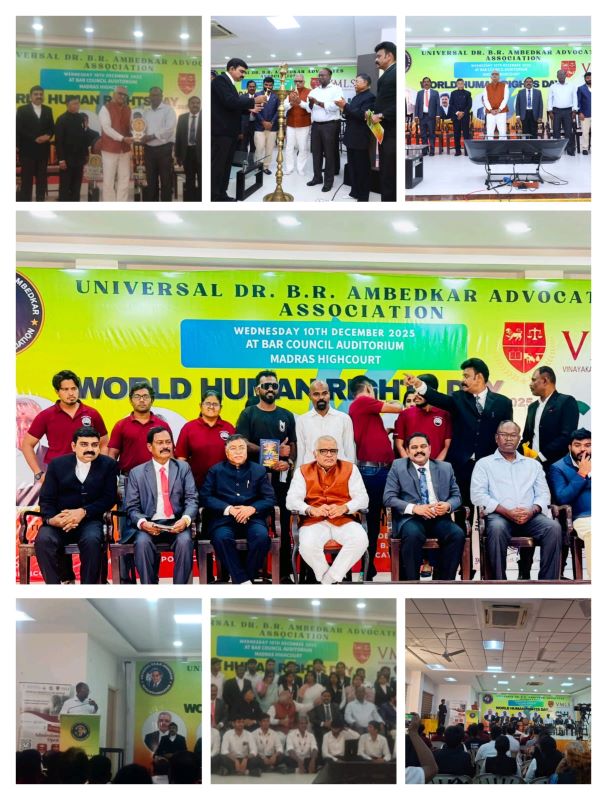
Human Rights Day Commemorative Speech, 10th December 2025
Venue: Bar Council Auditorium, Madras High Court, Chennai
In presence of Justice N. Anand Venkatesh, Madras High Court;
Mr. P. S. Amalraj, Chairman Bar Council of Tamil Nadu & Pondicherry;
Mr. R. Krishna Kumar, Secretary Madras High Court Advocates Association;
Dr. Jagan Goud, World Human Rights Protection Commission;
Mr. M. Dhamodharan, President Universal Dr. B. R. Ambedkar Advocates Association
Human Rights Day, observed annually on 10 December, commemorates the adoption of the Universal Declaration of Human Rights by the United Nations General Assembly in 1948. The Declaration affirms that all human beings are born free and equal in dignity and rights. In India, however, human rights did not enter our legal imagination merely through international
covenants. They emerged through long, arduous struggles against caste hierarchy, social exclusion, and institutionalized humiliation.
Nowhere is this truth more visible than in the constitutional vision of Dr. B.R. Ambedkar and in the jurisprudence of the Madras High Court, which has historically functioned not merely as a court of law, but as a court of social conscience. For Dr. Ambedkar, human rights were not abstract moral claims; they were enforceable legal entitlements grounded in dignity, equality, and self-respect. His constitutional thought resonates deeply with the Madras High Court’s long engagement with questions of caste, gender, temple entry, devadasi abolition, self-respect, and social reform. Human Rights Day therefore invites us not only to remember international declarations, but also to reflect upon how constitutional courts have translated dignity into lived reality.
Satyagraha or Duragraha? Ambedkar, Gandhi, and the Jurisprudence of Protest
The debate between Mahatma Gandhi and Dr. B.R. Ambedkar on satyagraha is not merely a historical disagreement; it raises foundational questions of constitutional protest, civil disobedience, and rights-assertion, questions that continue to confront courts even today. Gandhi’s criticism of Ambedkar’s struggles, particularly the Mahad Tank Satyagraha of 1927, as ‘duragraha’ reflected a moral framework rooted in persuasion and the reform of the oppressor’s conscience. Duragraha involves dogmatic adherence to one’s own view, viewing the opponent as inherently wrong, often leading to coercion, fanaticism, and a focus on
defeating the adversary rather than convincing them, even if appearing non-violent. Gandhi believed social change must flow from inner moral transformation rather than legal compulsion.
Dr. Ambedkar decisively rejected this position. For him, denial of access to water, roads, temples, and public spaces was not a moral issue but a denial of human rights. To insist on dignity was not obstinacy; it was justice. This distinction is crucial for constitutional jurisprudence. Courts do not adjudicate moral patience; they adjudicate rights. As Ambedkar famously observed, “Political tyranny is nothing compared to social tyranny.”
The Madras High Court has repeatedly echoed this logic. From temple entry cases to abolition of degrading customs and judgments affirming self-respect marriages, the Court has recognized that waiting for social conscience to evolve is often a euphemism for perpetuating injustice. In this sense, Ambedkar’s so-called duragraha anticipates modern constitutional
doctrine: rights are not postponed until society becomes kind; they are asserted precisely because society is unjust.
Poona Pact, Representation, and the Birth of Rights-Based Politics
The Gandhi–Ambedkar conflict culminating in the Poona Pact of 1932 represents a decisive moment in the emergence of modern Indian human rights activism. The crisis arose when the British colonial government, following the recommendations of the Communal Award, proposed separate electorates for the so-called “Depressed Classes,” a provision that Ambedkar vigorously supported. He argued that the historical marginalization of these communities had left them politically voiceless and socially invisible, and that without institutional mechanisms to guarantee representation, they would remain trapped in cycles of exclusion and oppression. Ambedkar’s insistence on separate electorates was not merely a political strategy; it was a profound assertion that representation is integral to human dignity. In other words, the right to participate in governance was inseparable from the broader project of social emancipation. Without such political power, civil liberties and social reforms would remain largely symbolic, as the dominant social groups could easily co-opt or dilute any legal guarantees.
Gandhi’s opposition, rooted in his fear that separate electorates would fracture Hindu society, led to his fast unto death in Yerwada Jail, a move that created immense moral and political pressure. The resulting Poona Pact, which replaced separate electorates with reserved seats for Scheduled Castes within the general Hindu electorate, was a compromise that simultaneously limited Ambedkar’s original demand and introduced a constitutional recognition of affirmative representation. This agreement, while often interpreted as a political settlement, also laid the foundation for a rights-based understanding of social justice in India. It marked a shift from viewing marginalized communities as objects of moral concern or benevolent reform to recognizing them as bearers of enforceable political and social rights.
The broader significance of this moment extends far beyond the immediate political context of the 1930s. It inaugurated a paradigm where citizenship, equality, and access to political institutions became interconnected. Dr. Ambedkar’s insight that meaningful rights cannot exist without corresponding political representation now forms a cornerstone of Indian constitutionalism. This principle has been repeatedly reinforced through judicial interpretation, particularly in the decisions of the Madras High Court, which over decades has emphasized the centrality of voice and representation in ensuring substantive equality. Whether in matters of educational access, employment reservations, or the participation of marginalized communities in public life, the Court has consistently reflected an Ambedkarite understanding: that majoritarian democracy, untampered by protections for minorities and marginalized groups, risks degenerating into domination rather than delivering justice.
The Poona Pact debate represents a crucial juncture in India’s transition from moral nationalism to constitutional human rights consciousness. It highlighted that political power is not merely an instrument of governance but a necessary condition for the realization of social, economic, and civil rights. It reframed the discourse on minority and marginalized group empowerment from charitable welfare to institutional entitlements, laying the intellectual and practical groundwork for India’s system of reservations, affirmative action, and broader constitutional guarantees. By articulating the link between representation and
rights, the Pact and its underlying debates heralded a new era in which the Indian state could be envisioned not only as a political authority but as a guarantor of justice for its most vulnerable citizens.
Constituent Assembly Debates and the Judicial Duty to Protect Dignity
The Constituent Assembly debates were, in essence, sustained deliberations on human rights. Dr. Ambedkar insisted that fundamental rights must be justiciable, binding not only the legislature but every authority, including the State itself. The abolition of untouchability under Article 17 represents one of the most radical constitutional interventions anywhere in the world. It transformed dignity from a moral aspiration into a constitutional command.
The Madras High Court has given concrete meaning to this command. In cases addressing caste discrimination, bonded labour, manual scavenging, and honour-based violence, the Court has consistently treated dignity as non-negotiable. In Venkatesan v. The District Collector & Ors., the Court held that denying entry to a temple on the ground of caste violates constitutional dignity and is antithetical to the rule of law. The Court observed that “caste and community are creations of human beings, and god is always considered to be neutral,” noting that preventing Scheduled Caste persons from entering a temple constituted an affront to dignity. This judgment applied principles of Articles 14 and 25, as well as the Tamil Nadu Temple Entry Authorisation Act, 1947, which guarantees temple entry irrespective of caste.
In caste-related honour killings, such as the Kannagi–Murugesan case, involving the murder of a Dalit man and his inter-caste spouse, the Madras High Court upheld life imprisonment for several accused and maintained robust accountability for caste violence. Cases like these illustrate that the judiciary recognizes caste-based violence as an affront to dignity and liberty, which are core constitutional values that the High Court rigorously protects. The Court’s treatment of self-respect marriages, a reformist practice rooted in Tamil social justice movements starting from the late 19th century, reflects the tension between traditional norms and individual autonomy. While earlier rulings adopted a narrow approach regarding procedural formalities, the Supreme Court later affirmed that such marriages are valid under Section 7A of the Hindu Marriage Act. This jurisprudential dialogue underscores that individual liberty and autonomy in personal matters are essential to human dignity, a principle deeply aligned with constitutional morality and Ambedkar’s vision.
As Dr. Ambedkar warned the Constituent Assembly: “In politics we will have equality, but in social and economic life we will have inequality.” Human rights jurisprudence exists precisely to confront this contradiction.
Fraternity, Self-Respect, and the South Indian Constitutional Ethos
One cannot speak of Madras High Court jurisprudence without acknowledging the Tamil Buddhist movement of the late 19th century which later on was inherited partially by the Dravidian and Self-Respect traditions that shaped South Indian social reform. In the late 19th and early 20th centuries, India witnessed a resurgence of social reform movements aimed at challenging caste hierarchies and promoting equality. Among the pioneers of this movement in Tamil Nadu was Iyothee Thass (1845–1914), a visionary leader, social reformer, and intellectual who tirelessly worked for the upliftment of Dalits and other marginalized communities. His contributions to fraternity and social justice were ground breaking, laying the foundation for future Dalit movements in South India. The Court has historically recognized that fraternity is not sentiment but a constitutional necessity. Ambedkar’s insight that liberty and equality cannot survive without fraternity finds expression in judicial recognition of self-respect marriages, women’s autonomy, and inter-caste unions. These judgments reflect a constitutional morality that prioritizes dignity over custom. The Madras High Court’s approach demonstrates that constitutional morality is not culturally alien to India; it is deeply rooted in indigenous struggles against hierarchy and humiliation.
Personal Law Reform, Hindu Code Bill, and Constitutional Morality
Dr. B.R. Ambedkar’s Hindu Code Bill represented a ground breaking effort to reform personal law in India, seeking to bring age-old customs and traditions into alignment with the principles enshrined in the Constitution. At its core, the Bill aimed to codify and modernize Hindu personal laws relating to marriage, inheritance, adoption, and succession, ensuring that they reflected the constitutional commitment to equality, justice, and human dignity.
Dr. Ambedkar recognized that personal laws, which governed the private spheres of individuals’ lives, were often deeply discriminatory, particularly against women, and perpetuated social hierarchies that ran contrary to the egalitarian vision of the Indian Constitution. The Hindu Code Bill sought to address these inequalities by granting women equal rights to property, marriage, and divorce, thereby dismantling systemic disadvantages entrenched over centuries.
Dr. Ambedkar’s unwavering commitment to the principles of justice and human rights is evident in his reaction to the political compromises that diluted the Bill. Faced with significant opposition from conservative quarters, both within and outside the legislature, he chose to resign from his ministerial position rather than allow the dilution of a measure he considered essential to the protection of human dignity and equality. His resignation stands as a profound reminder that constitutional principles and human rights must not be sacrificed for political expediency. It underscores the tension that often exists between transformative legal reform and entrenched social norms, a tension that continues to shape debates over personal law and social justice in India.
Over the decades, judicial developments have reflected a gradual realization of Ambedkar’s vision. Courts across India have interpreted personal laws in a manner that increasingly prioritizes constitutional values over rigid adherence to traditional practices. In particular, the Madras High Court has been at the forefront of this interpretative movement, consistently applying Articles 14, 15, and 21 of the Constitution to ensure equality, non-discrimination, and the protection of life and personal liberty. Through judgments on inheritance rights, marital disputes, and gender equality, the Court has reinforced the principle that personal law cannot operate in isolation from constitutional mandates.
The Supreme Court of India has further articulated the doctrine of constitutional morality, emphasizing that the values of the Constitution must guide law and governance, even where they conflict with prevailing social morality. This principle finds practical resonance in judicial interventions concerning women’s rights, dignity, and autonomy, where courts have struck down practices that violate fundamental rights despite being socially or traditionally accepted. Constitutional morality, in this sense, serves as a safeguard against majoritarian or patriarchal norms that undermine equality, reinforcing Ambedkar’s vision of a just and egalitarian society.
Human Rights as Constitutional Responsibility
Human Rights Day is not merely a ceremonial or commemorative occasion; it is fundamentally adjudicatory in character. While the day serves to remind society of the lofty ideals enshrined in international human rights declarations and national constitutions, its deeper significance lies in the recognition that rights do not sustain themselves by mere proclamation. Rights endure and acquire practical force only when they are actively protected, interpreted, and enforced by courts and other institutions of justice. This perspective shifts the emphasis from symbolic recognition to concrete judicial action, underscoring that the protection of human rights is a continual process requiring vigilance, interpretation, and enforcement. Courts are not passive bystanders; they are the engines through which the promises of rights are converted into lived realities. Without adjudication, declarations of rights remain aspirational words on paper, devoid of practical effect in the lives of marginalized and vulnerable populations.
Dr. B.R. Ambedkar, the chief architect of modern Indian constitutionalism, consistently reminded us that democracy is incomplete and unsafe unless equality permeates social life. Legal equality alone is insufficient; unless structural inequalities in society are addressed, constitutional guarantees risk becoming hollow abstractions. Dr. Ambedkar insisted that the protection of human dignity is the cornerstone of any meaningful democracy. This vision is particularly pertinent in societies marked by entrenched social hierarchies, caste discrimination, gender inequities, and economic disparities. In this context, constitutional
courts acquire a pivotal role as guardians of dignity, fairness, and justice. The jurisprudence of the Madras High Court provides a vivid illustration of how courts can actively intervene to protect the marginalized, to reinforce the principle that dignity is non-negotiable, and to ensure that the promises of equality are more than mere rhetoric.
For the judiciary, legal practitioners, and all those committed to constitutional values, Dr. Ambedkar’s lessons remain profoundly instructive. First, human dignity is not a matter of moral goodwill or abstract sentiment; it is a legal obligation that must be upheld and defended by institutions empowered to enforce it. Second, equality is not a subject for negotiation, compromise, or expedient concessions; it is a fundamental principle that defines the legitimacy of democratic governance. Third, delays in the realization of rights often amount to the denial of rights themselves; justice postponed can become justice denied, particularly for those who live at the margins of society. These lessons are not theoretical abstractions but they are practical imperatives that must guide judicial reasoning, legislative action, and civil society advocacy.
On this Human Rights Day, the call is not merely to remember Dr. Ambedkar as a historical figure, but to embody his vision in practice. Human rights must be defended through judicial courage, the consistent application of constitutional morality, and an unwavering commitment to the inherent dignity of every human being. Practicing Ambedkarite constitutionalism means challenging discrimination wherever it exists, refusing to accept formal equality as sufficient, and ensuring that the law actively protects those most vulnerable. In doing so, we transform Human Rights Day from a symbolic commemoration into a living, ongoing commitment to justice, equality, and dignity; a commitment that gives meaning to both rights and democracy.