

By: Surjit Singh Flora

(Asian independent) Guru Gobind Singh (1666–1708) was the tenth and last human Sikh Guru and the creator of the Khalsa, a warrior community of “Pure Ones” dedicated to upholding justice and protecting the oppressed.
Guru Gobind Singh sacrificed his entire family, including his mother and father, for the rights of people to live freely on earth and for the equality of all mankind, regardless of caste, creed, gender, or color. He championed women’s rights and served as a guru for all humanity, not just for Sikhs, yet remains unrecognized by society at large.
During a time of forced conversions and monetary coercion by tyrannical rulers, he and his sons engaged in fierce battles. Tragically, his two young children, aged seven and nine, were bricked alive by the rulers of Sarhind, who demanded acceptance of the Muslim faith or death. Two others, aged fourteen and twelve, valiantly fought in Chamkaur Sahib and also perished in their resistance against forced conversions.
Guru Ji’s mother was also murdered by the Mughal rulers of Sarhind. Guru Tegh Bahadur, his father, gave his life to defend the religious rights of Hindus who approached Anandpur Sahib seeking protection from the forced conversions imposed by the Mughal Muslim rulers. The guru emphasized that a sacrifice is essential to overcome this situation. At the age of nine, Guru Gobind Singh Ji requested his father to present him to the Mughals as a sacrifice.
Although he did not subscribe to Hindu philosophy, he requested Hindu priests to deliver a message to Emperor Aurangzeb in Delhi, suggesting that if he converted to Islam, the entire Hindu population would follow suit. When he volunteered as a prisoner, he was given the choice between converting to Islam or facing death; he chose death and was executed in Delhi.
He was a warrior-saint who battled against oppression and injustice: Guru Gobind Singh Ji is recognized for his courage and military skill, inspiring his followers to rise against tyranny and oppression. He founded the Khalsa, a group of devoted and committed Sikhs who were focused on maintaining the values of justice and equality.
He held a strong belief in the unity of God: Guru Gobind Singh Ji imparted the teaching that there is but one God and that all religions lead to the same ultimate truth. He emphasized the importance of love, compassion, and serving others as a means to achieve spiritual enlightenment.
He had faith in the strength of the individual: Guru Gobind Singh Ji inspired his followers to cultivate their inner resilience and to advocate for their beliefs. He held the conviction that each individual possesses the capacity for greatness and that spiritual liberation can be attained through self-discipline, meditation, and unwavering devotion.
He recognized the significance of community: Guru Gobind Singh Ji highlighted the value of unity and support among Sikhs. He inspired his followers to unite in their efforts to create a fair and just society and to lend support to each other during challenging times.
He held a strong belief in the principle of seva, or selfless service. Guru Gobind Singh Ji emphasized that serving others is a core element of spiritual practice. He inspired his followers to participate in acts of kindness, generosity, and service to others as a way to demonstrate their devotion to God.
The teachings and beliefs persist in inspiring and guiding Sikh communities globally, with Guru Gobind Singh Ji being honored as a spiritual leader and visionary who devoted his life to serving others.
Guru Gobind Singh was an individual. He was the final human spiritual leader of the Sikhs. He was an exceptional warrior, an extraordinary poet, and a remarkable philosopher. He boasts an extensive body of literary work.
Most Sikhs do not regard him as God. Some fundamentalists might view him as a divine figure. He requested Sikhs to see him not as a deity, but as a servant of God.
In 1699, he established the Sikh warrior community known as Khalsa and introduced the Five Ks, which are the articles of faith that Sikhs wear at all times. Born in Patna on December 22, 1666, he was the sole son of the ninth guru, Guru Teg Bahadur ji, and Mata Gujri ji. At the age of nine, he ascended to the position of the tenth Sikh guru.
CREATOR OF KHALSA
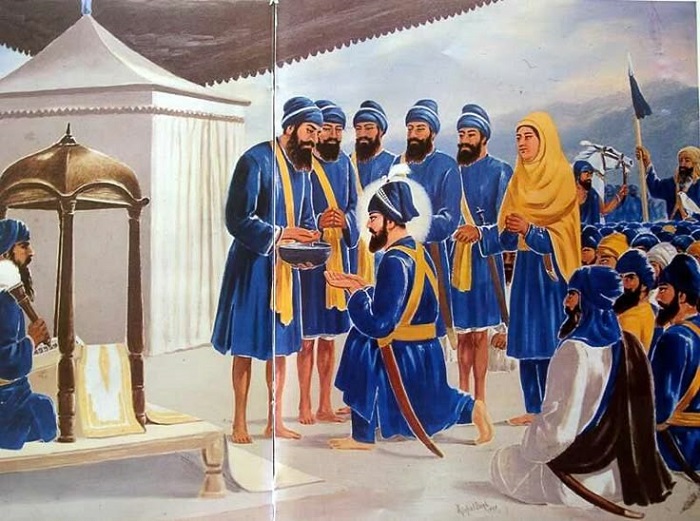
On March 30, 1699, Guru Gobind Singh Ji convened his followers at his residence in Anandpur. He requested a volunteer to offer his head for the sake of his brothers. Daya Ram presented his head, and the Guru Ji led him into a tent, later coming out with a bloodied sword. He once more requested a volunteer and performed the act again. This procedure occurred three more times. Finally, Guru stepped out of the tent alongside the five volunteers. The Guru ji named these five Sikh volunteers as Panj Pyaare, meaning ‘five beloved ones.’
The five volunteers included Daya Ram, referred to as Bhai Daya Singh; Dharam Das, known as Bhai Dharam Singh; Himmat Rai, called Bhai Himmat Singh; Mohkam Chand, recognized as Bhai Mohkam Singh; and Sahib Chand, identified as Bhai Sahib Singh. The initial Sikhs were pioneers.
KHALSA, A LIFESTYLE
During the assembly of 1699, Guru Gobind Singh ji established the Khalsa Vani—”Waheguru ji ka Khalsa, Waheguru ji ki fateh.” He designated all his followers with the title Singh, which translates to lion. He established the principles of Khalsa, known as the Five ‘K’s.
The five ‘Ks” represent the essential principles of life that a Khalsa is expected to adhere to. These consist of Kesh, or hair, representing the choice to leave hair uncut as a sign of acceptance of the form God intended for humanity; Kangha, or wooden comb, symbolizing cleanliness; Kara, or iron bracelet, serving as a reminder for a Khalsa to practice self-restraint; Kachera, or knee-length shorts, worn by a Khalsa to always be prepared for battle on horseback; and Kirpan, a sword meant to protect oneself and the vulnerable, including the poor, the weak, and the oppressed, regardless of religion, caste, or creed.
The five ‘Ks” represent the essential principles of life that a Khalsa is expected to adhere to. These consist of Kesh, or hair, representing the choice to leave hair uncut as a sign of acceptance of the form God intended for humanity; Kangha, or wooden comb, symbolizing cleanliness; Kara, or iron bracelet, serving as a reminder for a Khalsa to practice self-restraint; Kachera, or knee-length shorts, worn by a Khalsa to always be prepared for battle on horseback; and Kirpan, a sword meant to protect oneself and the vulnerable, including the poor, the weak, and the oppressed, regardless of religion, caste, or creed.
Wars led by Guru Gobind Singh
Notable conflicts The Battle of Bhangani (1688), as detailed in chapter 8 of Gobind Singh’s Bicitra Natak, recounts the moment when Fateh Shah, accompanied by mercenary leaders Hayat Khan and Najabat Khan, launched an unprovoked attack on his forces. The Guru received support from Kripal, his maternal uncle, and a Brahmin called Daya Ram, both of whom he honors as heroes in his writings. Sango Shah, the cousin of the Guru, was slain in the battle; he was a cousin of Guru Hargobind’s daughter.
The Battle of Nadaun in 1691 saw the Islamic armies led by Mian Khan and his son Alif Khan facing defeat at the hands of the allied forces comprising Guru Gobind Singh, Bhim Chand, and other Hindu kings from the Himalayan foothills. The non-Muslims who supported the Guru had declined to pay tribute to the Islamic authorities in Jammu.
In 1693, Aurangzeb was engaged in conflict with the Hindu Marathas in the Deccan region of India, and he issued directives to prevent Guru Gobind Singh and the Sikhs from assembling in large groups in Anandpur.
The Battle of Guler in 1696 marked the initial confrontation against Rustam Khan, the son of the Muslim commander Dilawar Khan, near the Sutlej River. In this encounter, the Guru allied with the Hindu king of Guler and successfully defeated the Muslim forces. The commander dispatched his general, Hussain Khan, to confront the armies of the Guru and the Guler kingdom in a battle near Pathankot, where Hussain Khan faced defeat and was ultimately killed by the combined forces.
The initial conflict at Anandpur in 1700 involved the Mughal forces led by Aurangzeb, who dispatched 10,000 troops commanded by Painda Khan and Dina Beg. In a fierce confrontation between Guru Gobind Singh and Painda Khan, the latter met his demise. The Mughal army retreated from the battlefield following his death.
The Battle of Anandpur Sahib (1701) was fought against the local Hindu kingdom leaders who governed the mountainous regions. A battle ensued in which Sikh forces killed Jagatullah. The hill chiefs besieged Anandpur, forcing the Guru to temporarily depart from the city as a condition for peace. Louis Fenech suggests that his conflicts with the kings of the Himalayan kingdoms were probably instigated by the expanding Sikh army, which subsequently raided and looted villages in the surrounding mountainous realms for resources; the Hindu kings united and besieged Anandpur.
The Battle of Nirmohgarh (1702) took place against Aurangzeb’s forces, commanded by Wazir Khan, along the banks of Nirmohgarh. The conflict raged on for two days, resulting in significant casualties for both factions, ultimately leading to the withdrawal of Wazir Khan’s forces from the battlefield.
The Battle of Basoli took place in 1702, where forces clashed with the Mughal army. The kingdom of Basoli, whose Raja Dharampul supported the Guru during the battle, gave the conflict its name. Raja Ajmer Chand, the leader of the rival kingdom of Kahlur, provided support to the Mughal army. The conflict concluded when both parties achieved a strategic truce.
The Battle of Anandpur in 1704 saw the Sikh forces confront the Mughal army, initially led by Saiyad Khan and later by Ramjan Khan. The Mughal general suffered fatal injuries at the hands of Sikh soldiers, prompting the army to retreat. In May 1704, Aurangzeb dispatched a more formidable army led by two generals, Wazir Khan and Zaberdast Khan, to eliminate the Sikh resistance. The strategy employed by the Islamic army during this conflict involved a lengthy siege of Anandpur, lasting from May to December. They effectively blocked all food and supply routes while also engaging in numerous battles.
Legacy and Final Successor
Before his death in 1708, Guru Gobind Singh ended the lineage of human Gurus and declared the Guru Granth Sahib (the holy scripture) as the eternal and perpetual Guru for all Sikhs. He is also remembered for his prolific literary contributions, including the Dasam Granth and the Zafarnama (the “Letter of Victory”) sent to the Mughal Emperor Aurangzeb.
IN the end! Guru ji Transformed Sikhs into a martial people, dedicated to justice and self-sacrifice, embodying the motto, “Soora so pahchaniye jo larey Deen ke het” (The true warrior is one who fights for righteousness).
click on the link below to download ‘The Asian Independent App’
https://play.google.com/store/apps/details?id=in.yourhost.theasianindependent
https://play.google.com/store/apps/details?id=in.yourhost.theasianindependent