THE ASIAN INDEPENDENT UK
Dr. Ramjilal,
Social Scientist and Former Principal,
Dyal Singh College ,Karnal (Haryana –India)
Email id : [email protected]
The Indian Constituent Assembly was established under the Cabinet Mission Plan of 1946, initially comprising 389 members. However, following the declaration of Pakistan’s creation and the partition of India, this number was reduced to 299, as many members who supported Pakistan and belonged to the Muslim League boycotted the Assembly. Consequently, the number of Muslim members was limited to just 27. The Muslim population in India who chose not to migrate to Pakistan remained, demonstrating their loyalty to the nation. During a session of the Constituent Assembly, Tazamul Hussain expressed this sentiment passionately: “We want to merge in the nation… We are Indians first, and we are all Indians and will remain Indians. We shall fight for the honor and glory of India, and we shall die for it. (Applause). We shall stand united. There will be no divisions among Indians. United we stand; divided we fall.”
Some prominent Muslim members of the Constituent Assembly were Maulana Abbul Kalam Azad, Sir Syed Muhammad Sadullah (the only Muslim member of the Drafting Committee of the Constitution), Tazamul Hussain, Hasrat Mohani, and B.H. Zaidi. Among the 17 ‘founding mothers’ of the Constitution, the sole Muslim woman was Begum Quidsia Aizaz Rasul.
Despite being a microscopic minority in the Constituent Assembly, facing an atmosphere of suspicion and communal riots, they significantly influenced the formation of key provisions in the Constitution. These included fundamental rights, such as equality, liberty, secularism, educational and cultural rights for minorities, as well as federalism ,and provincial autonomy. Furthermore, they opposed religion-based reservations in legislatures for Muslims.
According to the 1951 census, the Hindu population in India was 306 million, accounting for 84.1%, while the Muslim population was 35.4 million, or 9.49%. As of now, India’s estimated population is approximately 1.40 billion, with the Muslim population around 183 million, making up 14.2%. This data indicates that while the Muslim population is increasing, their representation in Parliament and state legislatures is declining, raising a critical concern.
Details:
The under-representation of Muslims in both Parliament and State legislatures is a pressing issue in Indian politics, with implications for the future.
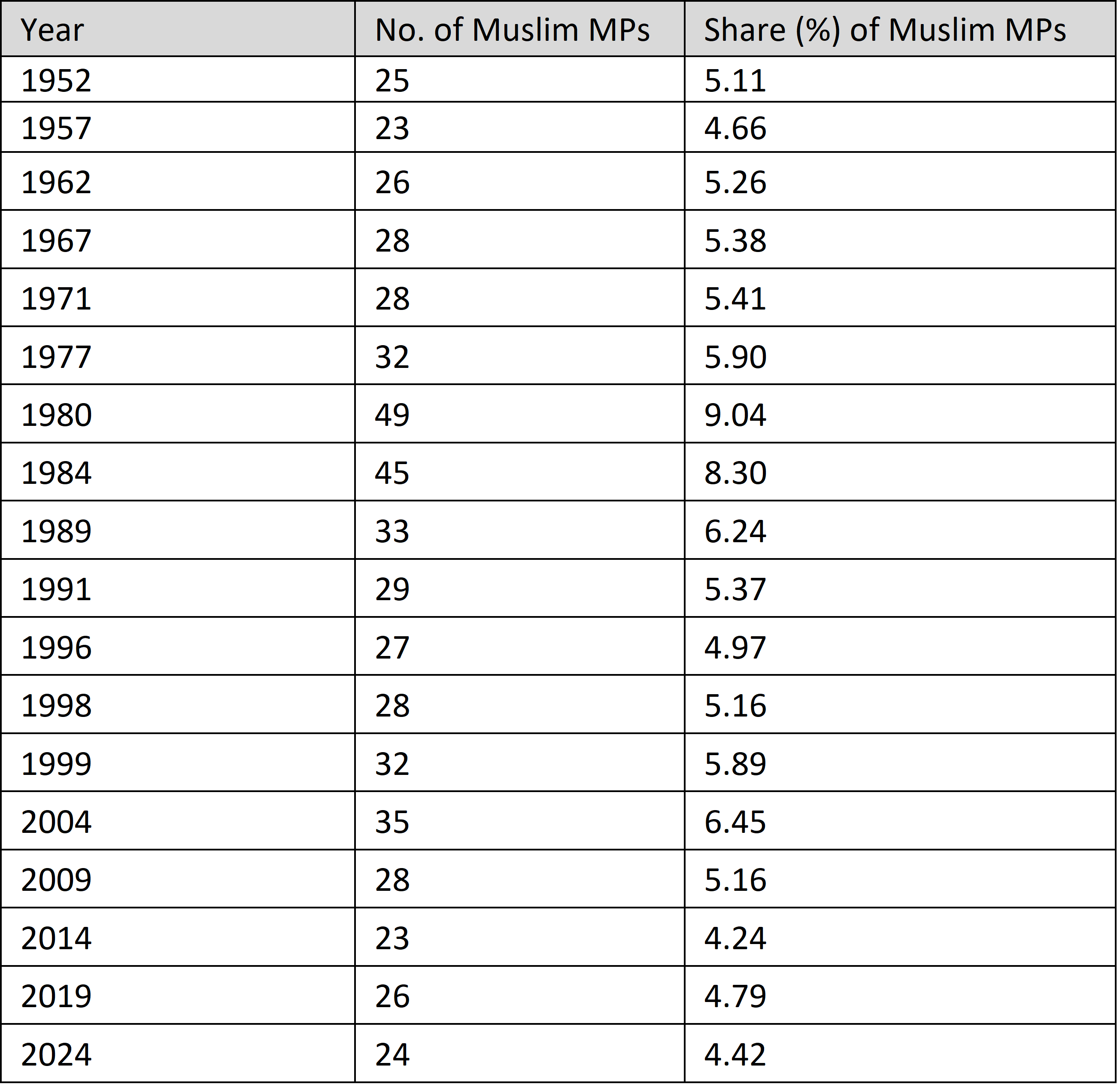
Under-representation of Muslims in Parliament: A Declining Trend – from 5.1% to 4.42%:
https://www.theindiaforum.in/sites/default/files/field/image/2024/beg%20t.png
The under-representation of Muslims in Parliament is evident from the following data (Source: Statistical Reports of the Election Commission of India):
In 1952, there were 25 Muslim Members of Parliament (MPs). By the 1980 elections, this number had increased to 49, marking the highest representation since 1952. However, by the 2024 Lok Sabha elections, this number had decreased to just 24. This decline occurs in a country that is constitutionally secular; however, due to the influence of radical Hindutva and growing hostility towards Muslims, their representation has consistently diminished.
Minority-Free NDA: A Paradox:
As of December 11, 2025, there are 4,131 Members of Legislative Assemblies (MLAs) across the 28 states and 8 union territories, along with 543 Members of Parliament (MPs) in the Lok Sabha and 245 in the Rajya Sabha, bringing the total to 788. The Bharatiya Janata Party (BJP)-led National Democratic Alliance (NDA) has been in power since 2014 under Prime Minister Narendra Modi. Currently, the NDA holds 293 seats in the Lok Sabha, with no minority representation. The BJP and its allies consistently advocate for a ‘Congress-free India,’ while the NDA coalition has effectively become ‘minority-free’ in the Lok Sabha. This situation represents a historical paradox in independent India and contradicts the essence of the Indian Constitution, which upholds secularism.
India’s estimated population stands at 1.40 billion, with Muslims accounting for approximately 183 million (14.2%). The country’s minority demographics include Muslims at 14.5%, Christians at 2.31%, and Sikhs at 1.72%, collectively representing about 28% of the population. Yet, with the exception of one Christian MP, Kiren Rijiju, these minority groups are not represented in the NDA. In contrast, the INDIA alliance, comprising 235 MPs in the Lok Sabha, includes 7.9% Muslim MPs, 5% Sikh MPs, and 3.5% Christian MPs. Notably, there is only one Muslim woman MP, Ms.Iqra Choudhary, while the estimated population of Muslim women is approximately 9 to 10 crore. Prominent political figures in the Lok Sabha include Asaduddin Owaisi, Yusuf Pathan, Sheikh Abdul Rashid, and Ms. Iqra Choudhary.
The Congress Party: Is It the Muslim League?
A significant question arises: Is the Congress Party akin to the Muslim League in Indian politics? The BJP frequently claims that the Congress is ‘anti-Hindu’ and ‘pro-Muslim,’ accusing it of ‘appeasement’ toward Muslims. However, regarding representation, out of the 99 MPs from the Indian National Congress in the Lok Sabha, only 7 are Muslim, representing a mere 7% of the total MPs. Thus, characterising Congress as the ‘Muslim League’ and alleging that it pursues a policy of Muslim appeasement misrepresents the facts.
Muslim Population and Representation in State Assemblies: A Wide Gap
The State Assembly elections conducted in 2021 across four states—Assam, West Bengal, Kerala, and Tamil Nadu—as well as the Union Territory of Puducherry, illustrate the disproportionate representation of Muslims in legislative bodies. In these elections, 824 MLAs were elected, with only 112 being Muslims. Based on population proportions, there should have been around 192-200 Muslim MLAs. Alarmingly, in some cases, no Muslim MLAs were elected at all..
This imbalance in representation and population is also evident in other states’ Assembly elections. For instance, Muslims constitute 30% of Bengal’s population but only hold 44 seats in the legislative assembly. Likewise, in Kerala, while Muslims make up 32% of the population, there are only 32 Muslim MLAs in the 140-member assembly. In Tamil Nadu, with a Muslim population of 10%, only 7 Muslim MLAs were elected. In the Union Territory of Puducherry, just one Muslim was elected. In the Delhi Assembly elections of February 2025, only four Muslim MLAs (from the Aam Aadmi Party) were elected out of 70 members. In the Bihar Assembly elections held in November 2025, despite Muslims constituting 16.3% of the population, only 11 Muslim MLAs were elected out of 243 members. Notably, the BJP does not have a single Muslim MLA in either the Delhi or Bihar Assemblies. This trend underscores the urgent need for a more inclusive representation of minorities in Indian politics.
Factors Contributing to the Decline in Muslim Legislative Representation in India
Several key factors contribute to the decline in Muslim representation in legislative bodies in India. These include social and political polarization, along with Hindu communalism, often referred to as “Hindu nationalism” or “Hindu Raj.” The first-past-the-post (FPTP) electoral system tends to favor majority groups, which creates significant challenges for minorities.
Main Factors Contributing to the Decline in Muslim Legislative Representation in India:
Several factors contribute to the decline of Muslim legislative representation in India. Social and political polarization, driven by Hindu communalism, plays a significant role. The first-past-the-post (FPTP) electoral system favors the majority, making it difficult for minorities to be represented.Challenges include the absence of reserved seats for Muslims, the diminished influence of Muslim voters due to constituency delimitation, and political parties’ reluctance to nominate Muslim candidates. Additionally, the geographical dispersion of the Muslim community hampers the creation of effective community-based parties. Historical legacies like the Partition have also left some Muslims feeling alienated, further complicating their political representation and identity.
Suggestions to Increase Muslim Representation:
To enhance Muslim representation in Indian legislatures, the following strategies are proposed:
1. Political Organization:
Muslims can either form their own national political party grounded in secularism to strengthen their leadership—or they can join secular parties at local, state, and national levels to assert their political influence and shape policies.
2. Increasing Political Participation:
There should be a concerted effort to raise social, educational, and political awareness within the Muslim community. Intellectuals, secular leaders, and media should expose communal ideologies and the radical leaders advocating for a “Hindu Nation” or “Hindu Raj.”
3. Constitutional Awareness:
Both Hindus and Muslims should be aware of the goals and secularism enshrined in the Constitution of India, recognizing that continuous vigilance is required to maintain liberty.
4. Active Political Participation:
Muslims should actively engage in all levels of political activities, from local to national. Their participation should extend beyond being mere spectators; they should work to influence policies, programs, and laws.
5. Mainstream Inclusion:
Continuous efforts should be made to integrate Muslims into the political mainstream and free them from any fears that hinder their participation.
6. Empowering Muslim Women:
There should be encouragement for Muslim women to step out of their homes and actively engage in political activities.
7. Caution Against Extremism:
The community must remain vigilant against fundamentalists and hardline clerics within their ranks who may stifle diverse opinions.
8. Addressing Hate Crimes:
Law enforcement and administrative bodies should take strict action against individuals involved in hate speech, mob lynching, communal violence, and any actions that undermine the secular character of Indian society.
9. Electoral Reforms:
To effectively address representation issues, reforms in the electoral system are needed. Adopting a proportional representation system would help ensure that the number of legislators corresponds to the Muslim population. In essence, the adage should be, “The greater the number, the greater the share.”
Bharat Ratna Karpoori Thakur inspired the common people to struggle for their rights through a poem that emphasizes the need for action and resilience:
“If you want your rights, learn to fight.
Learn to stand firm at every step.
If you want to live, learn to die.”
In conclusion, Indian democracy can only be strengthened through the inclusion of all religious communities, including Muslims, rather than their political exclusion.