

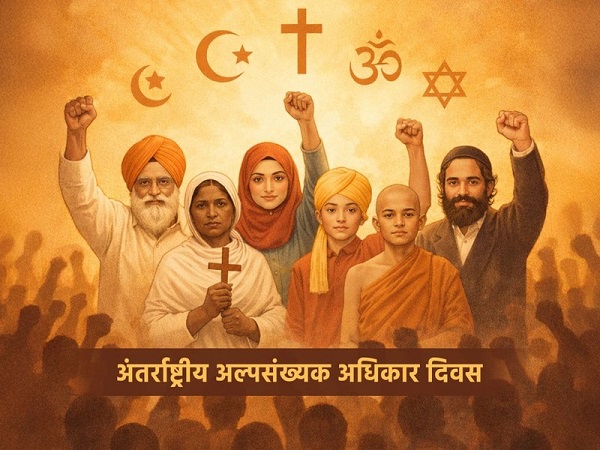
(Special on Minority Rights Day)
-SR Darapuri, National President, All India Peoples Front

(Asian independent) India, as a secular, democratic republic, recognizes and protects the rights of minorities to foster diversity and ensure equality. The term “minority” in the Indian context primarily refers to religious minorities—such as Muslims (about 14% of the population), Christians (2.3%), Sikhs (1.7%), Buddhists (0.7%), Jains (0.4%), and Parsis (a smaller Zoroastrian community)—as notified under the National Commission for Minorities Act, 1992. Linguistic, cultural, and ethnic minorities (including Scheduled Castes/Dalits at 16.6% and Scheduled Tribes/Adivasis at 8.6%) also receive protections, though religious minorities have been the focus of much recent discourse. These rights aim to prevent discrimination, preserve cultural identities, and promote social harmony, rooted in the principle that “no democracy can long survive which does not accept as fundamental to its very existence the recognition of the rights of minorities.”
Key Constitutional Provisions
The Indian Constitution, adopted in 1950, embeds minority rights within its fundamental rights framework (Part III). These provisions fall into two broad categories: general equality rights applicable to all citizens and specific protections for minorities’ cultural, educational, and religious interests. Below is a summary table of the core Articles:
Article 14: Equality before the Law: Ensures no denial of equal protection of laws within India; prohibits discrimination on grounds of religion, race, caste, sex, or place of birth.
Article 15: Prohibition of Discrimination: State cannot discriminate against citizens; extends to access to public places and opportunities.
Article 25- 28 Freedom of Religion: Right to profess, practice, and propagate religion (Art. 25); manage religious affairs (Art. 26); no religious instruction in state-funded schools (Art. 28); freedom from taxes for promoting religion (Art. 27).
Article 29: Protection of interests of Minorities: Any section with a distinct language, script, or culture has the right to conserve it; no denial of admission to state-aided educational institutions on grounds of religion, race, caste, or language.
Article 30: Right of Minorities to establish and administer Educational institutions: Religious and linguistic minorities can set up and manage institutions of their choice; state cannot discriminate in granting aid.
Additional safeguards include Article 46 (promotion of educational and economic interests of weaker sections, including minorities), Article 350 (facilities for instruction in mother-tongue), and the establishment of the National Commission for Minorities to monitor implementation. These rights emphasize the preservation of diversity, allowing minorities to maintain their identity without assimilation. However, the Constitution does not provide separate political reservations (e.g., seats in legislatures) for religious minorities, limiting them to Scheduled Castes and Tribes.
Present Status Under BJP Rule (2014–2025)
The Bharatiya Janata Party (BJP), led by Prime Minister Narendra Modi, has governed India since 2014, securing a third term in June 2024 despite losing its parliamentary majority (forming a coalition with the National Democratic Alliance). The government’s approach to minority rights has been polarizing. While it emphasizes inclusive welfare schemes benefiting all citizens—such as food subsidies, electrification drives, and economic programs that reach minority communities—the BJP maintains these are not minority-specific but universal, denying any discriminatory intent. It has also highlighted measures like banning instant triple talaq (Muslim divorce) as empowering Muslim women.
However, international human rights organizations, independent reports, and opposition voices have documented a deterioration in minority protections, particularly for Muslims, under BJP rule. Key concerns as of late 2025 include:
– Discrimination and Violence: Authorities have been accused of failing to curb attacks by BJP supporters on minorities, instead targeting victims (e.g., through property demolitions labeled “bulldozer justice”). In 2024, 11 Muslim homes in Madhya Pradesh were razed over alleged beef possession, and similar actions occurred in other BJP-ruled states without due process. The Supreme Court ruled such demolitions unconstitutional in November 2024, mandating guidelines, but reports indicate ongoing violations. Communal violence persisted post-2024 elections, with at least 28 attacks on Muslims and Christians, resulting in 13 deaths.
– Hate Speech and Rhetoric: Instances of anti-minority hate speech surged 74% in 2024 (1,165 documented cases), peaking during elections, with BJP leaders like Modi and Amit Shah frequently implicated. About 80% occurred in BJP-ruled states. The BJP rejects these as biased, attributing them to opposition narratives.
– Legislative Measures: The Citizenship Amendment Act (CAA), implemented in March 2024, fast-tracks citizenship for non-Muslim refugees from neighboring countries, excluding Muslims—a move criticized as “fundamentally discriminatory” by the UN and others. Paired with potential National Register of Citizens, it raises fears of disenfranchising millions of Muslims lacking documentation. Anti-conversion laws in BJP states have been used to target interfaith marriages and minority proselytization. The 2019 abrogation of Article 370 (Kashmir’s special status) and the Ram Temple construction in Ayodhya fulfilled Hindu nationalist pledges but alienated Muslim communities.
– Political Marginalization: No Muslim ministers serve in the 2024 cabinet, a historic first. Muslim parliamentary representation fell to 24 seats (4%) in 2024. The 2025 electoral roll revision (Special Intensive Revision) has been alleged by opposition as a tool to disenfranchise minorities as “illegal immigrants.” Home Minister Shah defended it as protecting democracy via “detect, delete, and deport.”
– Broader Impacts: Christians and other minorities face similar issues, including violence in Manipur (2023–ongoing) and restrictions on religious freedoms. India’s National Human Rights Commission lost accreditation in 2024 for lacking independence. The BJP counters criticisms by pointing to economic inclusion and rejecting “Islamophobia” labels as politically motivated.
In summary, while constitutional safeguards remain intact, their implementation under BJP governance has drawn widespread scrutiny for favouring a Hindu-majoritarian agenda, exacerbating tensions for minorities—especially Muslims. The government’s coalition dependencies post-2024 may moderate some excesses, but reports suggest persistent challenges as of December 2025.
click on the link below to download ‘The Asian Independent App’
https://play.google.com/store/apps/details?id=in.yourhost.theasianindependent