THE ASIAN INDEPENDENT UK

Bal Ram Sampla
Geopolitics
The defining paradox of South Asian geopolitics is Pakistan’s dual identity on the global stage. To Western allies and international financial bodies, Islamabad presents itself as a primary victim of global terror, pointing to the thousands of Pakistani lives lost to homegrown militancy. Yet, to its neighbours specifically India and Afghanistan, Pakistan remains an active sanctuary for some of the world’s most dangerous, UN-designated terrorists. This calculated duplicity, often referred to as the “victim card,” has worn thin as Islamabad continues to actively shield individuals who orchestrate mass violence across its borders.
The Blueprint of Duplicity
The foundation of Pakistan’s strategy lies in its self-serving division of militant groups. While the Pakistani military engages in bloody campaigns against domestic threats like the Tehreek-e-Taliban Pakistan (TTP), it simultaneously nurtures and protects export-oriented groups like Lashkar-e-Taiba (LeT) and Jaish-e-Mohammed (JeM).
When global forums demand accountability, Islamabad points to its internal instability and economic losses to claim it is “doing the dirty work” of fighting terror.
This narrative is a deliberate distraction. By framing itself as a besieged state fighting for survival, Pakistan attempts to secure international aid, evade sanctions, and deflect from the fact that its deep state continues to use proxy warfare as an instrument of foreign policy.
The Case of Hafiz Saeed
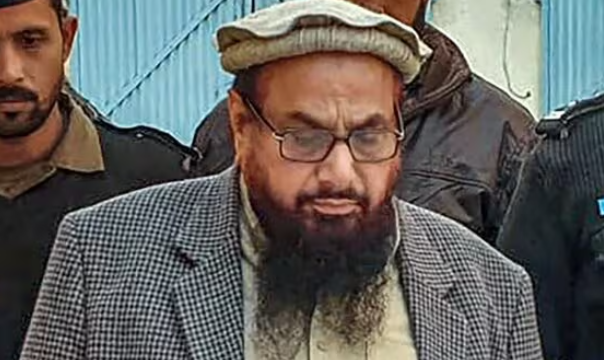
No figure exposes this duplicity more clearly than Hafiz Saeed, the UN-designated mastermind of the 2008 Mumbai attacks and the founder of LeT.
The Reality of Pakistan’s Shielding of Hafiz Saeed:
(1)The Legal Shield
Whenever India or international bodies demand justice, Pakistan claims it cannot extradite Saeed due to a lack of bilateral treaties, using legal technicalities to block foreign investigation agencies.
(2) The Mock Conviction
Under pressure from bodies like the Financial Action Task Force (FATF), Pakistan “imprisoned” Saeed for terror financing. However, this incarceration is widely seen as a protective custody mechanism, keeping him safe from international extradition while keeping his network intact.
(3) Ongoing Operations
Despite being “behind bars,” Saeed’s proxy networks remain operational. Recently, India’s National Investigation Agency (NIA) formally charged Saeed and issued fresh non-bailable warrants against him for orchestrating the deadly April 2025 Pahalgam attack. Pakistan’s immediate rejection of the NIA’s investigation proves that its “anti-terror” judiciary is merely a diplomatic firewall.
Conclusion
A nation cannot genuinely claim to be a victim of arson while actively maintaining a warehouse of fuel and matches for its neighbors. Pakistan’s ongoing protection of UN-designated terrorists like Hafiz Saeed completely dismantles its narrative of terror victimhood. Until Islamabad cooperates with international investigators and dismantles its state-sponsored proxy networks, its “victim card” will remain what it has always been: a tragic, transparent cover for state-sponsored duplicity.
References
1.https://www.indiatoday.in/india/story/2025-pahalgam-terror-attack-jammu-court-issues-non-bailable-warrant-let-chief-hafiz-saeed-trial-in-absentia-looms-2947383-2026-07-14?hl=en
2.https://www.livemint.com/news/india/pahalgam-attack-probe-nia-court-issues-arrest-warrant-against-lashkar-chief-hafiz-saeed-11784015823255.html?hl=en