

THE ASIAN INDEPENDENT UK

Bal Ram Sampla
Geopolitics
The article based on public records, US federal indictments, and independent reporting.
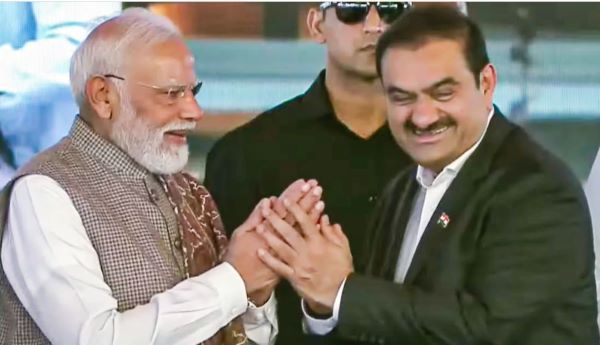
When Narendra Modi flew to Delhi in 2014 to be sworn in as India’s Prime Minister, he did so on a private jet belonging to Gautam Adani. That single image captures something essential about modern India: the line between state power and private wealth has not just blurred — it has effectively disappeared.
Both men are from Gujarat. Both rose together. And as one accumulated political power, the other accumulated economic power on a scale that few individuals in history have managed.
Analysts describe their bond as “so long and strong” that it is virtually impossible to disentangle. A Washington policy expert put it plainly: Modi’s friendship with Adani is “an open secret.”
How Government Power Became Private Profit
(1) In 2014, weeks after Modi’s election victory, Adani’s special economic zone in Mundra — which had been declared illegal by the Gujarat High Court for lacking environmental clearances — suddenly received those clearances from the new central government.
(2) In 2018, Modi’s government privatised six major airports. Adani, a company with no prior airport experience, won contracts for all six. The government called it fair bidding.
(3) Environmental rules governing Adani’s coal mines were changed. Laws around special economic zones were tweaked. Licenses, contracts, and clearances flowed in one direction. Adani went from a regional port operator to one of the wealthiest men on earth in the space of a single decade — the same decade Modi governed India.
The Global Port Strategy
Adani Ports is now India’s largest private port operator, handling nearly a quarter of the country’s cargo.
(1) Israel (Haifa Port):
Adani acquired a 70% stake in Israel’s Haifa Port for $1.18 billion — a strategic location at the gateway to the Middle East and a potential trade corridor to Saudi Arabia.
(2) Sri Lanka (Colombo):
Adani holds a 51% majority stake in the Colombo West Container Terminal, Sri Lanka’s largest-ever foreign port investment. It is widely rumoured and alleged that former President Gotabaya Rajapaksa was “pressured by Modi personally” to bypass competitive bidding and hand the contract to Adani.
(3) Tanzania, Vietnam, Bangladesh:
Adani has signed a 30-year port concession in Dar es Salaam, is pursuing a new greenfield port in Vietnam, and has a controversial power plant exporting electricity to Bangladesh.
The Evidence of Corruption
This is not opposition spin by Congress Party.. This is what US federal prosecutors allege, backed by the FBI.
(1) In November 2024, a five-count criminal indictment was unsealed in Brooklyn, New York. Gautam Adani, his nephew Sagar Adani, and six other executives were charged with “securities fraud, wire fraud, obstruction of justice”, and violations of the “Foreign Corrupt Practices Act”— America’s anti-bribery law.
(2) The allegation: between 2020 and 2024, Adani and his associates orchestrated a scheme to pay over “$265 million in bribes” to Indian government officials across five states — Andhra Pradesh, Chhattisgarh, Odisha, Jammu & Kashmir, and Tamil Nadu — in exchange for lucrative solar energy contracts. Prosecutors say Adani personally met with a government official to advance the scheme. They found documentation on mobile phones: photographs summarising bribe amounts, PowerPoint presentations laying out payment options, Excel sheets detailing how to conceal the payments.
(3) The US Securities and Exchange Commission filed a parallel civil suit alleging that Adani Green Energy then raised $750 million from international investors — including Americans — while its offering materials “falsely claimed” the company maintained strong anti-corruption practices.
Adani Group denies all allegations. Under US law, all defendants are presumed innocent until proven guilty. The trial has not yet concluded.
But here is what is not in dispute: India’s own government has “twice refused” to deliver the US court’s summons to Adani executives under the Hague Convention. The Modi government is, in effect, shielding a man under federal indictment in the United States from receiving legal papers.
The Regulator That Couldn’t See
Before the US indictment, there was Hindenburg Research.
(1) In January 2023, the American short-selling firm published a 100-page report accusing Adani of “the largest con in corporate history” — detailing alleged stock manipulation through offshore shell companies, undisclosed related-party transactions, and accounting fraud spanning decades.
(2) India’s market regulator, SEBI, was directed by the Supreme Court to investigate. What followed was a masterclass in institutional failure.
Court documents showed that SEBI had “drawn a blank” on investigations it had been conducting for years into suspicious Mauritius-based funds holding concentrated Adani stocks. SEBI claimed it could not investigate further — that the trail would be “a journey without a destination.”
(3) In August 2024, Hindenburg released a second report. This time it alleged that “SEBI’s own chairwoman”, Madhabi Puri Buch, and her husband held stakes in offshore funds linked to Adani’s family. The very person meant to investigate Adani allegedly had financial connections to his network. Buch denied the claims.
In September 2025, SEBI issued its final ruling: no violations found. Legal experts were divided. Some noted a genuine “regulatory blind spot” in pre-2023 rules. Others pointed out that the regulator appeared unable — or unwilling — to follow trails that led to powerful people.
(4) Meanwhile, at least “40 independent media investigations” corroborated or expanded Hindenburg’s original findings. The Organised Crime and Corruption Reporting Project (OCCRP) published documents showing offshore entities used to trade Adani stocks in apparent violation of Indian securities law.
A 2007 SEBI ruling had already established that Adani promoters had “aided and abetted” India’s most notorious stock market manipulator, Ketan Parekh. The penalty: a reduced fine.
The New Gatekeeper: AI and India’s Digital Future
If controlling India’s ports, airports, and energy sounds like enough, consider what comes next.
In February 2026, Adani Group announced plans to invest “$100 billion” over the next decade to build AI-ready data centres across India — powered by renewable energy and partnered with Google, which is committing $15 billion to a joint AI hub in Visakhapatnam.
Adani already operates a 2-gigawatt national data centre network through his Adani Connex joint venture. The $100 billion plan aims to expand this to 5 gigawatts — what the company describes as the world’s largest integrated data centre platform.
“India will not be a mere consumer in the AI age,” declared Gautam Adani. “We will be the creators, the builders and the exporters of intelligence.”
One conglomerate — run by a man under US federal indictment, shielded by the Indian government from receiving legal papers, whose regulatory investigations have repeatedly stalled — now controls or is building:
(I) India’s largest private port network, plus strategic ports in Israel, Sri Lanka, and Tanzania
(II) Six major international airports
(III) A dominant renewable energy portfolio
(IV) India’s largest data centre platform
(V) Major stakes in media, including NDTV, once a critical news channel that critics say has become “supine” since Adani’s takeover
The Pakistan Question: Separating Fact from Social Media Noise
A claim circulates persistently on social media: that Adani has secret business links with Pakistan. It is worth looking:
There are no active business links between Adani and Pakistan. No trade, no contracts, no energy supply. That version of the story is not supported by evidence.
But documented stories appear to have been conflated into the myth.
The first: in 2014, the Indian Express reported that Adani Power was planning a 10,000MW thermal power plant in Gujarat’s Kutch region, with the bulk of electricity reportedly intended for export to Pakistan. The proposal was discussed with the previous government and never moved forward. India and Pakistan have no shared power grid.
The second story is far more serious — and it has nothing to do with Pakistan as a business partner.
In February 2025, The Guardian published an investigation based on official documents revealing that the Modi government relaxed critical national security protocols along the Pakistan border to hand Adani land for the Khavda renewable energy project — now being built as the world’s largest renewable energy park. The Khavda plant sits barely one kilometre from the Pakistan border in Gujarat’s Rann of Kutch, a region with a history of military conflict between the two nations.
For decades, no major construction was permitted within 10km of the Pakistan border. Then, in April 2023, Military officials had raised concerns about tank mobilisation and border surveillance. They were overruled. The relaxation applied not just to the Pakistan border but to borders with China, Bangladesh, Nepal and Myanmar as well.
After the rules changed — making the land dramatically more valuable — it was transferred from the state-run Solar Energy Corporation of India directly to the Adani Group.
Security experts called it “unprecedented in free India.” The Congress opposition asked a pointed question in parliament: “Is one business group’s interest greater than national security?”
The Modi government and Adani Group say all approvals were properly obtained. The BJP dismissed the story as foreign media interference.
But here is the detail that ties it all together: the Khavda project is the very same solar energy venture at the centre of the US federal bribery indictment. The $265 million in alleged bribes were paid, prosecutors claim, to secure contracts to sell electricity from Khavda to state governments at inflated prices. Border rules were rewritten. Military advice was ignored. And the entire operation is now under criminal investigation in New York.
The Pakistan connection social media points to does not exist. What does exist is arguably worse: a company so politically protected that India’s own army was moved aside to give it land.
What Is Actually at Stake
The Adani-Modi story is not simply about one rich man and one powerful politician. It is about a model of governance — one where public contracts, regulatory decisions, and foreign policy are instruments of private enrichment, where accountability is blocked not by incompetence but by design.
Kenya saw it and cancelled $2.5 billion in Adani deals after the US indictment. Sri Lanka’s new government has pledged to scrutinise every Adani contract. Bangladesh has put an Adani energy project under judicial inquiry.
India has done the opposite: protected the accused, blocked US legal process, and continued awarding contracts.
When opposition leader Rahul Gandhi asked why Modi’s enforcement agencies had not investigated Adani, the Prime Minister said nothing. When the US indictment dropped, the BJP said it was “for the company to defend itself.”
Arvind Kejriwal, the former Chief Minister of Delhi, made a blunt claim before his arrest: an unnamed BJP leader had told him that “the day Adani drowns, Modi drowns.”
That may be political rhetoric. But the refusal to let the law run its course — in India, under SEBI, and by blocking US legal service — suggests that at the highest levels of Indian government, someone believes it to be true.
Conclusion
India’s 1.4 billion people deserve ports, airports, clean energy and AI infrastructure. What they should not have to accept is one man — and one political patron — standing as gatekeeper to all of it.
The US federal case continues. The evidence has been laid out. The question now is not whether anyone is watching.
The question is whether anyone in India is allowed to act on what they see.
References
1.US Department of Justice — Criminal Indictment (November 2024)
https://www.sec.gov/enforcement-litigation/litigation-releases/lr-26177
2.https://en.wikipedia.org/wiki/Indictment_against_Gautam_Adani_et_al.
3.India’s Refusal to Serve Summons — Court Records
https://www.business-standard.com/companies/people/adani-group-us-sec-ny-case-judge-assigned-streamlined-process-125010300177_1.html
https://en.wikipedia.org/wiki/Indictment_against_Gautam_Adani_et_al.
4. Hindenburg Research — Original Adani Report (January 2023). 106-page report
https://hindenburgresearch.com/adani/
5.https://www.occrp.org/en/investigation/documents-provide-fresh-insight-into-allegations-of-stock-manipulation-that-rocked-indias-powerful-adani-group
6.https://www.occrp.org/en/investigation/bank-documents-expose-scale-of-secret-investments-in-adani-group-by-adani-family-associates
7.Hindenburg Research — SEBI Chairwoman Report (August 2024)
https://hindenburgresearch.com/sebi-chairperson/
Hindenburg’s response to SEBI’s investigation:
https://hindenburgresearch.com/adani-update-sebi/
8.The Guardian — Khavda Border Security Investigation (February 2025)
https://scroll.in/article/1076846/how-adani-bagged-an-energy-project-on-india-pak-border-for-which-defence-rules-were-relaxed
https://thesouthfirst.com/news/modi-government-bent-border-rules-for-adanis-mega-solar-project-reports-the-guardian/
9.https://kashmirtimes.com/news/adani-group-near-indo-pak-border
10.https://www.facebook.com/share/v/1Kq7wXJs4q/