
By: Surjit Singh Flora

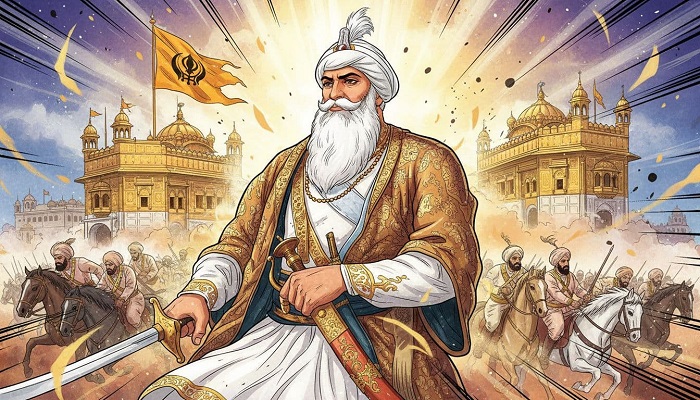
(Samajweekly) A leader can win battles and still vanish from schoolbooks. Jassa Singh Ahluwalia did more than fight Afghan armies. He helped turn Sikh survival into organized power, then used that power to recover captives, guard sacred ground, and build a polity of his own.
His name cuts through a harsh century in north India. It touches Nadir Shah’s raid, the ruin after Panipat, the rebuilding of Harmandir Sahib, and the rise of Kapurthala. It also points to a harder problem, why Indian history so often reduces men like him to a footnote.
Jassa Singh Ahluwalia was born on 3 May 1718 in the village of Ahlu, also called Ahluwal, near Lahore. His family came from a Jat Sikh background, and the name Ahluwalia came from that village. Sikh tradition says his elders sought Guru Gobind Singh’s blessing before his birth, a memory that shaped how later generations remembered him.
He grew up after the fall of Banda Singh Bahadur in 1716, when Mughal pressure on Sikhs grew harsher. Sikhs were driven into forests, hills, and hidden routes. Survival became a skill, and leadership became a matter of discipline. Jassa Singh learned in that setting, where one mistake could cost a village or a life.
The world around him was unstable, so his leadership had to be practical. He had to move fast, judge risk, and keep small bands linked together. That kind of training did not come from books. It came from hardship, travel, and constant danger.
By the time he rose, he was known for steadiness as well as courage. He was not only a fighter. He was also an organizer who could hold trust across factions.
The Sikh community in those years was not a single army. It was made up of jathas, Misls groups, and shifting alliances. The Dal Khalsa gave those forces some structure. Under Nawab Kapur Singh, and later under Jassa Singh, the Khalsa gained clearer command and wider reach.
In 1748, Jassa Singh was chosen as successor to Kapur Singh. Later, he received the title Sultan-ul-Qaum, a sign of national leadership among the Sikhs. The title mattered because it showed that authority in the Khalsa came through service, not blood alone.
His rise also led to something more concrete. In 1779, he moved on Kapurthala, secured the region, and made it the center of the Ahluwalia Misl. That step helped lay the base of Kapurthala State, a shift from mobile resistance to territorial rule.
Jassa Singh Ahluwalia became known not only for fighting, but for what he did after invasions tore through north India. Two moments shaped that reputation most. The first came in 1739, after Nadir Shah sacked Delhi. The second came after the Third Battle of Panipat in 1761, when Ahmed Shah Abdali’s forces left behind fear, ruin, and scattered captives.
The sack of Delhi in 1739 shocked the region. Treasure was looted, and many people were taken captive. Sikh groups responded fast. They attacked retreating columns, struck at loose convoys, and tried to recover prisoners before they disappeared deeper into enemy hands.
Jassa Singh was only about 21, yet he already moved with purpose. The goal was not blind revenge. It was recovery. Sikh fighters saw it as a duty to undo some of the damage done by the invaders.
After Panipat, the north was filled with broken armies and exposed people. Sikh oral tradition and later Sikh histories remember Jassa Singh Ahluwalia and other Khalsa bands as recovering women and wealth taken by Abdali, including Maratha captives, then escorting them back to their families.
That memory matters because it shows a different kind of power. It was not only about taking ground. It was about returning people to where they belonged. In an age when armies treated civilians as spoil, that act carried real moral weight.
Rescue also carried political meaning. A force that could recover captives could claim the right to protect the land.
The Sikh reply gave the Khalsa public standing. Local people knew the difference between a raider and a defender. Jassa Singh’s name gained force because he stood for more than battlefield success.
He helped shape an image of Sikh power that could punish violence and also repair its damage. That balance won respect across Punjab. It also made Sikh authority harder to dismiss.
Jassa Singh Ahluwalia’s legacy is tied to Amritsar as much as to war. Harmandir Sahib had been damaged and desecrated in the long wave of Afghan raids. He used wealth gathered during campaigns to help rebuild it. That was not only an act of devotion. It was also a statement that Sikh life would return to the center of its sacred world.
Rebuilding the shrine meant more than stone and gold. It announced that the Sikh community was not broken. It still had resources, order, and will.
The act also tied faith to statecraft. A people who could restore their holy place could also restore public order. Jassa Singh understood that a shrine could anchor a community as firmly as a fort.
Sikh memory still recalls Diwali in Amritsar even when Abdali threatened the region. That story survives because it captured something larger than a festival. It showed that fear had not emptied the city.
The celebration became a sign of endurance. Jassa Singh’s role in that world was not limited to military protection. He helped keep public faith alive when enemies tried to erase it.
Jassa Singh Ahluwalia often gets less space than he should because standard history writing favors empires with capitals, courts, and clear dynasties. Sikh confederate politics do not fit that frame easily. They were mobile, collective, and spread across Misls rather than one throne.
Many narratives move from Mughal rule straight to British rule with little room for Sikh sovereignty in between. That habit leaves leaders like Jassa Singh on the margins, even though they shaped Punjab’s political future.
Colonial-era history also favored court records and imperial timelines. Later textbooks often kept those habits. The result is a thin picture of the eighteenth century.
Jassa Singh Ahluwalia helped recover captives, rebuild sacred space, and lay the ground for Kapurthala State. He was a military leader, a political organizer, and a guardian of Sikh morale. That is a large record.
His neglect says less about his life than about the way memory works. History often keeps conquest in bright light and leaves restoration in shadow. Jassa Singh belonged to the harder work of rebuilding after ruin.
Jassa Singh Ahluwalia mattered because he turned Sikh survival into power, and power into institutions, faith, and memory. His story runs through rescue after invasion, rebuilding after desecration, and leadership during collapse.
He is remembered in Sikh tradition not only as a fighter, but as a restorer. That may be why his name still matters. History often praises the men who break things. It takes longer to honor the ones who put them back together.