SR Darapuri I.P.S.(Retd)
 (Asian independent) A police force is entrusted with the State’s most consequential power over the individual: the power to stop, search, detain, arrest, interrogate and, in legally defined circumstances, use physical force. In a constitutional democracy, that power carries an equally consequential obligation—the police must themselves remain subject to law, judicial scrutiny and institutional accountability.
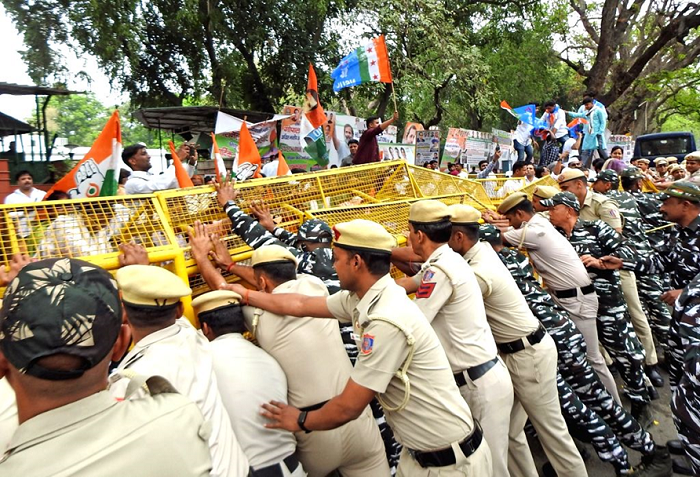
Recent allegations involving Delhi Police personnel, including allegations of sexual harassment and assault against women journalists at Jantar Mantar on 3 October 2026, therefore raise a question considerably more serious than whether particular officers behaved improperly. They raise the question of whether the institutional safeguards surrounding police power are strong enough to prevent authority from becoming impunity. Three women journalists alleged sexual harassment by police personnel during the protest; one alleged sexual assault by ACP Vivek Bhagat. Delhi Police transferred the complaints to its Crime Branch for investigation. These allegations remain allegations and must be determined through due process.
Earlier, during a protest by the ‘Kakroach Janata Party’ at Jantar Mantar on July 20, allegations were raised against Delhi Police personnel: a senior officer reportedly slapped a woman without provocation, an inspector allegedly shoved a baton against a woman’s posterior, and another staff member reportedly engaged in inappropriate physical contact with a female protester. Surprisingly, there is no information regarding any investigation or disciplinary action taken against these officers to date. This is despite the Supreme Court’s clear directive in “Shailendra Mani Tripathi vs. Union of India” (Writ Petition No. 280/2026)—specifically in paragraph 23—stating that the constitution of the HPEC (High-Powered Empowered Committee) would not prevent or restrain police or security forces from taking administrative or disciplinary action against officers found violating conduct rules. Such inaction naturally emboldens these officers, a consequence of which became evident on October
It would be neither accurate nor intellectually defensible to conclude from such allegations that the entire Delhi Police has become a “gang of ruffians and molesters.” A police organisation contains thousands of personnel performing fundamentally different functions, and allegations against individual officers cannot automatically establish collective guilt. But the opposite error is equally dangerous: treating each allegation as an isolated act of individual misconduct while ignoring the institutional conditions that determine whether victims can complain, whether evidence is preserved, whether investigations are genuinely independent, and whether offending officers actually face consequences.
The central thesis of this essay is therefore:
The constitutional danger is not that Delhi Police consists of “ruffians and molesters”; it is that any police institution can become an unaccountable power centre when the coercive authority of its officers is stronger than the mechanisms available to restrain, investigate and punish its misuse. Repeated allegations of abuse, particularly where the accused are themselves police officers, must consequently be examined not merely as questions of individual misconduct but as tests of institutional accountability.
This distinction matters because police misconduct and police impunity are different problems. Misconduct concerns what an individual officer allegedly did. Impunity concerns what the institution does—or fails to do—after that conduct is alleged. A single officer can commit a crime without proving institutional corruption; conversely, an institution can exhibit systemic accountability failures even though most of its officers act professionally and lawfully.
The decisive question, therefore, is not simply “Did an officer misbehave?” It is:
When the person accused of abusing State power is himself an agent of the State, who has the power, independence and institutional authority to hold him accountable?
That is the question through which the Delhi Police should be examined—not through rhetoric, but through the constitutional guarantees of equality, liberty, dignity, freedom of expression and peaceful assembly; the safeguards governing arrest and detention; the independence of investigations; the treatment of women and journalists; and the effectiveness of mechanisms designed to prevent police impunity.
A constitutional democracy does not require a weak police force. It requires a powerful police force that is itself demonstrably subject to law. The stronger the coercive power entrusted to the police, the stronger the safeguards against its abuse must be.
The issue, ultimately, is not whether Delhi Police is “good” or “bad.” It is whether its institutional architecture makes abuse of power difficult, detection credible, investigation independent and accountability unavoidable. That is the standard by which a democratic police force should be judged.