THE ASIAN INDEPENDENT UK
From the window of Ancient Indian Kamboj History:
The Kamboj Horses in Ancient India: Breeding, Trade and the Art of War

Dr Ramjilal, Social Scientist,
Former Principal, Dyal Singh College,
Karnal (Haryana – India)
Email: [email protected]
Abstract:
 The history of the Kambojas is closely associated with the history of the horse in ancient India. Sanskrit, Buddhist and Jain sources repeatedly connect Kamboja with excellent horses, skilled horsemen and the horse trade of the north-west. The reputation was so strong that Buddhist tradition described Kamboja as a country famous for horses. Kautilya’s Arthashastra also placed Kamboja among the important sources of superior horses. The Kamboj horse was therefore, not merely an animal of transport; it was an economic commodity, a military resource and a symbol of royal prestige.
Expansion:
Kamboja: A Horse-Producing Region :
Kamboja | Alive and Kicking in Gujarat
Ancient Kamboja was situated in the north-western zone of the Indian cultural world, broadly associated with areas towards present-day Afghanistan and adjoining regions. Its exact geographical boundaries changed over different periods. Its location, however, was strategically important because it connected the Indian subcontinent with Afghanistan, Central Asia and the Iranian world.
This geographical position helped Kamboja develop a major horse economy. The north-western regions of Kamboja, Gandhara, Sindhu and Bahlika formed an important corridor through which horses reached the Indian plains. Kamboja became known for the production, selection, training and trade of horses. It should therefore be understood not simply as a place where horses were bred but as part of a wider horse culture.
Ancient sources frequently classified horses according to their geographical origin and qualities. Therefore, the expression “Kamboj horse” should not necessarily be understood as referring to a genetically uniform breed in the modern sense. It generally denoted horses associated with Kamboja and its celebrated horse-producing and trading tradition.
Qualities of Kamboj Horses:
 Ancient Literature particularly praised Kamboj horses for speed, strength, endurance and courage. Jain literature describes the trained Kamboja horse as exceptionally swift and difficult to frighten by battlefield noise. Such qualities were essential in an age when horses were central to cavalry and chariot warfare.
The Mahabharata gives detailed descriptions of horses presented by the Kamboja king. Their colours, physical appearance and conformation are mentioned, suggesting that ancient horse culture valued both beauty and practical qualities.
emphasisedThe importance of training was equally great. A powerful horse could become a successful war animal only through disciplined training and proper care. Kamboja’s reputation consequently reflected not merely natural horse qualities but also the knowledge of horsemen who selected, trained and maintained these animals.
Kamboj Horses as Royal Gifts:
The Mahabharata provides some of the most striking evidence for the prestige of Kamboj horses. During Yudhishthira’s Rajasuya, the King of Kamboja presented 300 horses among other valuable gifts. The horses are described according to their distinctive varieties and physical characteristics. This was not an ordinary commercial transaction: the presentation of hundreds of valuable horses to a powerful king represented wealth, diplomacy and political recognition.
Another remarkable episode occurs during Yudhishthira’s consecration. The Mahabharata states that the King of Bahlika brought a golden chariot, while Sudakshina, the Kamboja king, personally yoked four white Kamboja horses to it. This reference is especially significant because it explicitly associates Sudakshina and the royal ceremony with four white horses of Kamboja origin.
These episodes show that Kamboj horses occupied a prestigious place in royal life. They could be offered as tribute, diplomatic gifts and symbols of political power.
Maharaja Sudakshina Kamboja and the Kurukshetra War:
 The Mahabharata mentions the Kamboja Mahajanapada. It also mentions Bhanumati. Bhanumati was the daughter of the Kamboja king Chitrang Kamboja and Queen Chandramudra Kamboja. She was the sister of Maharaja Sudarshana Kamboja of the Kamboja Mahajanapada and was married to Duryodhana.
The Kamboja queen of Jayadratha is also mentioned in the Mahabharata (11.23.11). One of the wives of King Jayadratha of the Sindhu-Sauvira dynasty was a Kamboja princess. The marriage alliance between the Kamboja dynasty and the Kauravas is a significant example of the political relationship between two royal families. This familial relationship strengthened their political and military ties.
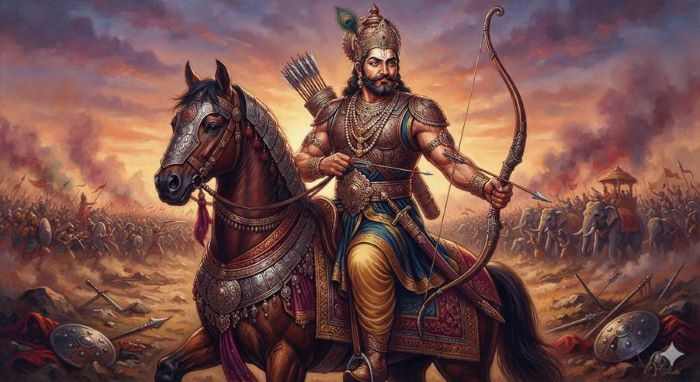
Maharaja Sudakshina Kamboja of the Kamboja Mahajanapada supported Jayadratha and Duryodhana in the war, especially to protect the honour and safety of his sister Bhanumati, who was Duryodhana’s queen. He commanded an army of approximately 6,000 horsemen, supported by golden chariots and white horses. Along with the Kauravas army, he fought against the Pandavas and Arjuna on the battlefield of Kurukshetra and was martyred on the 13th or 14th day of the war. Sudakshina’s importance was not limited to rituals. He appears as a prominent Kamboja ruler and warrior in the Kurukshetra War. He led the Kamboja army fighting on the Kauravas side, and in the Mahabharata, Kamboja warriors are known for their swift horses and effective cavalry warfare.
Another Kamboja king, Parama Kamboja, is said to have supported the Pandavas. He sent his cavalry, equipped with white horses, to assist them. The Pandavas lived with them during their exile and developed a friendly relationship with them. However, Parama Kamboja himself did not directly participate in the Kurukshetra War.
Therefore, the Kambojas contributed not only horses but also experienced cavalry to ancient Indian warfare. Their reputation was based on the combination of a good-quality horse and a capable rider. Cavalry could move quickly, attack vulnerable positions, pursue retreating armies, and operate at distances where infantry was less effective. The Kamboja’s military tradition thus became an essential part of northwestern martial culture.
Lord krishna Arjun rath chariot horse🙏 Stock vectorOne of the most memorable references occurs in the Sauptika Parva of the Mahabharata. Krishna’s magnificent chariot is described as being yoked to superior Kamboja horses. The four horses are named Shaibya, Sugriva, Meghapushpa and Balahaka.
This passage is particularly important because it places the celebrated Kamboja horse tradition in connection with Krishna’s royal and military chariot. The horses are presented as exceptional steeds, consistent with the high reputation given to Kamboja horses throughout the epic.
It is important, however, to distinguish the origin or quality designation from the individual names. The text describes the team as superior Kamboja horses and then gives the names of the four steeds. Thus, the passage provides strong evidence for the prestige of Kamboja horses without requiring the individual names themselves to be treated as the name of a Kamboj breed.
The importance of Kamboj horses extended beyond warfare. The scarcity of high-quality horses in many parts of India created a profitable long-distance trade. Merchants carried horses from the north-west towards the major political and commercial centres of the subcontinent. The Kamboja’s location on the routes towards Central Asia gave it an important position in this trade. Horses moved alongside merchants, soldiers and political representatives. They were exchanged for wealth and goods and were also presented to rulers as tribute. The horse trade therefore helped connect the north-west with the Gangetic plain and eastern India. The history of Kamboj horses is consequently also a history of ancient India’s wider commercial networks.
The Kamboja-Asvaka Resistance Against Alexander: A Golden Page of Glory
 During Alexander’s Indian campaign, the Assakanoi/Assakenoi community in the northwest offered strong resistance. Greek sources mention their queen as Cleophis. Many modern Indian historians and Kamboja historians have attributed Cleophis to the Indian name Kripa/Kripi and linked her to the Kamboja-Asvaka tradition. Dr. R.K. Mukherjee, Dr. V.D. Mahajan, Dr. L.M. Joshi, Dr. Fauja Singh, and especially Dr. J.L. Kamboj and Dr. Ramjilal support this identification.
The military importance of the northwestern mounted warrior tradition is also evident during Alexander’s invasion of 327–326 BCE. Greek writers describe the strong resistance of the Assakanoi/Asvakas in the areas of Massaga and Swat. The Kamboja-Ashvaka Resistance Against Alexander
The military significance of the northwestern mounted warrior tradition is also evident during Alexander’s invasion of 327–326 BCE. Greek writers describe the strong resistance of the Assakenoi/Ashvakas in the region of Massaga and Swat. After the death of the local ruler, Queen Cleophis is associated in classical accounts with continuing the defence. Diodorus wrote that she eventually reached a compromise with Alexander and was restored to her kingdom.
Later Indian interpretations have linked the Ashvaka mounted warrior communities to the broader Kamboja tradition. It can be emphasised that the resistance of the great Kamboja queen, Kirpa Kamboja, was serious enough to lead to negotiations. The Kamboja queen and Alexander had to sign a treaty because, on the one hand, the queen did not want to take innocent lives; on the other hand, Alexander’s army was tired of constant warfare, and there was a fear of rebellion within his army, as later events proved. As a result, peace and the reign of Queen Kirpa Kamboja were maintained after the agreement. This is a glorious page in ancient Indian history.
From Kamboja to Bengal:
The Kamboja tradition subsequently appears far beyond its original north-western homeland. Epigraphic evidence establishes the existence of a Kamboja ruling family in parts of Bengal during the later tenth and early eleventh centuries. The Dinajpur pillar inscription refers to a ruler belonging to the Kamboja family as a lord of Gauda, while the Irda copper plate records Kamboja rulers including Rajyapala, Narayanapala and Nayapala.
This evidence is historically important. It demonstrates that the Kamboja name and political tradition had become established in eastern India. It also illustrates the remarkable geographical mobility of political and military groups in early medieval India.
The horse connection continued as well. The Monghyr inscription of the Pala ruler Devapala has been interpreted as referring to horses connected with Kamboja, showing that the northwestern horse-producing region remained linked with eastern India.
Thus, Kamboja’s historical influence should not be confined to its original homeland. Its political and commercial connections extended across large parts of the subcontinent.
Kamboja and Kambuja (Cambodia):
A further question concerns the relationship between Kamboja and Kambuja, the ancient Sanskrit name associated with Cambodia. The similarity has led historians to propose different explanations. The leading scholars of ancient Indian history connected the Cambodian name with the ancient Indian Kambojas.
Additionally, the wider Indian cultural influence on early Cambodia is well documented. Sanskrit language, Indian religious traditions and political concepts became deeply embedded in early Khmer civilisation. It is historical fact that the Kamboja name has an extraordinarily wide geographical history, extending from the northwestern frontier of India into eastern India and into the broader cultural world of Southeast Asia.
A Horse Tradition with a Wider Historical Meaning:
The history of Kamboj horses reveals the close relationship between animal husbandry, trade, warfare, diplomacy and political power in ancient India. Kamboja’s geographical position allowed it to participate in the movement of horses between Central Asia and the Indian plains. Its horsemen developed a reputation for military skill, while its horses became prized possessions of kings.
The Mahabharata provides particularly vivid examples: the Kamboja king’s gift of 300 horses to Yudhishthira, Sudakshina’s four white Kamboja horses, his participation in the Kurukshetra War, and the description of Krishna’s chariot with superior Kamboja horses.
The later evidence from Bengal shows that the Kamboja tradition did not disappear with the ancient period. Kamboja rulers established themselves in parts of Bengal, while horses continued to travel from the Kamboja country towards eastern India.
Conclusion:
The Kamboj horse represents an important but often overlooked chapter of ancient Indian history. Kamboja was associated with a sophisticated tradition of horse breeding, selection, training, trade and warfare. Its horses were valued for speed, endurance and courage and became objects of royal gifts and military use.
From the royal ceremonies of the Mahabharata to the battlefield of Kurukshetra, from the horse-warrior resistance encountered by Alexander to the later Kamboja dynasty in Bengal, the historical record reveals a tradition of remarkable geographical reach.
The Kamboj horse was therefore much more than a celebrated animal. It was part of a wider network connecting commerce, military power, political authority and cultural exchange across ancient India and its north-western and eastern frontiers.
References:
A .Original and Secondary Sources:
1. Vyasa. , The Mahabharata, Sabha Parva, Book II — passages concerning the Rajasuya sacrifice, the King of Kamboja and the presentation of horses to Yudhishthira.
2. Vyasa., The Mahabharata, Drona Parva, Book VII — references to Sudakshina Kamboja, Kamboja warriors and their participation in the Kurukshetra War.
3. Vyasa. The Mahabharata, Sauptika Parva, Book X, Section XIII — description of Krishna’s chariot and the four Kamboja horses: Shaibya, Sugriva, Meghapushpa and Balahaka.
4. Kautilya (Chanakya). ,Arthashastra, Book II, Chapter XXX, “The Superintendent of Horses” (Aśvādhyakṣa) — classification, registration, native place, breeding and management of horses.
5. Kautilya., Artha shastra, translated by R. Shamasastry, Bangalore, 1929 — the classification of horses associated with Kamboja, Sindhu, Aratta and Vanayu among the superior categories. This classification is also discussed in modern studies of ancient Indian horse management.
6. Chettri, Sabina, and Sangmu. Thendup. ,“Horses and Statecraft in Kautilya’s Artha sastra.” Journal of Asiatic Society for Social Science Research, Vol. 7, No. 1, 2025, pp. 150–159. DOI: 10.46700/asssr/2025/v7/i1/150.
7. Diodorus Siculus., Bibliotheca Historica, Book XVII — account of Alexander’s campaign in the north-western Indian region, including Massaga and Cleophis (Kleophis) of the Assacenians. Diodorus records that Alexander reinstated Cleophis in her kingdom.
8. Arrian. Anabasis of Alexander, Book IV — Alexander’s campaigns against the Aspasians and Assacenians/Ashvakas in the north-west of the Indian subcontinent.
9. Curtius Rufus, Quintus., Historiae Alexandri Magni, Book VIII — the Assakenoi resistance and the role attributed to Cleophis after the death of Assakenos.
10. Macdonell, A. A., and Keith, A. B. , Vedic Index of Names and Subjects, Vol. I–II. London: John Murray, 1912 — references concerning geographical regions and horses associated with the north-western areas.
11. Law, B. C., Tribes in Ancient India. Banaras/Calcutta, various editions — discussion of the Kambojas, their geographical location, political position and connections with horse culture.
12. Gode, P. K., Studies in Indian Cultural History — discussion of ancient Indian horse varieties and the classification of Kamboja, Sindhu, Aratta and Vanayu horses in the Arthashastra.
13. Gupta, Chitrarekha., “Horse Trade in North India: Some Reflections on Socio-economic Life.” Journal of Ancient Indian History, Vol. 14, 1983, pp. 186–206.
14. Basham, A. L., The Wonder That Was India. London: Sidgwick & Jackson, 1954; later editions. — background on ancient Indian society, economy, warfare and contacts with Central Asia.
15. Majumdar, N. G., “The Irda Copper Plate.” Epigraphia Indica, Vol. XXII, 1933–34, pp. 150–158 — important epigraphic evidence concerning the Kamboja family in Bengal.
16. Majumdar, R. C., and Pusalkar, A. D. (eds.). The History and Culture of the Indian People: The Age of Imperial Kanauj. Bharatiya Vidya Bhavan, 1964 — discussion of the Kamboja presence in Bengal and related inscriptions.
17. Banglapedia. ,“Kamboja Gaudapatis” — discussion of the Dinajpur Pillar Inscription and Irda Copperplate, and the Kamboja rulers Rajyapala, Narayanapala and Nayapala in Bengal.
18. Majumdar, R. C.,History of Bengal, Vol. I — discussion of early medieval Bengal and the Kamboja rulers.
19. Sen, B. C., Some Historical Aspects of the Inscriptions of Bengal — evidence concerning the political history of Bengal and Kamboja rulers.
20. Kamboj, J. L., Ancient Kamboja: People and the Country. 1981 — study of Kamboja geography, political history and cultural traditions.
21. Singh, Kirpal. The Kambojas Through the Ages. 2005 — discussion of Kamboja history, including the Kamboja-Pala rulers of Bengal.
22. Pusalkar, A. D., and R. C. Majumdar. Studies of the Bangar Charter of Mahipala I and the political changes in Bengal associated with the Kambojas.
23. Industry, Trade and Commerce in Early Medieval Bengal, University of North Bengal repository — discussion of the Kamboja rulers in Bengal, the Irda Copperplate, Dinajpur inscription and the political position of the Kamboja dynasty.
24. Coedès, George. The Indianized States of Southeast Asia. University of Hawai‘i Press — major study of Indian cultural and political influence in Southeast Asia, including early Khmer/Kambuja history.
25. Mabbett, Ian W., and David P. Chandler. The Khmers. Blackwell — historical discussion of early Cambodia and the development of Khmer civilisation.
B. Contemporary References – Asian Independent U.K.
1.Lal, Ramji. Dr., “The Great Queen Kripa Kamboja: The Unsung Heroine of Ancient India.” The Asian Independent UK, 27 April 2026.
2.Lal, Ramji .Dr., “The Warrior Kamboj Queens in Ancient India: Martial Leadership and Historical Legacy.” The Asian Independent UK, 2026.
3.Lal, Ramji.Dr., “Main Sources of the Ancient Indian Kamboja Mahajanapada: An Overview.” The Asian Independent UK, 18 May 2026.
4.Lal, Ramji. Dr. “The Kamboja Mahajanapada and the Mahabharata: An Overview.” The Asian Independent UK, 1 June 2026.
5.Lal, Ramji. Dr.,“From the Window of Kamboj History: From Pamir to Angkor Wat–Cambodia – A Journey of Three Millennia: A Review.” The Asian Independent UK, 30 June 2026.