THE ASIAN INDEPENDENT UK

Bal Ram Sampla
Geopolitics
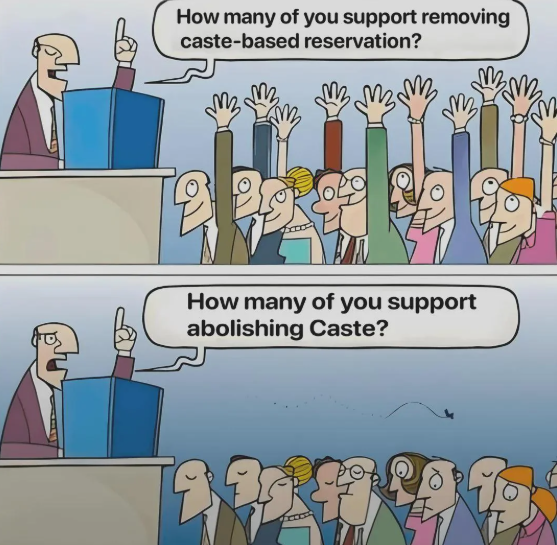
Most debates about caste in India begin and end with reservation, who gets it, how much, for how long. But this misses something important: reservation was always meant to address caste-based discrimination, not the existence of caste itself.
Decades after independence, caste has not disappeared. It has simply changed clothes. People no longer speak of untouchability in polite company, but they still carry their caste proudly, often literally, in their surnames, displayed on nameplates, matrimonial ads, and school admission forms like a badge of belonging or honour.
If the real goal is to dismantle caste as a social category, not just cushion its economic effects, then the conversation needs to shift upstream.
One proposal that is circulated on Social Media is worth taking seriously: stop attaching caste identity to newborns going forward. Instead of inheriting a caste surname, a child could take a “patronymic” (father’s or parent’s first name), a village or region name, or simply a chosen family name, the way many communities in Tamil Nadu have done since the Self-Respect Movement led by Periyar in the early twentieth century.
Caste surnames, official or unofficial, would be barred from public use, with the ban applying only to future births rather than forcing an administrative overhaul on existing adults. Reservation could then be phased down gradually, once the machinery that reproduces caste identity in daily life has genuinely started to break down.
Why the Idea Has Force
There is real logic here. Reservation treats the symptom, economic and educational disadvantage, while leaving the identifying marker of caste fully intact and socially active. A surname is one of the most immediate, least deniable ways caste gets transmitted from one generation to the next. It shapes first impressions, marriage prospects, and casual social sorting before a person has said a single word about themselves. Removing that marker at the point of birth is a narrower, more targeted intervention than trying to rewrite the identities of hundreds of millions of living adults, and it has a working precedent in Tamil Nadu’s own history.
Where It Gets Complicated
But the proposal runs into three serious problems.
First, surnames are not the only signal. People identify caste through village of origin, family reputation, marriage networks, and occupational history, channels a naming law cannot touch. Banning the visible marker while the underlying social structure stays intact risks pushing identification into subtler, harder-to-regulate channels rather than eliminating it.
Second, it collides with reservation’s own paperwork. SC/ST/OBC quotas depend on caste certificates, which depend on a documented, identifiable caste record. A state that simultaneously erases caste as a public marker undermines the very system it needs to verify who qualifies for affirmative action, at least during any transition period. The sequencing in the proposal (surname ban first, reservation reduction later) has to answer this tension directly.
Third, and who actually benefits from anonymity? Historically, dominant castes displayed their caste identity in public and dominated public life regardless. Meanwhile, individuals from marginalized castes adopting neutral or dominant-caste-coded surnames has often functioned as a way to pass quietly, not as a “structural fix, but as an individual escape hatch”. Critics of surname-erasure proposals argue this places the burden of ending caste discrimination on the identity of the discriminated, rather than on changing the behavior of those who discriminate.
A stronger anti-discrimination law, with real enforcement in hiring, housing, and marriage, might target the actual harm more directly than a naming reform ever could.
A Precedent That Already Failed: Singh and Kaur
The strongest evidence against this proposal comes from a much older and more forceful version of the same idea. In 1699, Guru Gobind Singh mandated that all Sikh men take the name “Singh” and all women “Kaur,” specifically to erase caste identity on sight and create one common identity beneath a shared religious banner. It was the closest historical precedent to a state-mandated caste-surname ban: universal, backed by strong religious authority, and adopted centuries ago rather than proposed today.
It did not work as intended. Most Sikhs simply inserted Singh or Kaur before their existing caste or clan surname rather than replacing it — “Jaswinder Singh Sidhu,” “Harpreet Kaur Grewal” — so the caste marker survived alongside the new religious one instead of being erased by it. And the underlying caste hierarchy stayed fully intact in practice. Jat Sikhs remain the dominant landowning group; Khatri and Arora Sikhs occupy a distinct trading-caste niche; Dalit Sikh communities (Mazhabi, Ravidasia, Ramdasia) face real exclusion in the form of separate gurdwaras, caste councils, strong endogamy, and social distance from “upper” Sikh castes , despite Sikh theology explicitly rejecting caste from its founding.
This is a fairly direct test of the concern raised earlier: a naming reform, even one far stronger and more culturally binding than a modern legal statute could hope to be, did not stop people from re-attaching caste identity through a side channel once the original marker was neutralized. If Singh and Kaur couldn’t hold the line over three centuries, a birth-certificate rule banning caste surnames would need something that reform never had , active enforcement against caste markers creeping back in informally, and above all, real teeth against caste-based discrimination itself. Otherwise the same pattern likely repeats: the marker returns in a new form while the hierarchy underneath it goes on unchanged.
A Narrow Case, Not a Simple One
None of this means the idea is wrong. It is a genuinely creative attempt to interrupt caste transmission at its most basic unit , the family name, without touching the identities of people already living. But it is not self-evidently sufficient on its own, and any serious version of it would need to be paired with two things it currently leaves unanswered: an alternative mechanism for verifying reservation eligibility, and a hard look at whether removing the marker of caste actually weakens the practice of caste discrimination, or just makes it less visible.
Ending caste as a lived social hierarchy is a much larger project than reservation policy alone was ever built to carry. A surname reform is a plausible opening move — but it is one piece of a much longer argument, not a substitute for it.
References
Sikhism / Singh and Kaur
1. Wikipedia, Sikh names: https://en.wikipedia.org/wiki/Sikh_names
2. SikhNet, Caste and Sikh Identity: An Insightful Exploration: https://sikhnet.com/news/caste-and-sikh-identity-insightful-exploration
3.Sukerchakia, Sikh Surnames & The Castes — https://sukerchakia.com/sikh-surnames-the-castes/
Dalit Sikh communities (Mazhabi, Ramdasia, Ravidasia)
4. The Print, Who are Dalit Sikhs? New Punjab CM Channi’s caste is just one among a complex hierarchy: https://theprint.in/theprint-essential/who-are-dalit-sikhs-new-punjab-cm-channis-caste-is-just-one-among-a-complex-hierarchy/736821/
5. The Print, Punjab’s many Dalit Sikhs — Ramdasia, Ravidasia, Mazhabis, Ranghretas, Rai, Sansi: https://theprint.in/opinion/punjabs-many-dalit-sikhs-ramdasia-ravidasia-mazhabis-ranghretas-rai-sansi/736978/
6. Wikipedia, Mazhabi Sikh — https://en.wikipedia.org/wiki/Mazhabi_Sikh
7.The Tribune, Curb casteism in gurdwaras, BJP asks Takht : https://www.tribuneindia.com/news/archive/punjab/curb-casteism-in-gurdwaras-bjp-asks-takht-533294
Tamil Nadu / Periyar / Self-Respect Movement
8. The Mooknayak, Periyar’s Vision: The Self-Respect Movement and its Enduring Legacy : https://en.themooknayak.com/bahujan-nayak/periyars-vision-the-self-respect-movement-and-its-enduring-legacy
9. Doing Sociology, The Self Respect Movement, Tamizh Society and an Alternative Social Space : https://doingsociology.org/2021/09/20/the-self-respect-movement-tamizh-society-and-an-alternative-social-space-k-s-vaishnavi/
10. The Modern Rationalist, Periyar Threw Away His Caste Suffix in 1927 : https://modernrationalist.com/periyar-threw-away-his-caste-suffix-in-1927-itself-is-it-permissible-to-refer-as-e-v-ramasamy-naicker-in-the-union-public-service-commission-exam/